Sunday, December 1, 2013

"The Night of the Doctor"

A lost cutscene from the 90s Eighth Doctor videogame.
I don't normally bother to review short specials or mini-episodes any more because Moffat produces too many and most of them are inconsequential crap, but I'm making an exception in this case because "The Night of the Doctor" is an important part of the 50th Anniversary material - arguably the most important piece of Doctor Who produced in the anniversary year or indeed the most important to be made since the show returned. I wouldn't have been interested in this, expecting it to just be Smith or John Hurt, until the BBC released it early to avoid a leak and it became evident that it was something more important. In spite of this, we begin with some shitty CGI of a crashing spaceship. On board the frustrated pilot is trying to send a distress signal but the computer system is apparently screwing up and going into medical mode instead. She tells the computer "Stop talking about Doctors."
"I'm a Doctor, but probably not the one you've watched the most."
"I'm a Doctor," comes a voice as we cut to a familiar face, "but probably not the one you were expecting."
Holy shit. Paul McGann is back. In his second ever on-screen appearance and after a gap of seventeen excruciating years the last of the Classic Doctors has returned. I've voiced my approval of Paul McGann's Eighth Doctor elsewhere, describing him as the "holy grail" of Doctors. In the space of two lines he absolutely annihilates everyone who's come after him over the last eight years, much like the ghost of Billy Hartnell in the previous episode. Seeing him again feels like getting back something that was lost. Say what you like about the TV Movie, but P McG is as much the Doctor as any, moreso than some, and his all-too-brief appearance here cements that more than ever. His absolute refusal to overact, something which has been denied of any of the New Doctors, gives him a presence that the character has never had in the revived series. Seeing him again, I didn't know what to think.
"Yes, I'm the Doctor, but I'm one of the good ones!"
Aboard the spaceship, the Doctor welcomes the pilot aboard after seeing that she's a brave type, staying behind as everyone else was screaming. It's a very Moffat sort of thing, but we do get some decent dialogue, redeemed especially by Paul McGann's delivery: "the front crashes first. Think it through." At the TARDIS, however, Cass the pilot gets all pissy that the Doctor's a Time Lord, despite the fact that he's not involved in the currently-occurring Time War. I would have dearly loved for P McG to argue that he was only half Time Lord. We get some crap dialogue like "go back to your battlefield" and a desire to see the Doctor die because she thinks that all Time Lords are as bad as the Daleks. The Doctor refuses to leave her, so they both plummet to the surface of the planet below. Did the Doctor just sacrifice his life to try to prove a point to a racist?
Sacred fire, sacred flame, sacred cow.
Some old biddy in red peeks out of a cave, announcing that "The Doctor has returned to Karn." More fan service, then, this time referencing classic Tom Baker serial "The Brain of Morbius." It's classic Moffat bait-and-switchery, hoping that we'll disable our critical faculties if he feeds us enough Classic allusions. Not gonna happen. The Sisters resurrect McGann temporarily, and he gets to deliver a lame Moffat joke: "bring me knitting," one item too far in an otherwise humorous list. It's fortunately played as bitter and sarcastic by McGann, who gets as much dramatic mileage as possible out of Moffat's mediocre dialogue where a New Doctor would fail by being facetious and glib. Realising where he is, the Doctor accuses the Sisterhood of being the "keepers of the flame of utter boredom," a badly-mixed line which is hard to hear.
Upon seeing how many more autograph requests he's going to get now.
The main Sister offers to help P McG regenerate again, claiming that "Time Lord science is elevated here." Wasn't the exact opposite true in "The Brain of Morbius"? Weren't they backwards and superstitious, "quaint" in Tom's words, their longevity a product of mythologised accident rather than intentional success? The Doctor is offered a number of utterly redundant qualities: "Young or old, fat or thin, man or woman." What a choice. Apparently they want him to regenerate so that he can save the universe from the Time War, something the Eighth Doctor has been refusing to do. Before now it was always assumed that it was the Eighth Doctor who ended it all in the playroom of RTD's mind, but P McG tells us that "I help where I can; I will not fight." I quite like this idea. It's incidentally backed up by his new costume, designed by Red Dwarf's Howard Burden I believe. In P McG's own words "he looks like he's been around the block in it." This characterisation is actually a nice concession, possibly unintentional on Moffat's part, to the Classic depiction of the Doctor as a character who intervenes for the sake of good in situations he discovers, but doesn't deliberately travel the universe with the intention of enforcing his personal idea of justice or code of ethics wherever possible.
Payment in full: tokens for the BBC Wales cafeteria.
The Sister isn't having any of it. "You are a part of this, Doctor." Is he? Says who? Confronted by Cass' death, refusing to accept help from a Time Lord, the Doctor apparently decides that it's time to start knocking some heads in, to stop being the Doctor, the 'good man.' "Warrior," he mutters, the first clunky line that not even P McG can half-redeem. "Make me a warrior now." Apparently they were expecting this and a special potion has been whipped up specifically for this purpose. A bit awkwardly, P McG screams at the Sisters to get out, and we get another naff exchange: "Will it hurt?" "Yes." "Good." The angst is pretty artificial. The Doctor gives a nice shout out to his Big Finish companions and drinks his hemlock with a parting quote: "Physician, heal thyself."  Profound or pretentious? I think it's a little of both.
Bottoms up.
The Doctor promptly regenerates into a stock photograph of a young John Hurt and the episode ends: "Doctor no more." How apposite. Having just seen the demise of the last Classic Doctor it could not be more true. The TV Movie may be a poorly-plotted mess featuring the Doctor breaking with convention by kissing a woman for the first time on screen and claiming inexplicably to be half-human, but Paul McGann was always the best part of it and despite these things the Eighth Doctor has always had more in common with his twentieth century, Classic Series counterparts than any of the New Doctors ever have. Paul McGann's performance, honed over ten years of doing regular Big Finish, feels just right. The worst thing about this episode, besides the iffy dialogue and bad plot, is the fact that it's too short. Paul McGann obviously knows what he's doing, and we aren't given enough of him doing it. Unless he was busy or something it utterly baffles me that this perfectly good Doctor with limited screentime is reprised in this online-only mini-episode while a completely made up incarnation gets to star in the Anniversary Special proper. Sure, Paul McGann's not the 'name' that John Hurt is, but 1) he's very good as the Doctor, 2) the Eighth Doctor would have fitted in perfectly well, and 3) I'm sure many fans like myself would enjoy more screen time with him.
"WHO? IS? THIS???"
Paul McGann himself acknowledges that fans "always want more" and maybe it's greedy of me to expect more than this, but I really think it's disappointing for him to be brought back in such a perfunctory way. Moffat claimed that he couldn't see the Eighth Doctor being the button-pushing war-ender of the New Who backstory, but isn't that what character development is for? The fact that this was released as an online mini-episode rather than appended to the Anniversary Special proper also shows that there's a certain level of embarrassment about the project, the episode being released in a 'safe' way to avoid scaring off the 'straights', despite the fact that without seeing this a 'straight' is going to have no idea who John Hurt's character is meant to be. Worse still, it's frustrating to see this Doctor brought back only to be killed off for a New Who storyline that's had the writers painted into a corner for years when it comes to characterising the Doctor. It's like being given a present you've really wanted for ages, but the only person giving it to you says "After seven minutes I take it back."
"Thanks for coming in, Paul. Now bugger off,
don't want Matt and David to see you."
On the one hand, "The Night of the Doctor" is the validation that Eighth Doctor enthusiasts like myself have been craving for a long time. On the other, it could easily be construed as an overly short, half-arsed piece of compromise that doesn't give full due to an underutilised, underrated Doctor and actor. Unlike some of his fellow former Doctors, Paul McGann seems to get work pretty regularly,  and evidently he's reasonably content fleshing out his incarnation of the Doctor in the Big Finish audios. Nonetheless, I almost find bringing back McGann just to regenerate into Moffat's made up War Doctor to be an utter piss-take, because it makes it abundantly clear that in actual fact McGann himself should be in the 50th Anniversary Special: he's got the fans, he's got the chops, and as he's friends with the other Classic Doctors (especially Sylv and Colin, I believe) he could have been the one representing the Classics. The success of this mini-episode proves that just because the TV Movie has a bad reputation doesn't mean the Eighth Doctor isn't well-loved. In the end, I don't really know what to think about "The Night of the Doctor." Maybe I should be grateful to Moffat for reprising the character at all, but why would you do it in such a limited way? It's a calculated move, I fear, related to the Anniversary Special proper being as bums-on-seats as possible. If anything, I think this should have been shown as a prologue to the Special itself. It's great to see the Eighth Doctor return, but it could have been so much more.

Thursday, November 28, 2013

"The Name of the Doctor"

"So you're my replacements? A clown, a dandy, a different clown,
a cricketer, a third clown, a fourth clown, a Scouser,
a man from the North, a bell end and a fifth clown?"
'The Shame of the Doctor.' Did anyone seriously think in the lead up to this that Moffat was going to reveal the Doctor's actual name? Of course not. Besides, wouldn't it just be Gallifreyan gobbledegook? The hype-manufacturing is utterly shameless with a title like this, and perhaps unsurprisingly we begin with some astonishing fan service. Two techies on Gallifrey observe body doubles of Billy Hartnell and Carole Ann Ford walking into a big metal portaloo. "What kind of idiot would try to steal a faulty TARDIS?" asks one techie. I really think he should sound more overtly 'classic series', speaking in a Received Pronunciation accent and saying something like "What kind of fool would try to steal a decommissioned time unit?" or something to that effect. Anyway, in a few seconds of repurposed stock footage from "The Aztecs" Billy Hartnell upstages everyone who's ever been on the show for the last eight years despite having died nearly four decades ago. This is insane fan service. We're actually seeing the First Doctor stealing the TARDIS with Susan. I'm surprised he doesn't have the Hand of Omega float in too. Susan's too tall and they're both already wearing human clothes but this still boggles my mind. I often complain about the New Series rejecting its origins, but this is almost going too far the other way. The thing is it's fan service without being fan service. It's not like a Classic Doctor is actually appearing in new footage. Suddenly Clara shows up and spouts some shitty dialogue at Billy, who stares at her with disapproval from the mid 60s.
"Even the sonic screwdriver won't get me out of this one."
It seems Clara is falling through golden light rattling off purple prose like a champion, appearing throughout the Doctor's life, including standing in front of an extra wearing Colin's costume and a blonde wig and being awkwardly inserted into shonky-looking 20th century video footage. Thus she almost encounters Tom about to blow some mothers away with the D-Mat gun in "The Invasion of Time", Sylv hanging from his umbrella in "Dragonfire", Pert driving Bessie from "The Five Doctors", half a second of someone dressed as Paul McGann, some more repurposed footage from "The Five Doctors", this time of Trout running away before cutting to a body double who can't be bothered to run at the same speed completely ruining the illusion, and Davo floating from "Arc of Infinity." So that's all of the post-Hartnell Doctors. Colin and P McG are just stand-ins, Tom, Davo and Sylv appear through the use of footage from what are generally considered to be some of their weakest serials, and Pertwee and Trout are sourced not only from another infamously weak serial but also one which shows neither of them in their prime. It's utterly bizarre. Why do a tribute to Classic Doctors in this way? You could say that only a fan would recognise the serials, but only a fan would give a shit about seeing the Classic Doctors anyway. It baffles me. Clara mentions that she was "born to save the Doctor." Well that's that mystery done away with in the first minutes of the episode. Why is this bit here? Was Moffat embarrassed by the quality of the old video, the poor colourisation work on Billy and the awkward insertion of Jenna Coleman into the footage and decided to just rush through it quickly at the beginning? Clara talks about a blown leaf being the source of her birth, and "I'm still blowing." Good grief. Roll titles.
"So how do you find your careers are going these days?"
Oh for heaven's sake, we're back in Victorian London again. Some crazy guy is speaking in rhymes about the 'Whispermen', this week's arbitrary Moffat spooky goons. To my immense frustration the tedious New-Silurian Madam Vastra returns, crazy guy claiming to have info about some secret of the Doctor's being discovered. Vastra decides to have a 'conference call.' For some reason Strax needs to come along from where he's having a dust-up with some big Scottish dude. Is this supposed to be funny? Why does Strax need to be involved? Incidentally, why is Vastra married to her own servant? Isn't that a bit weird? The 'conference call' is pure camp nonsense with tea-memories and the like. We cut to Clara. Isn't she sweet. Angie and Artie are back too, but mercifully it's only temporary. Angie actually gets a half-decent line when she asks if Clara's mother was "deep on puddings." Vastra's sent Clara a letter Doc Brown style with a soporific candle to let her in on the 'conference call' but she drugged the paper anyway. Why bother sending the candle? She shows up at the table with the Victorian characters because "time travel has always been possible in dreams." It's true that dream time travel is a recurring motif of early science fiction, but this is just pure magic and feels totally out of place in Doctor Who. Then again this isn't really Doctor Who when you get down to brass tacks. Oh god no, it's River Song. She smugs it up and they chat about space time coordinates and how only River knows the Doctor's name. Apparently the crazy guy in the jail, besides these coordinates, also told Vastra one word: 'Trenzalore.' That's not a word.
The Guild of Last-minute Rorschach Cosplayers.
"I think I've been murdered," Jenny utters. Oh shit! This is genuinely the one perhaps halfway effective bit in the episode. It turns out that a bunch of top-hatted Victorian gents with stockings on their heads have invaded Vastra's house. They also manage to find Strax too and even enter the trance. How did they do that? Then the floating disembodied head of Richard E. Grant appears and gives them their marching orders: the Doctor must go to 'Trenzalore' if he wants to save his friends. Back in the land of the living Matt Smith is bumbling around with a blindfold on, having been tricked by the two kids. "The little Daleks!" he complains in what is one of the lamest and most leaden non-jokes of recent scripts. Hearing Clara's story, the Doctor pisses off to the TARDIS without drinking the tea she just nicely prepared for him and has a big cry under the console. Trenzalore, as mentioned by the big fat blue head of Dorium Maldovar in a box the year before last, is the Doctor's grave. It kind of reminds me of the cliffhanger of the first episode of "Revelation of the Daleks", except that was good. The Doctor's reluctant but he has to save Vastra, Jenny and Strax because they looked after him between the one where Amy and Rory got bumped off and the one with the killer snow. The TARDIS isn't having any of it and starts chucking a fit with sparks flying everywhere like Classic series laser weaponry. Observing the hellish landscape of Trenzalore below them, the Doctor laments not being able to retire and "take up watercolours or beekeeping or something", the latter being a Sherlock Holmes reference for those keeping score. The TARDIS won't land but is happy to float in orbit, so the Doctor turns off the antigravity and they drop like stones but ultimately harmlessly to the surface.
Cardiff in the future.
"My grave is potentially the most dangerous place in the universe," the Doctor declares. What? How? It's not explained. It turns out the grave is the TARDIS, which in a somewhat interesting fashion has grown massive as the "dimension dams start breaking down." Once again it's a handful of halfway decent ideas in a sea of dross. To my misfortune River is still around, chatting to Clara before the men with the stockings on their heads, the Whispermen, show up speaking weak rhymes. Apparently it makes sense that a nearby grave on it bearing River's name is a secret entrance to the main tomb and the Doctor and Clara escape. Up in the TARDIS, Strax instantly brings Jenny back to life with some kind of remote defibrillator. How did she suffer no damage from being dead so long? Why does everyone always come back to life in Moffat Who? To distract us from these questions Richard E. Grant enters as the Great Intelligence. I'm led to believe that his presence in this half of the series is almost solely because they knew that "The Web of Fear" had (largely) been recovered and they thought this would encourage more sales. Hamming it up like a demented showman with about as much genuine enthusiasm as if he was reading the shipping forecast the Intelligence reveals that they're outside the Tomb of the Doctor. We already know that.
"Doctor, tell me your name or you will be watching
The Scream of the Shalka for all eternity!"
Down in the tunnel River Song's suddenly started complaining about the Doctor abandoning her in the Library. But it's not even really her, is it? It's like a hologram. Honestly, how much does this show really owe to Red Dwarf? Back upstairs, the Intelligence goes on to declare that the Doctor eventually dies in some big battle, and that he deserves to be thought of as a killer due to killing that fake Klingon dude back in the first RTD Christmas Special, leaving David Bradley to get blown up in Chibnall's dinosaur punisher, and for visiting so much destruction upon the Cybermen and Daleks. What, the two worst factions in the universe? He also name drops the Valeyard as a figure in the Doctor's future. I was not expecting that. It's not a bad bit of fan service, but given that it's recently been revealed that Smithy is actually the thirteenth incarnation and not the eleventh it's slightly redundant. Richard E. Grant reveals that he's still disembodied by ripping his own face off before another Whisperman turns into him. Did he just waste a Whisperman? What's the point of showing us this bit? It has no payoff later in the episode. The Whispermen are completely lame stooges. The Silence have no mouths, the Whispermen have no eyes. What's next? Is Capaldi going to have to fight a race of evil clowns who live under beds and have no noses or ears?
"I have to, Doctor ! The budget is in there!"
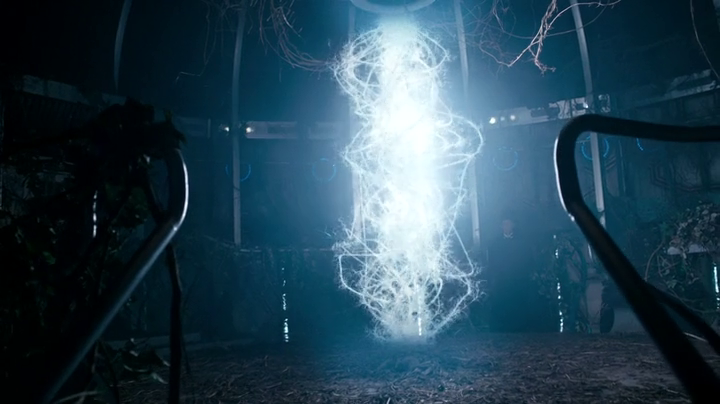
Elsewhere in the TARDIS Clara flashes back to earlier episodes, remembering "memories you shouldn't have." It's more magic thinking like Amy magically recalling everything back into existence at the end of Series 5. All of a sudden they show up where everyone else is and Richard E. Grant reveals that to open the tomb proper the Doctor's name must be spoken. The Smith stands around like a lemon refusing to say it as the invincible Whispermen threaten his friends, but fortunately this projection of River can somehow silently say his name and open the door. It takes an absurdly long time for them to just open the door and go through, after which they find an overgrown console room with a big swirly thing in the middle, which the Doctor obnoxiously describes as "the tracks of my tears." "Less poetry, Doctor," snaps the Intelligence, and I can't help but agree with some enthusiasm, although it seems a bit hypocritical considering some of the guff he was spouting earlier. Apparently the big glowing thing is the Doctor's corpse, a scar in reality caused by time travel. What kind of sense that's supposed to make I can't tell you. The Doctor points the sonic screwdriver at it and we hear some stuff like Hartnell musing on time and Colin chewing out the Gallifreyan Judiciary.
After hearing about some 'creative liberties'
in 'An Adventure in Time and Space.'
"An open wound can be entered," the Intelligence declares, sounding like he has a very peculiar fetish. Do people usually 'enter' open wounds? Apparently he's prepared to sacrifice his own life by stepping into the light which will send him everywhere in the Doctor's life so that he can attack him at every time simultaneously. Smith warns that this will string him out through time "like confetti." That's the best simile he had to hand? The Intelligence doesn't care. He's really keen to get revenge for his two recent defeats and those two times Trout defeated him forty-five years ago. I can't help but feel like there are other villains with more reason to do this. He steps in and the Whispermen vanish, not having to be defeated in any way. The Doctor writhes on the ground, Vastra panicking that he's "being rewritten." How does she know? Apparently the Intelligence managing to "turn every one of your victories into defeats" means Richard E. Grant brooding with his hands behind his back in some stock footage from the Classic Series. How are we supposed to buy this? We're seeing nothing. What's the threat? It's all tell and no show. "He's dying all at once," Vastra notes. What's that supposed to mean? "The Dalek Asylum, Androzani..." Vastra continues, before puttering out into silence. Anywhere else? It's an amusingly tokenistic effort to give a sense of the Doctor's travels - one relatively recent episode and one Classic reference that's already been made in New Who. This makes absolutely no sense whatsoever. Vastra runs outside where all the stars are going out, which seems to happen all the time in New Who finales. How good is her scanner thing that it can read changes to time? Jenny disppears and Strax goes back to full on Sontaran mode. If Jenny disappeared, why doesn't Strax disappear too? Isn't his life completely different? Why would he still be there? It's the typical half-arsed divergent reality approach to time travel that replaces paradoxes with inconsequential bullshit.
"Now, to get into his eye-line..."
Vastra kills Strax and then calls "Strax?" She just disintegrated him, did she expect him to reply? Back in the tomb Clara decides the only thing to do is to jump into the light herself, explaining this series' mystery of multiple Claras. Apparently the real Clara will die and lots of copies will exist throughout time. It makes absolutely no sense. So after gathering her courage, the Doctor's completely uncharacterised companion runs into the light while the Doctor continues to groan on the ground and we get a reprisal of the stock footage fest from earlier. This time we see a little Tennant too. How does she stop the Intelligence? He's just gone now. Where did he go? Did she kick him in the balls? What the hell just happened? If the Claras in the Asylum and Victorian London didn't know who the Doctor was, how do the others manage to save him? We cut back to the footage of Billy Hartnell looking shady upon entering a door from "The Aztecs." It turns out that Gallifrey-Clara didn't tell him it was a mistake to leave Gallifrey but rather to take a different TARDIS because "the navigation system's knackered but you'll have much more fun." Are we supposed to believe a Gallifreyan would say that? Is that Clara a Gallifreyan? How does this work? Also, are we expected to believe that the First Doctor took the TARDIS, as in the proper TARDIS, because some stranger told him it would be fun? Billy would probably tell her to piss off. We now see a silver portaloo flying through the vortex like a grey turd being flushed down bloodied stool water.
Quiet in the Peanut Gallery.
Strax is now back and remembers what happened, so now that everything's more or less fine purely due to Clara running into some old video from the 60s, 70s and 80s the Doctor decides that he'd better go rescue her. River starts having a strop, but the Doctor stops her, revealing that he could see her the whole time. Why should I care about this relationship? The time gimmick means that I've only ever seen everything after the fact. I have absolutely no investment in it. I honestly don't care about River Song's feelings and don't believe in her relationship with the Doctor in a dramatic sense whatsoever. There's nothing here to grasp, to understand or be invested in. Some people thought this bit was heartbreaking. I thought it just showed how absolutely abysmally this entire plot has been handled since the start of Series 6. I've never seen any actual relationship develop between the Doctor and River, only told that it exists. Why should I care? The Doctor pulls her in for an incredibly awkward kiss, which looked to the others like he was tonguing the empty air. River questions how she could still be present, busting out her catchphrase again, suggesting there's more of her to come. Please, no. She then dissipates, and I hope we never see her again.
No Tom! Come back!
So the Doctor steps into the light but fortunately we don't now see him plastered onto pictures of old Doctors. Instead Clara lands in some smoke machine set with more extras in costumes nabbed from the Cardiff Doctor Who Exhibition charging past in the background. We see a Billy stand in that bizarrely looks more like Richard Hurndall from "The Five Doctors" as well as pretend versions of Colin, Davo, Eccly and finally a Tom who charges off into the distance. The Doctor reveals that in this place he's "everywhere" but that it's "collapsing in on itself." What? How? What is this place? What's going on? The 'answers' are all just meaningless babble, and the Doctor nonsensically sends Clara the leaf from "The Rings of Akhaten." She stumbles around a bit and the Doctor gives her a big hug. How is he saving her? Isn't she meant to have died? What's going on? Then we see a spooky silhouette, someone Clara doesn't know. Everyone in this place is the Doctor, apparently, but this guy's the Doctor but not the Doctor, as it were, an incarnation of the Time Lord otherwise known as the Doctor who isn't, in this particular incarnation, the Doctor. Get your head around that one. He utters some lines about necessity in a distinctive croaky voice, and Smith reveals the title's twist by declaring that this incarnation's deeds were not done "in the name of the Doctor." Apparently the name 'Doctor' is some kind of promise. Is it? Smith and Clara piss off and the silhouette turns around to reveal none other than John Hurt, as the words "Introducing John Hurt as the Doctor" manifest absurdly in the air next to him, thus setting us up for the 50th Anniversary Special.
INTRODUCING
JOHN HURT
AS
ECCLESTON'S REPLACEMENT
What the hell was that utter nonsense? I don't even know what to say about this episode. It's just stock footage and horseshit. Absolutely nothing happens. Jenny dies and comes back to life twice. The Great Intelligence defeats itself, essentially. Clara's sacrifice is immediately negated. Strax is dead for about a minute. It's just a forty-four minute leadup to Moffat's big twist of the day, that there's some secret incarnation of the Doctor played by John Hurt. So Trenzalore's the Doctor's grave. Big deal. It's not capitalised upon, it's just an excuse for more magic. The plot occurs completely arbitrarily, events occurring without causes purely at the whim of the set pieces. The usual suspects acclaimed this episode purely for showing footage of the old Doctors, but in actual fact it's entirely meaningless. It's not like we haven't seen old footage before. What's so great about this? I didn't realise this at the time but this is completely empty and hollow, relying on shock value to disguise the fact that it doesn't really exist. We're supposed to applaud seeing Billy and Susan depart in the TARDIS and wonder at the identity of John Hurt's Doctor, but it's all so predictable right now. The answer is always "the Doctor." It's become so commonplace that in fact the answer to the question "What's the Doctor's greatest secret?" is "the Doctor." This episode isn't exactly offensive, but it's totally brainless and in actual fact completely inconsequential. Time and money was wasted producing this episode-length overture to the Anniversary Special. With both the Special and Matt Smith's imminent departure forthcoming it seems that of all the significant episodes it was this one that had the wind completely taken out of its sails. There are interesting ideas here, I suppose, but they're strung together in such an arbitrary way that it achieves nothing. It has never been more clear that what should have been found in the tomb of the Doctor is a single CRT screen playing episode three of "Survival."

Wednesday, November 27, 2013

"Nightmare in Silver"

Where your license fee is going.
I wish I was an emotionless Cyberman so that I was incapable of the self-loathing necessary to rewatch this episode. When I first saw it, I thought that it was one of the worst episodes of New Who I'd ever seen, certainly one of the worst not-written-by-Moffat Matt Smith episodes, but upon reflection it probably isn't quite as bad as "The Curse of the Brown Spot." It is, however, still dreadful, but more in a forgettable and bland way rather than an offensive way. Although I'm led to believe that it may have experienced production difficulties, this episode was written by Neil Gaiman. Isn't he meant to be legit? I know the average punter loves "The Doctor's Wife" and it's, I suppose, original if nothing else, but this is just all 'nothing else.' After being blackmailed in the last episode the Doctor brings Clara's two young charges to some amusement park planet called Hedgewick's World, and the Doctor immediately starts hamming it up something fierce. The two kids, by contrast, are so wooden and unconvincing that it's difficult to believe that they're human in real life, let alone this show.
Mine's bigger.
A hobo in a brown top hat and some soldiers show up and immediately piss off again while the Doctor continues to act like a knob. I have no idea what's going on. Hedgewick's World is just a bunch of generic creepy abandoned roller coaster crap that they never actually go to in the episode. Instead the top hat hobo Webley diverts them to his collection, a badly-lit room with some random shit in it. It's evidently meant to evoke a sort of Victoriana camp gothic but this really just feels like dirt cheap kid's TV at the moment. Webley reveals that his automated chess player is an old Cyberman and the titles roll. Artie goes up against it because he's in his school chess club and is instantly taken in by the four move checkmate. How can he be in chess club and not know how to spot that? I was in the moron version of the chess club at my school and even I knew how to detect the four move checkmate.
"Ricky Gervais actually doesn't need me right now if you must know."
In the style of the famed Turk of automata days of yore the Cyberman is in fact controlled by Warwick Davis in a box. I guess this is the best way to introduce a small person? Have him hiding in a box? I almost thought Smith was going to tuck his hands under Davis' arms and lift him out like a baby. Webley has a couple more Cybermen too. They all have the RTD-era Cybus logo. How are they in space then? Realising that the plot is going nowhere so they might as well stuff around, the kids float a bit in some anti gravity thing. The Doctor gets what is one of the few remotely good lines of the episode, observing of some local robotic silverfish that "I should add them to my funny insect collection." Clara wants to take the kids home, and I fully agree, but the Smith thinks that trouble's afoot so he of course tucks the kids up in Webley's room and abandons them there while literally all of the adults present piss off to have a wander around the park.
Can't even see the join.
Apart from the awful acting of the kids the episode doesn't start off too badly, but it's boring. The Cybermen also talk about "upgrading" too. So are they the New Who Cybermen? I think Gaiman offered that they were some hybrid of Classic and New. Bugger that. We get a couple of mentions of "spare parts" in this episode too, here from Porridge and later from the Doctor. Is it a Big Finish reference, or a reference to "The Tenth Planet"? Warwick Davis waffles on about how the Emperor of space gave the order to blow up some galaxy and kill all the Cybermen, so now there's this big black bit in the sky surrounded by a big blue bit. We're meant to feel sorry for the Emperor, but Warwick Davis sounds like, for all his protestations, that he couldn't give a shit about the Emperor or indeed anything.
"Are you sure it wasn't written by Chibnall or Gatiss?"
Angie pisses off to the barracks where the soldiers from earlier are sequestered. It looks like a disused school hall. She really is awful. Artie is too, but at least he's not playing a brat, and to my immense relief he's hastily nabbed by a Cyberman. Another one shows up at the school hall to kidnap Angie, with further rejoicing. At this point the Cyberman uses some super speed ability that never appears again. The Doctor puts Clara in charge and pisses off to rescue the kids, which wouldn't have been an issue if they'd been left supervised. The soldiers can't call for help because they don't have communicators. Why not? With Clara in charge, they go to hide out in the "comical castle." This turns out to actually be your average run of the mill castle with some purple lighting, and despite Clara's satisfaction of it having a drawbridge, it doesn't just a regular bridge which offers no defensive benefit whatsoever.
"Dear diary. I hoped Peter might start early. I think I still have to
do more episodes after this. Mood: disappointed, but not surprised."
Meanwhile the Doctor talks to another robot silverfish and gets teleported to a bunker somewhere. Apparently they need the kids because of the "infinite potential" of a child's brain. This again? Isn't the underdeveloped intelligence an issue? Then the Doctor gets cyber-infected, receiving his own metal face dealie, and starts acting like an absolute knob, walking back and talking to himself as his mind is taken over by the 'Cyber-planner.' Why is the Cyber-planner so eccentric? Shouldn't he be logical? It's a wasted opportunity, the already wacky character played by Matt Smith now acting alongside an even wackier character also played by Matt Smith. They should have gone the completely opposite way and had him cold and emotionless, but instead he talks in a sing song voice and calls himself "Mr Clever." What am I watching?
"Cyber-planner? Cyber-planner?!? CYBER-PLANNER?!?!?"
So the Doctor threatens to regenerate to kill the cyber-stuff in his body as stock promotional images of the previous Doctors scroll by. I wonder if this kind of thing will include John Hurt in the future. Anyway apparently the Doctor and the Cyber-planner each control almost fifty per cent of the brain, and the Doctor challenges the Planner to a game of chess for mastery. Why does it agree? I don't know. It's just done for the sake of a cliché piece of visual shorthand for conflict, it doesn't make any sense. Watching Matt Smith, who once seemed like the saviour of modern Doctor Who, lurching back and forth talking to himself is just painful. As a brief respite we cut to the punishment platoon soldiers getting spooked as a Cyberman stomps around. For all their talk of upgrading they're still as noisy as New Who Cybermen have ever been and still walk like they've shat their pants. But look, it can detach its hand like Kryten in "Terrorform." Seriously, how much does New Who owe to Red Dwarf?
Lets you facepalm and perform everyday tasks simultaneously.
Clara's still in charge and she tries to be all authoritative towards the soldiers, a bunch of characterless cyphers muttering at each other while the Smith talks to himself. It's utterly repetitive, completely lacks drama and goes nowhere. In a pointless bit of continuity the Smith temporarily takes out the planner by slapping some gold on his face. It's meant to choke their respirators, how does gold interfere with the software? Now Smith has no only some cyber crap but also gold leaf stuck to his face and has to try to sell it. Warwick Davis, by contrast, makes no effort to sell some twee, half-arsed backstory-painting bullshit about the soldier captain and him once seeing "dancing snow bears" or some similar generic-sounding piece of 'outta this world' set dressing. The captain wants to activate their planet-killing bomb and end it all, but she's offed by a sharp-shootin' Cyberman before she can. Clara now fully takes control. When did she become this stone cold leader badass? What is her character?
The Shiter-Men
So they go Cyberman hunting. Evoking either Kryten once again or crash dummies the Cyberman can actually remove its head. We get a shit moment of some fat bloke shouting at a Cyberman before Clara kills it with a big laser. The Doctor shows up with Webley and the two kids, who are in a "walking coma." Clara's upset, but I don't know how she can tell the difference. Next comes the second halfway decent bit in the episode where the Doctor demands to be restrained so that he can continue his chess game without posing a risk to the others. It's a nice idea, but the chess game is still stupid. He also gets to do an appallingly bad impersonation of Eccleston and then Tennant as the Cyber-planner before having a bit of a lech over Clara. He gets another good line now: "you have to die pointlessly and very far from home." It's like dropping your change into a bucket of used needles. Are you really going to reach in and get it back out?
"An accessory? This demands a whole separate action figure!"
With Smith mugging like a maniac in the castle, Clara electrifies the water, but somehow I think that's not going to make much of a difference what with the completely acceptable bridge and the fact that the Cybermen are vacating their big CGI tomb in prodigious numbers. After hitting on Clara for a bit the Planner destroys the bomb trigger. I guess it's nice that Clara could tell it wasn't the Doctor because he was being all romantic, but then this is killed stone dead by Smith, in a moment so packed with ham it's illegal within five miles of a Synagogue,  "They're here!"in what I guess is a Poltergeist reference but with none of the subtlety. In fact there are so many Cybermen they stretch off in a big line towards the matte painting of the amusement park that we never get to see. It looks interesting. What was going through their heads with this one?
Do cyborgs dream of lawnmowers in fleece?
The electrified moat does nothing because the Cybermen just upgrade so gosh darn quickly. How do they upgrade their hardware in the field? The soldiers are in deep shit now, but who are these characters? Why am I expected to care about them? Who's Clara, even, really? And I'm not referring to the mystery of her identity in this series. Why does the Cyber-planner give the kids back? And why does he get so emotional as he's dismissing the value of emotions? It takes craft to characterise the Cybermen, notionally emotionless as they are, and this is just lazy, especially since the actual Cybermen themselves are once again just stooges for a possessed boss, in this case half of Matt Smith.
"I can do you better than that. I can give you fifteen!"
Everything is going to hell as more horror motifs are laid on, a Cyberman revolving its head to produce an appalling comedy gasp from one of the soldiers. The Cyberman-killing gun gives up the ghost and Clara's attempts to twat a Cyberman medieval style fail miserably as it grabs the mace from her hand before immediately tossing it away, the intervening seconds being manipulatively used in promotional material to make it look like one of the Cybermen was going to be wielding some kind of ceremonial weapon. The Planner's getting frustrated with the Doctor, however, who claims to be able to win in three moves, and conveniently enough just before ushering Clara and her fellow stooges into the dark beyond they falter and stop, all their processing power being devoted to trying to discern the truth of the Doctor's claim. This is actually quite an intelligent solution. I once entered the pattern of an unsolvable Rubik's Cube into a Rubik's Cube solving program, not realising it was unsolvable, and had I not realised that my cube was a piece of knock off unsolvable crap and cancelled the program it would have just kept going trying to find the solution. It's an awful shame that this kind of genuinely interesting writing doesn't crop up elsewhere in the episode. It is, of course, hampered by mediocre acting, lazy direction and a budget that has obviously been shattered by making new Cyberman costumes.
The whole reason Warwick Davis was cast: only he could sit on
the throne they could afford to make without it collapsing.
The Cybermen temporarily defeated, Angie reveals that she's somehow figured out, predictably enough I suppose, that Porridge is in fact the Emperor and that he can reactivate the bomb, destroying the planet and killing the Cybermen. With some reluctance he does so, and our heroes narrowly escape to a shitty pseudo-Roman set which is meant to be the Emperor's spaceship. The Doctor gets another decent line here: "nice ship, bit big." The planet we kept getting told would implode if the bomb was activated now explodes. Mistaking her limited characterisation for a kindred spirit in the noble tradition of phoning it in hard core, Warwick Davis asks Clara to marry him. She of course shuts him down. I feel a tad sorry for the Emperor and the ideas of the burdens of leadership which are conveyed without much subtlety but Warwick Davis clearly couldn't give a shit and as such neither could I. Back in the TARDIS Artie thanks the Doctor for the trip with all the warmth of a robot thanking a mechanic for changing its oil and the Doctor tells Angie "I've got something for you," but sadly it isn't a knuckle sandwich. Clara pisses off and the Doctor rather worryingly observes that her skirt is "just a little bit too tight." Firstly, it isn't in this episode. Secondly, wow. Really? That's the kind of thing the Doctor says now?
"No, no, I don't feel different. It's not weird now at all."
 Considering that this was written by Gaiman, Moffat's heavy-hitter, this episode feels exactly like what it is - a piece of filler. It does nothing interesting with the Cybermen, the guest cast either can't act or are so badly written and directed that it makes no difference and Matt Smith is completely wasted playing an even zanier version of an already zany character. This review might come across as rather dry, but honestly I felt so bored watching this. The only emotions I experienced were a few cringes as a result of the kids and Matt Smith's overacting. Considering Gaiman's rep and the cultural cachet he brings to the show, surely they should be putting the dosh behind him to really serve the Smith with some top notch, A-Grade material. Instead we get this forty four minute waste of time. I only did this because I want to have a complete set of reviews for the Anniversary stuff, and having rewatched this I hope to never see it again. I don't know what went wrong here, but obviously something did, and it shows, because this is undoubtedly the worst episode of this half of the series and one of the worst of the entire Smith tenure. A nightmare indeed.

Tuesday, September 10, 2013

Doctor rankings

In anticipation of Doctor Who's Fiftieth Anniversary (the event, not the New Who special episode, which will inevitably suck) I thought I'd provide my personal rankings, as people often do, for the eleven official, canon Doctors which have so far graced our screens. In the spirit of making this balanced, I have also sorted the Doctors into tiers, to better distinguish groups of Doctors from each other in terms of their quality. As such, tier ranking holds greater significance than individual ranking. There is a larger distinction between tiers. Do you understand? It will make sense. I have ranked the Doctors in ascending order of preference Let's go!

Tier 5
The Tenth Doctor - David Tennant
"I don't get a picture to myself?"
A true bell end in the noble tradition of bell ends throughout history, the Tenth Doctor is in my opinion the least watchable of the Doctors by a significant margin. Alternating between cringe-inducing facetiousness that isn't remotely funny and periods of laboured maudlin sorrow, the Tenth Doctor has absolutely zero subtlety and is utterly painful to behold. He also has some pretty atrocious catchphrases. It's not helped by the fact that most of his episodes are appalling hogwash with rarely anything approaching a plot, containing nothing but constant manipulation of the audience's emotions to no particular purpose beyond pleasing the easily-pleased. David Tennant is a very talented actor, but the teeth-clenchingly unbearable way he was made to portray the Doctor is a complete waste of his skills, probably the biggest waste in the programme's history. I cannot think of a Tenth Doctor episode I would voluntarily watch at my leisure.

"I am outta here in eleven episodes' time..."
Tier 4
The Ninth Doctor - Christopher Eccleston
Much like his successor, the Ninth Doctor can often be very embarrassing to watch with his over-the-top grinning and cries of "Fantastic!" Despite being the Doctor for only one series of New Who, Eccleston already feels like he is seriously phoning it in by the conclusion of the series, appearing increasingly bored in the role in several later episodes. He is more bearable than the Tenth Doctor, but his limited run of episodes also means that there are very, very few decent ones to compensate for the rubbish that has afflicted the majority of New Who's existence. Another instance of wasting the actor, not allowing Christopher Eccleston to play a more serious, subtle character was a spectacular failure of the production, and if the rumours that he left the show due to dissatisfaction with things behind the scenes are true then he really is evidence of how readily opportunities were being wasted.

Tier 3
The Eleventh Doctor - Matt Smith
"You won't write me like a knob, will you?"
Had you asked me at the end of 2010 I would have had the Eleventh Doctor much higher on my list. In his first run of episodes he was a funny, quirky, charming interpretation of the character who was, in his eccentricity, a radical departure from the all-too-human Doctor who preceded him. This all fell apart with Series 6, however, when they forgot how to write good stories and started playing up to the eccentricities with which Matt Smith had endowed his original performance until the Eleventh Doctor had become a ridiculous caricature made up of catchphrases and frantic body language which was originally the purview of the much more theatrical Tenth Doctor. Whether this was playing up to the audience by making the Eleventh more like the popular Tenth I don't know, but it was still a mistake and a waste. The fact that we got one series where the Eleventh Doctor was good to watch and two where he was rather unpalatable seriously shafts him down the list, and the fact that his third series was disrupted, evidently due to production problems, makes him the hat trick for New Who's wasted opportunities with their lead actors.

"Oh god, another convention?"
The Fifth Doctor - Peter Davison
The lowest Classic Doctor on my list, please understand that Tier 3 is still above average despite the fact that Davison is, mathematically, below the median line in these rankings. I don't particularly have anything against the Fifth Doctor, but don't have a great deal for him, either. I don't find him particularly memorable in the role and I think he's let down by some fairly irritating companions, especially Tegan. I can't believe she's in all but two Fifth Doctor stories - it's mind-bogglingly ridiculous that such a fundamentally unpleasant character was kept in the show for so long. I still think that Davison did a good job following on from Tom Baker, and that he possibly left the role earlier than he should have, but I certainly appreciate the sentiment that it would have required more stories like "The Caves of Androzani" to make things worthwhile, and they just weren't coming. Many of his stories aren't great, but at the same time I don't feel like he was wasted in the role.

The Seventh Doctor - Sylvester McCoy
"I think I may have used this anecdote before."
It was hard to choose whether McCoy or Davison should occupy the seventh and eighth slots on my list, but in the end I have decided that this spot shall be allocated to the Seventh Doctor. I don't watch Seventh Doctor stories a great deal, and don't have especially fond memories of many, apart from, perhaps, "Survival", but contrary to some opinions online I find the Seventh Doctor quite engaging to watch even if he is a little silly at times. I enjoy the relatively serious portrayal of his character in his latter two series and I find him very believable in the role, albeit somewhat unusual. Perhaps if his portrayal had been possessed of a little more flair he might have been higher, but some rather weak stories and a relatively standard performance in the role prevent the Seventh Doctor from ascending the loftier heights of my esteem.

"This scene! It's the best bit in the whole film!"
Tier 2
The Eighth Doctor - Paul McGann
Despite appearing in only one televised adventure, I find the Eighth Doctor very appealling. Perhaps it's because of his rarity: he's like the holy grail of Doctors, something of a curiosity with his limited screentime. The TV Movie is very far away from perfect, but he is without a doubt one of the best parts of it. What is perhaps most noteworthy about the Eighth Doctor is that he sells very well the idea that the Doctor could appear relatively young and yet still have the sense of alien eccentricity which is so integral to the character. Having carried on the role in numerous Big Finish audios I think it's only fair to applaud Paul McGann for giving his Doctor a greater presence in performance than would otherwise be possible, although sometimes I find his voice work can be a little staid at times. Nonetheless, you can't go past the shoes bit in the TV Movie, can you?

The Sixth Doctor - Colin Baker
"More Big Finish you say?!?"
Widely derided in some circles for various reasons, the only reason the Sixth Doctor is in Tier 2 and not Tier 1 in my books is because of the lack of quality TV stories from his unfortunately brief tenure. Hampered by weak scripts and an unpopular costume, the Sixth Doctor brings a very engaging blend of blatant arrogance and tender compassion to the role, blending the more extreme traits of the Doctors in an intriguing mix. I can perfectly appreciate why he was voted the best audio Doctor, as well, because Colin Baker's performance in the Big Finish audio dramas is of a very high standard and really gives his Doctor the opportunities he deserved on television. Tier 2 is a Tier of Doctors who managed to rise above the limitations of their original situations, and in this regard the premium spot must go to the Sixth Doctor.

"Just keep out of the eye-line
and we'll all be happy."
Tier 1
The Third Doctor - Jon Pertwee
It must be understood that in Tier 1 there's very little to separate the Doctors at all. Each of these Doctors had a good long run in the role and many noteworthy stories of quality. Undoubtedly the most suave of the Doctor's many incarnations, the Third Doctor's dry sense of humour and short temper for fools make him a rather unique experience as a commanding and dashing figure. While Pertwee is very good at the Doctor, bringing a presence of leadership and a very sharp sense of humour, the seriousness with which he sometimes endows the character occasionally occurs at the expense of some of the Doctor's funnier characteristics. Arguably, and fittingly given his situation, one of the more human-like Doctors, he must also be applauded for his dress sense, which set the standard that the Doctor could wear something other than a frock coat and big trousers. 

The Second Doctor - Patrick Troughton
"How many got wiped?"
Sadly all too little of Troughton's stories as the Doctor have survived, but he is nonetheless in his limited existing experiences a masterful performer as the Doctor. The combination of his curiosity, compassion and indignation make him consistently watchable, and his concluding appearance in "The War Games" is one of sheer mastery. Managing to sell the idea before anyone else that the show could continue despite recasting its lead actor, Troughton is also the definitive follow-up Doctor establishing that some of the superficialities could change but the fundamental sense of justice and wanderlust could remain. His eccentric mannerisms also paved the way for many Doctors who came after.

"I can taste it already!"
The Fourth Doctor - Tom Baker
Despite the fact that I only have him in the number two spot, Tom Baker is the Doctor: one of the actors who has simply 'got it' in the role. No matter how weak the script, shonky the supporting performances or how many pints he had down the pub at lunch Tom is almost consistently believable in the role, bringing the right balance of an alien nature, limitless passion, good humour and a desire to put things right. Never outstaying his welcome in his unsurpassed seven-year tenure in the role, there is never a dull moment with the Fourth Doctor on the screen, and he perfectly captures the Doctor in a way which virtually encompasses any incarnation past, present or future.

The First Doctor - William Hartnell
"They kept it running for how long?"
The original and the best, what Hartnell brings to his original presentation of the character that just elevates him above Tom in my personal preference is sheer class, a level of both charm and power that establishes the character of the Doctor from the very beginning. Wise, cunning, sometimes harsh, endlessly curious and consistently ingenious, the First Doctor brings a particular sense of conviction and spirit of adventure which almost makes him unique among the character's many incarnations. Capable of being both a dignified, unruffled gentleman and a humorous, almost impish figure of fun, there is a certain integrity to Hartnell's definitive performance in the role which furnishes the First Doctor with a particularly satisfying air. At the end of the day he is the one who set the standard, and still holds that crown position at the top where he began.