Thursday, November 22, 2012

Skyfall

When is Bond not Bond? People might reference such instalments as my guilty pleasure Diamonds Are Forever along with The Man With The Golden Gun, Moonraker, and Die Another Day as the worst examples of Bond films, through weak actors or contrived plots or what have you. Skyfall however takes the cake by being absolutely mind-numbingly tedious.
Casino Royale and Quantum of Solace were all about rebooting Bond; taking him back to his roots, examining what made him who he is and getting to grips with the psychology and emotional world of a British Secret Agent with a license to kill. Casino Royale was undoubtedly far more successful than Quantum of Solace in that regard but at least they were doing something. Skyfall seems hell-bent on returning 007 to his traditional place as Britain's all-purpose troubleshooter, assuming the trouble literally needs to be shot. Spoilers beware, but we're introduced to a new Moneypenny, a new M and a new Q to fill out Bond's traditional supporting cast. The only thing missing is a villain with a big laser threatening to take over the world.
But Skyfall is assuredly lacking in big lasers or world-high stakes. This is fair enough of course; everyone knows massive stakes lose their impact through tireless repetition. This is about one man's vendetta, and not against Bond or the world but rather against M, who is given a drastically expanded role and relevance to the main plot. Villain du jour is Raoul Silva, a former MI6 computer hacker with a grudge. It's kind of like Goldeneye if Boris was the main villain rather than Trevelyan, which I hope suggests something about the quality and tone of the film.
But I'm getting ahead of myself here. The core of the film is Bond's "resurrection". We've seen the character reborn in Daniel Craig's first two outings; now the Bond of days gone by is being brought back to life. Bond is accidentally shot by Moneypenny in the film's opening action sequence and must undergo a metaphysical restoration to life when MI6 and M need his help. We're consistently beaten over the head with how crap Bond is: he can't shoot straight, he's not as strong as he once was, he's getting old and worn out. Over the course of the film Bond, and by extension the audience, must re-learn Bond's power. The fiftieth anniversary instalment asks us the question "Is Bond still relevant?" and tries very enthusiastically to reassure us that "Yes, he is!"
The problem with this postmodern introspection is one fundamental question: who cares? The idea of whether or not Bond is still "relevant" is surely by its very nature absurd. James Bond is a superhero, a larger-than-life character. He's part of a made up division of a British intelligence service so mythologised as to be practically surreal. Bond has always been about escapism: outrageously exotic locations, impossibly beautiful women, amazing technological wizardry. At the end of the day he's never been about reality, even at the height of the Cold War or the War on Terror, certainly not in his cinematic guise. The matter of Bond being "relevant" is nonsense: by his nature he's always been relevant or never been relevant, and in this case it's the same thing.
This is the dilemma which lies at the heart of Skyfall; like enormous swathes of current popular culture, it's mostly just pretentious self-referential posturing which achieves nothing beyond the massaging of its own ego. Making an introspective Bond film is the worst kind of grandeur delusion, acting like the Bond franchise is some kind of high drama rather than a culture phenomenon about a man who jets around the world seducing women and shooting people in the name of Britain.
As I've said, the main plot is about M and this fellow who claims to have been betrayed by her, Silva. Silva's a fairly lacklustre Bond villain in my view; not everyone has to be a foil to 007 or a maniacal supervillain but he's just a camp Spanish man with an inexplicable ability to stay slightly ahead of Bond in crowded corridors. He of course has the arbitrary deformity, a false jaw disguising lost teeth and a saggy face, but beyond that he's rather unimpressive. We're made to see him as very threatening of course: he blows up MI6, he escapes from MI6, and he has his own island in a deserted industrial town which reeks of the limbo landscape from Inception. He achieves all this through computer mastery, the details of which are as usual glossed over to grip us with the dangers of the Information Age, but of course the final confrontation with him ends up being a bunch of guys shooting each other, some big explosions, and a helicopter. 007 should have beat him to death with a PC monitor or something.
The first half of the film feels like incredibly by-the-numbers Bond. We start off with a car and train chase in Istanbul, then it's back to London, then Shanghai, Macau and the desert island. Now if this was Roger Moore he'd probably end up chasing Silva around the island while one of the apartment buildings slid open to reveal a spaceship or a giant laser or something but no, Silva gets captured by MI6 and it's back to London again. At this point the film starts to get weird. It's worth noting that the first half also features the only thing approaching a Bond girl, Silva's arbitrary squeeze Severine, who gets killed before Silva's capture. Bond notes from a tattoo on her arm that she must have been in the sex trade in her past, but he still rather awkwardly seduces her in the shower, which I felt was a decidedly dodgy treatment of sexual abuse. Anyway, she gets offed, no more Bond girl, which feels like a major absence in terms of bringing all this old-fashioned Bond business back into the case.
The second half of the film is a big run-around the UK, first with Silva attacking M at a hearing in Westminster. I naturally assumed this would be the climax: terror strikes in the heart of London! M is vindicated, we're not as safe as we think! etc. But no, Silva escapes and the film proceeds to go for about forty minutes longer than necessary as Bond takes M into hiding at his family estate, "Skyfall", in Scotland.
What follows is the most bizarre Bond action sequence ever conceived, as Bond, his old gamekeeper and M rig up the house with a series of "hilarious" Home Alone style traps like the old shrapnel in the light fittings routine or the time-honoured shotgun shell floorboard trick. Where the hell did this wisecracking old gamekeeper guy come from? What the hell film am I watching? We're revisiting Bond's childhood but really receive no major revelations; he blows up the house, somehow survives an extended wrestle with a terrorist in a frozen pond, and knifes Silva in the back, but not before M is fatally wounded. So passes M.
It's potentially interesting to have a plot so centred around M. It's potentially interesting to visit Bond's ancestral home. It's potentially interesting to have an ignominious final battle with the villain. But does it work here? Not in my view. This last section of the film felt ridiculously tacked-on and unnecessary for Bond's resurrection. I was gritting my teeth in agony as the film repeatedly failed to end at suitable moments, and it was this last Skyfall section which ruined the experience for me and turned my opinion of it from a serviceable but ultimately forgettable Bond encounter to one I genuinely disliked.
The one good part of the film is Ralph Fiennes' presence as Gareth Mallory who, spoilers beware, is set up as the new M. We're introduced to Mallory as a stuffy bureaucrat who, over the course of the film, reveals himself as increasingly competent, capable and supportive, and whose character progression is far more believable than the sight of Craig's craggy, stone-hearted Bond shedding obligatory Hollywood tears over M's body. The whole problem with Skyfall is that it's too damn long for its unimaginative set pieces and self-gratification, making the whole process utterly tedious. The first half is adequate, if unspectacular and rather lacking in impact in terms of its direction, but the second is simply tiresome and far too evocative of other, inferior action and spy films of which Bond was traditionally the unreachable idol. The majority of the dialogue is thin and equally shallow, with characters regularly stating the obvious or delivering lines as if they're ripe with gravitas when they simply aren't. Numerous jokes fall utterly flat and Silva's characterisation relies excessively on him expounding predictable lectures about his betrayal and M's failure which could be found in the mouths of any modern cinema villain.
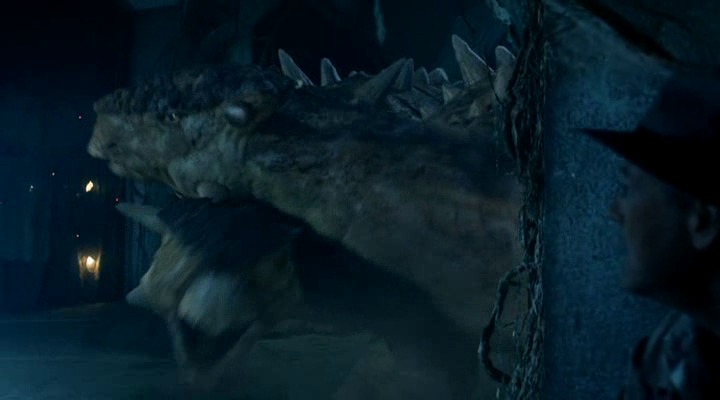
Bond floats through the first half of the film in particular through improbable locales like an uninhabited Shanghai skyscraper and a Macau casino with inexplicably vicious and improbably large Komodo dragons in a dreamlike reverie all the way up to the surreally deserted island. If this is meant to reinforce Bond's relevance it spectacularly fails to do so, making the franchise's tropes seem artificial and arbitrary. The second half is, by contrast, a bizarrely grey run-around which simply doesn't feel like Bond at all. The series should of course try new things but they at least have to be interesting, and this isn't. It feels like halves of two films jammed together, one Bond and the other a montage of cheap British spy-fi television, all squeezed through a filter of weak Christopher Nolan imitation, producing less of a whole rather than a more complete product. I ultimately found it deeply unsatisfying, largely because of how utterly boring and long-winded it became to little purpose. This was, in my view, not the film to celebrate the fiftieth anniversary of Bond in cinema, no matter how many machine-gun Aston Martins are thrown in.

Monday, November 19, 2012

Assassin's Creed

My ambiguous relationship with mainstream gaming is not a hidden fact. It's been an increasing opinion of mine for some time that as it becomes mainstream-oriented, geek culture as a whole is becoming more dominated by hype and sentiment at the expense of quality. It's for that reason primarily that I have heretofore largely avoided Ubisoft's Assassin's Creed franchise. There was something about the regular sequels and equally regular mass marketing campaigns that screamed "excessive hype". I could see it being one of those things people probably got more excited about than was reasonable because they didn't know any better. That's not entirely fair, because the games have never met with the kind of over-the-top review scores and ridiculous praise some franchises receive, but they have certainly been a consistent output which reeks of greedy market saturation. However I saw the recently released Assassin's Creed III in action recently and thought to myself that maybe I ought to give the series a proper go, having already attempted but lost interest in Assassin's Creed II. I felt I needed to start from the beginning, so I braved hell and high water quite literally to make it to the shops to get Assassin's Creed, the original game from 2007.
At the end of the day I can say this with confidence: Assassin's Creed is okay. My expectations were fairly low and they were probably exceeded by a tiny margin. The first game's strength lies in its control scheme and environments. Its main weak points are, in my opinion, its learning curve and approach to difficulty. Many reviews I've seen beforehand bemoan the first game's alleged repetition, but as such I was expecting it and never really felt frustrated by it; that's just the benefit of hindsight.
In Assassin's Creed you play primarily as Altaïr Ibn-La'Ahad, a member of the secretive order of Assassins, in the medieval Holy Land at the time of the Third Crusade in 1191. The framing device for this historical folderol is that Altaïr's distant descendant, Desmond Miles, is being forced by a sinister corporation to relive the memories of his assassinating ancestor through a device called the Animus in 2012, which was at the time of the game's release the near future. This establishes that throughout history two secretive organisations, the Assassins and the Templars, have been vying for the fate of the world. Over the course of the game Altaïr is directed against numerous Crusade-era targets, both Christian and Muslim, to discover that the Templars are seeking mysterious ancient artifacts to achieve world peace through mass mind control. The Templars' modern-day equivalents are now using Desmond's ancestral memories to recover the location of said artifacts.
Now you'd be excused for thinking that this plot could easily be found in the pages of a best selling trash paperback by someone like Clive Cussler or Dan Brown, and admittedly it's not the most compellingly original narrative ever devised. It's all too tempting, I feel, for us to wish to attribute some romantic connectedness to the repeated atrocities of history in an effort to contrive any sense of meaning to the horror or to romanticise or glamorise them in order to dull their edge. I feel that this in some ways potentially detracts from some of the themes of the game, which does struggle rather heavy-handedly but nonetheless deliberately to make an argument about the balance of free will and order, but it would be hard to make a game of it otherwise. Altaïr is a startlingly dextrous killer with an extremely stylised outfit and the general air of cruising around the Holy Land knifing nasties does seem to detract somewhat from the serious airs the game tries to put on.
Nonetheless it is in Altaïr's cruising that the game succeeds. Travelling through the game's three major cities of Damascus, Acre and Jerusalem is a free-flowing and smooth experience which never really feels like a chore. Altaïr can walk, stroll, run or sprint depending on the circumstances, and in sprint mode can smoothly ascend buildings, jump gaps and generally clamber about like a white-robed monkey with a big knife. The free-running is easily the best part of the game, where making smooth traverses across the rooftops of a detailed city feels natural and rewarding. Each city is divided into three major districts, each district unlocked when its resident assassination target is assigned. The cities feel fairly believably large and realistically designed and ascending high vantage points atop towers and major public buildings to better "synchronize" Desmond's experiences with those of Altaïr give a satisfying sense of scale and grandeur which is echoed on arrival to the cities themselves, especially Jerusalem. This is held back somewhat by the amusingly small "Kingdom" overworld linking the major cities which is about a kilometre square when the real cities are all over one hundred kilometres apart. The Kingdom serves very little purpose and doesn't even need to be traversed once you've visited the city you intend to travel to at least once so I'm not sure why they bothered with it; it certainly reduces the sense of scale. Given that you spend most of your time in the cities themselves and that they do feel realistically sized for the time period (even though I imagine they're probably not) I really think it's an element which could have been left out.
One major issue with the cities is the sound. Ambient noises are used to signpost sidequests and liven up the locations, but there are very few voice clips and the same speeches and dialogues are repeated endlessly. It's not helped by the fact that Damascus and Jerusalem, being both Saracen-controlled, use the same voices; at least the Crusader-controlled Acre mixes things up a bit. After a while I found hearing some Saracen chap crying "Praise be Saladin!" every five minutes to be rather wearisome. Similarly once you've heard a nasty guard accusing someone of being a "Dirty thief" the first time, that's all you're going to hear for the rest of the game. It's a little mind boggling that a game which had so much effort put into the physical details of its setting had relatively little done in terms of audio. The single voice of the numerous Acre beggar women is particularly excruciating.
With that in mind we should move onto the stealth mechanics. For a game about being an assassin, the stealth isn't great. The awareness of guards is indicated by a flashing light in the corner of the screen, which changes colour from white to yellow to red depending on how alert the guards are to your presence. If guards become fully alerted to you, either because you committed a violent act near them, lingered in a restricted area or otherwise drew attention to yourself in an unfavourable way, the light goes red until you move out of their line of sight. Then you must hide yourself pronto to completely shake them off. This is fine early in the game, but as it progresses there are more guards, especially on rooftops, and they're more wary of a white-robed killer in their midst as their bosses tip them off that someone might be coming. At times the red light will start blinking and you can't tell who's onto you. At other times you have to pace along incredibly slowly to avoid drawing attention to yourself even in the regular city environs, which makes street travelling tedious and frustrating, especially during timed missions in which you must assassinate a series of targets in plain sight before a handful of minutes run out. At other times a drunk will push you into somebody or you'll simply cause a passer-by to drop their luggage, at which points it's drawn swords all around and Altaïr fleeing for the nearest roof garden or bale of hay. The guards are weirdly relentless too; Altaïr's meant to be a trained killer with the balance and poise of a gymnast, but for some reason all the guards are just as good as him at scaling huge edifices, swinging from narrow beams, performing precision jumps and, most bizarrely of all, surviving two and three storey drops to pursue you from the rooftops back to the streets. I would expect them to be competent swordsmen but their inexplicable acrobatic talent detracts from Altaïr's own presence and often makes losing pursuers stupidly difficult. As such it becomes more and more important to simply not attract attention.
This is why I have an issue with the game's learning curve. In order to increase the game's challenge as it progresses, you're not so much confronted with more difficult stealth opportunities or more precise kills; you're simply restricted in what you're allowed to do. While you do regain equipment and abilities as Altaïr recovers his rankings in the Assassin organisation, it feels as if the game simply takes away your freedoms and reduces what you can do rather than genuinely increasing the level to which anything is tested beyond your patience. There is no greater skill or finesse at avoiding detection in later parts of the game, just more situations where you're forced to hold down the button that makes Altaïr walk more slowly. Again, it doesn't test your skill, just your patience, boredom threshold and attention span.
My other major frustration in this regard is to how the game teaches you its combat. The combat system is, essentially, fine. You have several different weapons with different speeds and levels of damage and surviving and succeeding in combat is a matter of successful blocking and well-timed counters and grab breaks, as you might expect such swordplay to be. However beyond some arbitrary and overly simple training exercises you run through each time you're given a new combat skill, the game doesn't force the player sufficiently to hone these skills in real battles. In virtually all circumstances for the majority of the game, combat can be largely avoided. You drop in, stab your target with the hidden retracting blade on your wrist, scarper from the guards and hide until the heat's off. Your only other major opportunities for combat are if you deliberately antagonise guards or in the random acts of philanthropy you can perform around the city where you rescue citizens from bullying soldiers. These rescue missions are almost always entirely optional, however, and give little reward beyond assistance with escaping or hiding should you be chased in future, and are generally relatively straightforward, so there's really very little apparent necessity for you to practice your swordplay.
This gets turned on its head frustratingly late in the game when you begin being forced to take on large groups of heavily armed opponents single-handed; you can't run or stealth kill a specific target, only grind your way through masses of knights, and if you haven't mastered the counter attacks, which I myself had no reason to before then, you'll find yourself being killed over and over. I had to learn how to fight during the fights which should have been testing everything I'd learned to that point. The counters are tiresomely difficult to time correctly; while it's possible, using the hidden blade, to perform one-hit-kill counters, these are never taught at any point in the game, and for me at least it became a teeth-grinding process of trial, error and muscle memory until I was able to bludgeon my way through the unending ranks of Crusaders who were out for my blood.
This particularly rankled in one of the game's final confrontations in which Richard the Lionheart pits you against your prime target, Robert de Sable, arguing that whoever wins a fight to the death is surely favoured by God and must be telling the truth about what's going on. "Fair enough," I thought, "It's fitting for the period for me to have a duel to the death with de Sable with the ring of honour proving who is vindicated." But no, apparently this trial before God meant de Sable got to send ten heavily armed Templar knights at me, all of whom I had to fight entirely on my own before facing de Sable himself, while Richard happily stood there like a complete plum as if this was entirely fair and reasonable - he is presented as if, compared to the other nutters in the game, he's one of the sane and wise leaders. Similarly, in an earlier confrontation where I had to kill de Sable's decoy, I couldn't, as I had every other time, drop in and knife my target. No, I had to stand there like an absolute lemon during a cutscene before the decoy and a huge gang of knights with archer support all charged at me swords drawn. The game at no point ever trains you to take on these kinds of numbers, yet you're expected to have figured it out. It really is needlessly punishing. So those are my two main issues with the gameplay: the very forced and arbitrary way the game tries to increase the stealth difficulty and the complete lack of progressive, organic training for the combat. The practice area back at the Assassin fortress is far too simplistic and easy to give you a realistic impression of how to perform these skills in the field.
In terms of repetition it's true to say that the preamble before the main assassinations does become predictable after a while. These are times when the game's story, despite being a little unimpressive, sacrifices the gameplay. Sitting on a bench while two stooges talk about party decorations at your next target's big do or swiping some compromising correspondence from a courier's pouch are unchallenging tasks which feel like little more than padding. That being said, some of the Informer missions do change things as the game progresses, with more targets to be eliminated and narrower time limits. Nonetheless I must admit that it's not great; the main problem is that the interrogation, eavesdropping and pickpocket missions give you nothing to practice which is useful during the more harrowing parts of the game. While hunting down targets for an informer do somewhat test your stealth skills, such as they are with the game's rather limited stealth mechanics, there are no mandatory missions which require you to improve your combat, which would have really helped. Similarly these sections are compounded in difficulty by the presence of beggars and various troublemakers - drunks, madmen and the like - who target you and only you for harassment, getting in your way or shoving you about, which reduces rather than enhances the sense of realism. The drunks should be bothering everybody; it could be more interesting trying to avoid sprawling civilians getting into brawls rather than being unrealistically picked out for irritation every time. The madmen wander the streets in ridiculously high numbers. The beggars are just implausible; I think desperately poor women would pick softer-looking targets for their pleading than heavily-armed, stony-faced stalkers. It's really just a forced way of making the stealth more frustrating, and it's really these kinds of very artificial enhancements to difficulty which spoil the later parts of the game.
In the end Assassin's Creed is mostly worth it for the free-running, which really is very enjoyable, and the animations and scenarios can make it very satisfying to leap from roof to roof, shimmy down a fresco, jab some unsuspecting Templar lieutenant in the vitals and then scurry away again before the guards know you from a passing ghost. The graphics are pretty nice for a game from 2007 and it feels reasonably natural. The voice acting isn't stellar and neither are the weird dreamlike cutscenes which occur every time you perform an assassination, in which Altaïr gets to have a long and cryptic dialogue with the person whose throat he just perforated, but the presentation generally gets by. The game played pretty smoothly on the Xbox 360 and apart from some frustrations with the lack of precision on the D-pad picking weapons it runs well on that system. I don't think it's the kind of game I would want to play on PC. It's pretty cheap these days so it's worth getting if you need to kill some time, and even though some of the gameplay elements are a bit cheap and the story's a little pretentious it's still an enjoyable experience.

Monday, October 8, 2012

"Mogworld" by Yahtzee Croshaw

A couple of years ago Yahtzee of Zero Punctuation fame made the step into writing with the publication of his first novel, Mogworld. It's not the first novel he's ever written - you can see some early unpublished works on the old version of his website - but it's the first one he's had published and the first one since he became a celebrity outside the amateur adventure game community. With his second novel, Jam, on the way, I thought I'd re-read Mogworld and offer some thoughts.
Mogworld plays it safe. Yahtzee knows his readers are going to be geeks who watch Zero Punctuation, so he's written a novel which is both a fantasy and a satire on video games. Anyone who has read any particularly generic fantasy literature or played an online game like World of Warcraft will get many of Yahtzee's points straight away. With that in mind it's worth considering that Mogworld is possibly too safe. It tries to make a point about the genres which dominate what I might hesitantly call "geek culture" without being too alienating to a non-geek audience - if you've never played an online rpg or read fantasy before you probably still won't have too much trouble - and so a lot of what he writes about comes across as a little thin or underdeveloped. The main instances of this are that the plot takes a very, very long time to reach what is really quite a rushed conclusion, and the fact that the characterisation is limited and the setting is painted in strokes so broad that it doesn't necessarily grasp the imagination.
This causes the plot to in many ways feel very artificial and even dreamlike as basic characters float past vague backdrops through a series of improbable coincidences strung together in a rather predictable way. The protagonist is Jim, a recently-resurrected undead mage who believes that he was on the verge of a great spiritual revelation immediately following his death, and who is thus seeking to end his unnatural longevity. This ambition is frustrated by the Deleters, mysterious angelic beings who insistently return him to his body. What was given away from the off in promotional material about Mogworld and thus spoiled a good deal of the dramatic irony and surprise is that Jim's whole world is a completely procedurally-generated MMORPG whose history has been simulated to ensure a realistic setting for the video game. Having reached the level of development they sought, the game's developers have now halted death so that the game's NPCs and the player characters, who are all existing individuals in this computer-generated world, can continue in perpetuity. Jim is accompanied in his quest by Meryl, an airheaded undead girl, Thaddeus, an undead straw fundamentalist priest, and Slippery John, a thief who constantly refers to himself in the third person for unexplained reasons.
If you've read early Discworld or The Hitchhiker's Guide to the Galaxy you've encountered Mogworld's style of humour already - punning English words turned into foreign-sounding names, incompetent characters constantly getting into trouble and the juxtaposition of the fantastic with the mundane. The necromancer who resurrects Jim and his companions, for instance, is an evil dark lord who lives in a "Doom Fortress" (one of Yahtzee's favourite phrases, I've noticed) who also happens to provide excellent job opportunities and is referred to like a well-loved executive in a corporation. The equally dangerous Baron Civious' wife talks like a cooing English matron. Melodramatic fantasy behaviour is always lampshaded or immediately undermined by something prosaic or stereotypically lower-class. The world is also built as an intentionally generic swords-and-sorcery environment in the vein of, say, Dungeons and Dragons or Conan the Barbarian. This would be enough if it hadn't been done a million times before; as it is it just feels like it's retreading ground already totalled by Terry Pratchett's first few Discworld novels and to me at least seemed stale and unambitious. The funniest moments in Mogworld derive from the characters, especially the game developers, and their interactions, not from crafting a deliberately silly universe. Jim is, similarly, a typical cowardly, sneering, unlikeable comic-fantasy protagonist in the style of Rincewind from Discworld or perhaps Rimmer from Red Dwarf whose personal tragedy is constantly weighed against his misanthropy and arrogance. Indeed much of the characterisation of the core group, as well as the programmers, the villain Barry and his benefactor, the egotistical game developer Simon, fall rather heavily into the Red Dwarf or Blackadder zone of a group constrained for whatever reason to only interact with each other, which is effective for television but can't necessarily carry the narrative of a novel. It might explain why so much of the plot is a string of bizarre episodes and encounters.
Yahtzee, to his credit, uses Mogworld to explore some interesting ideas about the value of life and the possible dangers of immortality, as well as, perhaps most effectively, questioning what constitutes self-awareness and consciousness. These ideas, however, are not necessarily borne out as well as they could be. Jim, for instance, only discovers at the very end of the book that his world was created for entertainment, and the ramifications of this particular scenario are given little attention. The novel could possibly have done without its epilogue, which offers up a conclusion which seems to not follow through on all the possibilities of the plot of sentient game characters and the consequences for their existence. Yahtzee flits in and out of examing an idea about a hero vs a protagonist which seems to distract him at the end, and I think this is the main issue with Mogworld: it's trying very hard to say something but seems undecided about what it wants to say and therefore all of its arguments end up not being fully realised. It's not helped by, as I've stated, the underdeveloped setting and the routine quality of some of the humour. In addition, at the risk of coming across as a bit of a snob, Yahtzee's vocabulary is a little unspectacular and probably could use fleshing out; there were times when the heavy reuse of certain words made some of his writing fall flat.
Mogworld's definitely a decent enough novel carried by some interesting ideas and a patter of humour which is rarely laugh-out-loud but compelling enough. Its main issues are the meandering narrative and its somewhat scattergun approach to ideas. I have a great deal of respect for Yahtzee creatively and it's interesting to read a novel by him, but as I say it feels like a safe first publication relying heavily on references to and conceits from other works, and I'm hoping that in the upcoming Jam Yahtzee will take the opportunity to expand his potential to something hopefully a bit more audacious.

Saturday, September 29, 2012

The Opinions Can Be WrongCast: Red Dwarf X Anticipations

The Opinions Can Be WrongCast - Red Dwarf X Anticipations
In the final week before the return of classic British sci-fi comedy Red Dwarf, we take a look back at the ups and downs of the show's original run and assess our hopes for the future.

Tuesday, September 18, 2012

"Dinosaurs on a Spaceship"

Chris Chibnall is one of those divisive Who writers; I suppose most of them are, but he seems to be moreso than usual. His first writing gig for New Who was the very forgettable "42" and his second the rather hit-and-miss Third Doctor era tribute "The Hungry Earth" and "Cold Blood" so there isn't that much to go by but so far it hasn't exactly been the top stuff in any series, that's for sure. He also wrote some of what I feel are the particularly dreadful episodes of the generally abominable Torchwood, which don't really count but do at least give something of an impression. With that in mind it doesn't really need to be said that I went into this episode with a healthy amount of trepidation, and this defensive pessimism is probably what resulted in me being somewhat pleasantly surprised. That's not to say that "Dinosaurs on a Spaceship" is a good episode of New Who by any stretch of the imagination, but if I am to describe it as mediocre or bad it falls into one of two categories. There are those kinds of bad episodes that are offensively bad because they take way too much (including the audience) for granted; "Asylum of the Daleks" was one such episode. The other kind are the sort that are bad but are at worst nothings about which you simply don't care, or at best are enjoyable for what they are without really being much at all. "Dinosaurs on a Spaceship" falls into this latter category.
The Doctor views a small segment of the Cast List.
We begin in ancient Egypt in a scenario which is sure to get my hackles up as Queen Nefertiti is trying rather forcefully to seduce the Doctor: it's these rather heavy-handed moments that occasionally conflict rather bizarrely with the otherwise extremely family-friendly tone of this episode's core concept which I find most disagreeable about the episode. The Doctor gets a message from the "temporal News Feed" on his psychic paper, but I had to go back and carefully check this scene: it's hard to tell how he gets the message considering how rushed the moment is so it's easy to think that he just inexplicably gets some honking noise in his pocket and then runs off. The Doctor reappears in the year 2367; it's nice to be in the future for a change. Did the white lettering really have to be in a beam of light though? It's kind of hard to read. The Indian Space Agency is worried about an unknown ship heading for Earth; this setting is an interesting if not fully developed piece of set-dressing which is palatable for its freshness if nothing else. The CGI's not great in this episode though and it's not helped by Murray Gold's usual musical assaults on our eardrums; shots of blobby-looking spaceships zooming along to brass band music is something which has become so wearisomely repetitive in New Who as to border on the offensive. The Doctor decides he needs to pick up some more buddies so off we go to oversaturate our support cast.
"I need your help; the whole of history has become
inundated with giant floating letters and numbers."
First we pick up John Riddell, a big game hunter camping out in Africa at the beginning of the Twentieth Century. Why does a big game hunter not strike me as the kind of person the Doctor would have as a friend? Amy even points out later that he's a man who harms defenceless animals for a living. It's a relatively throwaway role for Rupert Graves as well, but we'll get to that. He picks up the Ponds as well of course in yet another very forced reintroduction of our other two main stars and inadvertently brings Rory's dad Brian along, another essentially unjustified plot element only accomodated for by the casting of the reliable Mark Williams. This of course means that the Doctor gets to act like a complete idiot not knowing who Rory's dad is (was he not at the wedding?) but through some adequate dialogue and direction Matt Smith gets to portray this "zany" side of the Eleventh Doctor with a little more decorum and genuine humour than he has in past episodes like the previous Christmas Special. He remarks that he's "got a gang" so there's basically zero justification for this diverse cast of kooky characters beyond perhaps the sale of an action figure combo pack, and then goes on to say that he's "never had a gang before." Really, though, it's not too far from the even more over-the-top assemblage in last series' "A Good Man Goes to War" among other episodes, so it strikes me as a somewhat disingenuous remark as far as that's concerned.
Denver the Last Dinosaur? He's my friend and
a whole lot more?
Not long after this we reach our title drop because, as the Doctor and his "gang" explore the ship, the dinosaurs are unleashed. Personally I don't think the dinosaur effects are too bad in this episode; I found them to be reasonably realistic considering their level of interaction with the actors and the complexities of their movement. I guess they look a bit fake but really it's the scenario which is terribly contrived; it's painfully obvious that they've started with the idea of dinosaurs on a spaceship and written backwards from there. After the reptile-skin title sequence we get a more full look of this spaceship's interior. Frankly this set is the most disappointing of them all; it's very boring and just looks like a grey warehouse. Given that the ship's meant to be a sort of flying menagerie it's a little uninspired and falls back far too heavily on New Who's typical and inexplicable fixation on depicting the insides of spaceships as just bland industrial settings with pipes or pillars everywhere. In searching for the engine room, the Doctor, Rory and Brian get teleported to a beach and thus separated from the others for the majority of the rest of the episode, and it really shows that Chibnall doesn't really know what to do with so many characters; they've been included for their incongruity rather than out of any major interest in making dramatic sense.
Location filming in the bustling heart of Cardiff.
So we discover on the beach that Brian Williams is an anxious traveller; "Thank you, Arthur C. Clarke!" he tells the Doctor in one of the episode's funnier moments. The beach looks awfully similar to the one used in the Weeping Angels two-parter back in Series 5 of New Who and apparently it is indeed the same one which lessens its impact somewhat. We cut back to Amy's half of the team to reinforce that Nefertiti is one of New Who's typical incredibly super hammy historical characters who spouts "olde schoole" dialogue at the drop of a hat. There's an extremely corny moment where they have to step over a sleeping Tyrannosaurus which just reinforces how pointless this plot currently is, especially since we immediately return to the beach again. The Doctor and Williams Senior and Junior discover that this beach is indeed the engine room of the ship, which is "powered by waves". We're supposed to just assume this makes sense. I know wave power is a real thing but all I see are waves crashing on an artificial beach. How does this power a massive spaceship? Then they get attacked by pterodactyls, which are in fact pteranodons apparently. Would ptero-anythings really be that dangerous? They don't appear to have teeth or claws, and it's believed that they ate fish. Nonetheless the Doctor and the Williams father-and-son duo scarper to an extremely convenient nearby cave which happens to be right there.
"What are all those people doing with that camera?"
All these moments would seem completely frustrating in their absurdity had they occurred in some of the other worn-out stylistic templates of New Who but the absurdity is alleviated consistently by the very kid-friendly atmosphere of the whole episode; the plot moves along at a decent clip and the sense of threat from the dinosaurs isn't laboured. Basically the overall silliness compliments the concept, which is an improvement over something like "Asylum of the Daleks" where the plot holes were only enlarged by the episode's enormous confidence in its own profundity and gravitas. Such delusions of grandeur are simply not present here, to this episode's credit. This is compounded when the Doctor, Rory and Brian are captured by a pair of "funny robots" voiced by contemporary British comedy duo David Mitchell and Robert Webb. Essentially we've gone so far full circle that we've come back to the days of 1989's "Survival", Classic Doctor Who's final serial, in which a pair of shopkeepers were played by 80s comedy duo Hale and Pace. It's rather curious considering David Mitchell's earlier critiques of Doctor Who but I guess maybe it's been a slow year with only a new series of Peep Show on the cards or something.
I'll let this one speak for itself.
So we return to Team Arbitrary Plot Exposition as Amy is now super competent with alien technology. Well actually, it's Silurian technology; the appearance of a New Who Silurian, played as ever by Richard Hope, is revealed with a series of ominous chords. This I don't really understand; at least some of the Nu-Silurians have been twice now depicted as friends and allies of the Doctor. Regardless, this is a good explanation for why dinosaurs are present; Silurians brought them along during a migration from prehistoric Earth. This was something which I think could have used a little more development; we know that traditionally the Silurians went underground to hide from cataclysmic events. Why was this group in space? It could have been tied, through a little plot re-working, to the idea from the end of "Cold Blood" that the Silurians would emerge from hibernation some time in the thirty-first century but sadly this opportunity was missed, and I guess it wouldn't necessarily explain the dinosaurs. Speaking of dinosaurs, returning to Team Wandering Around, Brian Williams is approached by a triceratops which starts sniffing his trousers. What could it possibly have to inspect there? "Only my balls," Brian Williams comments stoically. Really, Chibnall? We get a lot of innuendos like this about "powerful weapons" and so on which really are an odd contrast to the otherwise child-friendly tone. I guess it's just a traditional "something for the parents to chortle about" element; presumably it'd be over most kids' heads. Having distracted Mr Triceratops the "funny robots" bring the Doctor to a piratical spaceship which Amy has discovered to be lurking at the heart of the Silurian vessel. This is really where the CGI in this episode unfortunately hits rock bottom because the pirate spaceship looks very fake, like something from an early 2000s video game cutscene. Could have been done more realistically with a model!
David Bradley plays every 70s rock musician still living.
The Doctor is introducted to slimy villain du jour Solomon, an injured and very obviously evil space trader in the traditional "mercenary attitude" vein played with his usual menace by a well-cast, if somewhat typecast, David Bradley. The Doctor also gets to make a somewhat homoerotic suggestion about Franz Schubert. Solomon gets the pointless robots to injure Brian so that the Doctor will repair his own injuries, and thus we get to have our subplot of Rory earning the respect of his dad as he becomes all protective and shows off his nursing chops. These scenes are nicely subtle and come across as reasonably sincere. It's a shame the "funny robots" simply aren't funny, although I suppose it reinforces how disturbing the robots are. I like the like when the Doctor says that "I never talk about myself with a gun pointed at me," when of course the real guns are pointed at his friends. This is a good indication of the Doctor's great compassion and, fortunately, isn't explained for the benefit of the thickies. It's also nice to see the Doctor doing some genuine medical work even if it isn't given much attention. I know he's a Doctor of Everything, not specifically a medical Doctor, but it's still satisfying to see his expertise taken for granted like this. Solomon also scans the Doctor to learn that he doesn't exist apparently, which lends further suspicion to how this "Doctor who?" thing is going to play out. It turns out Solomon killed off the Silurians on the ship to get at the valuable dinosaurs, and the Doctor accuses him of committing "piracy and genocide." The thing is though, why did the Silurians send out the distress signal in the first place? I'm not sure it's ever explained. The Doctor complains that the dinosaurs "are not objects to be sold or traded." Why did he bring Big Game Hunter Riddell then? To teach him a lesson? It's never explained. He suggests that Solomon not "ever judge me by your standards," despite having committed a little genocide in his time but I suppose in the Doctor's case it generally wasn't for personal profit.
This scene is why we're only getting five episodes this year.
Anyway the Doctor, Rory and Brian with the smelly balls escape on a triceratops, which is a bit of a silly set piece, emphasised by what absolutely terrible shots the two robots are. "We definitely used to be faster," complains the David Mitchell robot, in probably the only genuinely funny and Mitchell-and-Webb-esque gag from the "funny robots" in the whole episode. Apparently riding this lumbering dinosaur is faster than running because our intrepid heroes pop around a corner and appear to have escaped by doing just that. Maybe they travelled further between shots? The Indians have launched their missiles, apparently being able to communicate directly with the Silurian ship so the Doctor can complain, but we know it's not a real threat. Similarly, Riddell busts out some "stun guns" which for some reason are cocked like pump shotguns and look like conventional human weaponry despite the fact that every other time we've seen Silurian weapons they've looked very unusual. Rory asks if there are weapons on the ship which prompts the Doctor to kiss him with joy; I found this bit surprisingly funny and am still surprised at how much it didn't irritate me. Anyway Solomon reappears because he wants to claim Nefertiti who has a "face stamped across history." This was not played up enough at all in my opinion, largely due to how frantic the character action is due to the excessively large cast and makes her seem like even more of an arbitrary plot device. This time he turns to killing off the dinosaurs, which offends the Doctor because he is a friend to all of god's creatures; this is contrasted to the complete inhumanity of the robots, which I suppose is a change. Nefertiti hands herself over so Solomon can make some very unpleasant salacious suggestions reminiscent of how practically every villain treated Peri back in the Sixth Doctor's day and the baddies scarper; they can't escape though, because the Doctor has "magnetized" Solomon's ship somehow. It's never explained how or when this happened.
"Hello there. How are you enjoying the programme so far?"
The Doctor and friends meanwhile escape to the Silurian control room which looks like absolute crap thrown together on a budget which had mostly been devoted to CGI dinosaurs. In one of the most ineptly convenient plot moments in the episode, two people of the "same gene chain" are required to fly the ship so of course this falls to Rory and smelly-balls Brian. The Doctor cracks a joke about monkeys which would have been a lot funnier had he not said "comedy gold" just after. We get some equally heavy-handed foreshadowing of later plot developments as Amy and the Doctor talk about his increasingly sparse visits and which of them will outlive the other. Meanwhile Riddell needs some assistance defending the control room from what are either Jurassic Park-esque "legitimately dangerous" velociraptors or baby tyrannosaurus'. He and Amy team up to fight while the Doctor pops over to Solomon's ship to rescue Nefertiti. We get another forced 2001: A Space Odyssey reference as the robots sing "Daisy Bell" upon deactivation. Then the Doctor sets the missiles to track Solomon's ship instead of the Silurian Ark and leaves Solomon to die. "Did the Silurians beg you to stop?" he asks Solomon, being quite harsh but not unusually so given what's happened in some Classic stories. The shot of Solomon's ship flying out from the Ark looks bloody cheap and awful in what is probably the worst CGI in the episode; it is of course destroyed with one of those big noisy space explosions.
Dyb dyb dyb dob dob dob.
Amy and Riddell take out the dinosaurs in a fit of what borders on coital fury to the extent that I'm surprised they didn't light up cigarettes at the end and the day is saved now that Brian and Rory have used the convenient video-game controls on the Ark to fly it away from Earth. Brian makes one request of the Doctor in what is probably the best moment in the episode and one of the most genuine in New Who; he takes the opportunity to observe Earth from space, while having a cup of tea no less. Given that viewing Earth from space is indeed meant to be quite a sight I thought this was an excellent choice and managed to be rather touching without being remotely cheesy or melodramatic. The whole thing of Rory earning his dad's respect is not overplayed to any extent; this is the way to do the 'parent in the TARDIS' thing (if it needs to be done at all).
We're watching you.
Now we just wrap up the plot with Nefertiti bizarrely ending up with Riddell back in 1902 and Rory and Amy receiving a bunch of extremely fake-looking postcards from Brian's travels. So he got over his fear of travelling, how nice. And the Doctor found a home for the dinosaurs 'cause he's such a champ. All in all this is a damn silly episode but as I said at the beginning, it's inoffensively so; most of the dialogue is not especially cringe-inducing. The most objectionable material is the excessive amount of really laboured innuendoes. Once again, the sense of kid-friendliness helps this episode a great deal because it doesn't take itself very seriously except in regards to the issue of Solomon where it matters. We got a nice if rather underdeveloped futuristic setting and Matt Smith getting to do the funny stuff without too much excess. On the other hand there are way too many companions and the scenario really does feel very contrived. Riddell would have made an interesting contrast to Solomon, for instance, but he's never developed so it's a missed opportunity. Solomon and the dilemma he poses is fairly trite as well, but I think it was handled in a sufficiently interesting fashion to be adequate. All in all it's not memorable Doctor Who at all but it was better than I expected and these days that's almost all you can ask for.

Monday, September 3, 2012

"Asylum of the Daleks"

"Lunatics running the asylum" has always been an apt description of Doctor Who's 21st Century revival given that it has been written and produced by, mostly, embittered Classic Series fans who never really liked the show they were brought up on in the first place. Never has it been more evident than in the observable deterioration of Steven Moffat's writing quality over the period from 2010 to now, in which a fresh start to a shallow reboot regressed back to different, but ultimately comparable, forms of shallowness and simplicity. "Asylum of the Daleks" is, in my view, not a very good episode at all. To put it simply, very little happens, it takes itself far too seriously, the plot is rather contrived and its characters are extremely wearisome. My key word for this review is "unnecessary" because it describes huge amounts of the action.
"This whole episode was a trap."
We begin on Skaro with a clumsy voiceover setting up the Daleks and the Doctor and the Doctor's apparent death at the end of the previous series. The Doctor meets a strangely-accented woman inside a giant Dalek-shaped building that the Daleks apparently have. Putting aside the fact that Skaro's been blown up about three times now, including Remembrance of the Daleks and the Time War, it looks pretty good in my opinion. Shame the episode couldn't have been set there because it looks quite nice. It's also a relief to see the Doctor so early because Matt Smith is as usual one of the most watchable elements of the show. Strangely-accented woman tells him her daughter has been captured by the Daleks but she escaped; given that no one escapes the Dalek camps ("concentration camps" could have been used to effect here), the Doctor deduces that it's a trap. Oh really? He just got summoned by a complete stranger to Skaro and he wasn't previously aware that it was a trap? An eyestalk pops out of the woman's head and a Dalek gun from her oustretched palm, to represent that she's under the control of the Daleks, a rather bizarre and unsubtle piece of imagery. He gets zapped and our plot begins.
A surprise appearance by the late Peter Cushing?
No wait, now we need to have Amy in sultry model makeup in a fashion shoot; turns out Amy and Rory are getting divorced and we're meant to care. There was a set of one-minute shorts settng up this plot released online before this episode but I'm not reviewing them because they were too short and too crap. I guess there's an element of mystery in that we don't know why they're getting divorced? Other than that it's pretty forced. Amy and Rory both get sprung individually (which is unnecessary) by more eyestalk-in-head Dalek puppets. This is the start of the time-wasting; we just didn't need to see this beyond setting up Amy and Rory's divorce, which besides being a tiresome soapy plot point could have been established more subtly later when the Doctor notices how far apart they are. My objection is because of how many utterly contrived reasons we've seen in the last series' worth of episodes in order to reunite Amy and Rory with the Doctor. It wastes so much time; why not have them already with him?
The Daleks aren't completely inhospitable.
Amy and Rory wake up in a completely bare, stark, glowing white utilitarian Dalek Prison which for some reason has a nice little convenient and completely incongruous barred window staring out into space for some typical footage of CGI ships whizzing around while music heavy with bombast assaults our ears. Rory wonders how much trouble they're in and the Doctor walks in suggesting that in true Spinal Tap fashion the amount of trouble registers as an eleven, which is to say an extra 'one' above ten on the trouble scale.
"They got me a long time ago."
This would have been a good, albeit somewhat cheesy time, to cut to the titles but we're not there yet. Frankly I think this whole bit of the Doctor walking in was a bit wasted: it could have been cool in some kind of Amy-and-Rory-in-the-dark situation where it appears that the Doctor has teamed up with the Daleks; he does look very much the "amoral intellectual" in that scene with his bow tie and tweed and dour expression and little joke. If everything suddenly went very "Mindwarp" (that's a Sixth Doctor story from The Trial of a Time Lord, you moron) I could see it working.
"YOU! WILL! BE! IMPRESSED!"
The roof opens up and they're raised into a huge chamber full of Daleks. The gold RTD Daleks are suddenly back in full force, and it's a shame seeing Moffat caving to fan pressure against the New Paradigm Daleks which, beyond being in a few too many toy-friendly colours, were something upon which he should have stuck to his guns. The Doctor reveals that this is the "Parliament of the Daleks" and we're obviously meant to be very impressed. He goes into "eager Jesus" mode as his prior incarnation once did, arms oustretched to be exterminated, but the Daleks actually want him to save them. I thought the whole point of Moffat giving the Daleks a rest for a whole series (besides a small cameo) last year was to restore their menace, but now they look more inept than ever. Incidentally, what the hell do they need a Parliament for? Aren't they a totalitarian one-will one-way species? It's just an excuse for wide CGI-laden shots of lots of Daleks which doesn't look particularly impressive given that we've seen them in enormous quantities before.
Finally we get to the titles. We've moved to a rather simple lettering which I find looks a bit cheap. I noticed that the DW-TARDIS symbol only appears for about half a second. Did it not catch on as well as they wanted?
"But I'm too perky to die, Doctor."
Now we're introduced to a new girl played by the actress who's playing the new companion, although we don't yet know the connection. We're obviously meant to consider her to be very perky and likeable as she makes soufflé and records a journal in a crashed space ship. Her 60s-style space clothes are an interesting design choice; I think she needed gogo boots though. We get a rare "good" moment in this episode where she turns her classical music up to deafening levels to block out the sounds of mad Daleks trying to break into the room; it's fairly horrifying and it's the kind of tone we needed more. Now we go back to the "Parliament" and Amy gives a tiresome "now an expert on the Doctor" account to Rory of the Doctor's thought processes. The Dalek puppet strange accent lady whose potential plot is now set up to be completely abandoned is questioned briefly by the Doctor as to her memories before he is introduced to the "Dalek Prime Minister". What do they need a Prime Minister for? The "Prime Minister" or blob in a jar explains to the Doctor that they're above the "Dalek Asylum", a prison planet of legend where all the craziest and most battle-scarred of Daleks are kept. The Doctor claims it makes no sense because the Daleks would just kill them. The Dalek Prime Minister (I can't believe I'm writing that) the blob in a jar tells him that "It is offensive to us to extinguish such divine hatred" and that the Daleks have a concept of beauty, which is why they've been preserved. This has got to be one of the lamest and most contrived excuses in the whole episode, because the Doctor's absolutely right - the Daleks would just kill Daleks they couldn't control no matter how hateful they are, and we've seen them destroy their own kind countless times. It could have been a planet where Daleks captured by other species in some kind of galactic alliance dumped the Daleks they couldn't destroy or something and thus we could have done without the whole Parliament and the "helping the Daleks" plot because this only compounds the image of the Daleks as complete morons who pose no threat whatsoever. Rory asks "what colour" the Daleks down on the Asylum are, in one of the only genuinely funny jokes in the episode, but then he immediately has to explain the joke.
"Welcome to the Giant Blank CD of the Daleks."
They now get a transmission from the girl down on the planet and the Doctor asks the Daleks if they've tried talking to her but of course they haven't. "...he asked the Daleks," the Doctor qualifies, and a joke or bit of irony gets explained again. He couldn't have just said "Of course not," or something, could he? Is it because more Americans watch the show now and Moffat thinks they're completely incapable of understanding humour if it's not spelled out for them or something? He gets all sentimental that this girl on the planet has apparently been making "soufflés against the Daleks" oh isn't that so sweet and chipper. Aren't humans so indomitable? How tiresome. Stop telling us everything Moffat and be content to show it! Honestly, an enormous amount of this episode would have been bearable without the constant efforts to lampshade every single event in words. So this ship this girl is on has crashed into the Dalek Asylum; there's too much of a risk of the crazy Daleks escaping, so they need the Doctor to go in, deactivate the impenetrable forcefield and let them blow up the planet. Wait - they weren't willing to kill the crazy Daleks before but now that there's a risk of them escaping they are? This kind of contradiction just doesn't fit the Daleks. Hang on - the forcefield is impenetrable. So how could a ship crash there? What the hell? If the shield can be penetrated by a crashing ship why can't it be by the big horrible Dalek nukes we see later that blow the planet up with about ten of them in a second?
A weak parody of Cameron's Tory government?
The Doctor gets an unnecessary extra appellation as the "Predator of the Daleks." "'Predator' is the Daleks' word for you!" explains the strange accent Puppet lady completely needlessly. Why is everything being explained when it's completely obvious, and not being explained when it makes no sense or seems to contradict itself? We're obviously meant to just be gasping at how horrible this makes the Doctor look or something. They're given wristbands to avoid being harmed by their descent to the planet. "It is known that the Doctor requires companions," apparently, and that's all the reason we get for Amy and Rory being there. These kinds of self-referential winks to the show's structure are incredibly tiresome. They may as well have had them say "it is known that Doctor Who is a long-running British science-fiction programme first broadcast in 1963 featuring an alien Time Lord known as the Doctor who travels..."
Now we're beamed down to a snowy planet for a nice change of pace. There's an unnecessary guy in a snow suit and we discover that the girl on the planet has a zany space name to go with her zany space clothes: "Oswin Oswald." Rory's disappeared; he's been separated from the Doctor and Amy because as usual the writers for New Who don't know how to handle more than one companion. He's been beamed down to a Dalek dungeon where the story is going to be trapped for the remaining half an hour of viewing. There are a bunch of dusty old Daleks down here; I guess they're meant to be scary. One thing that was bigged up about this story was that it was meant to have Daleks from "every era of the show" but these just look like RTD Daleks covered in dust to me.
"But I was only gone two minutes!"
The Doctor and Amy go down to the snow-suit man's spaceship, where his silent travelling companions are obviously dead. I think we're meant to be surprised about that, or surprised when he turns into yet another Dalek puppet. The Doctor reveals that there's a cloud of nano-machines in the air which converts anyone not wearing one of those wristbands into a Dalek puppet, so apparently the Daleks are also high-tech Cybermen now. The dead crew all get up as puppets and we see the march of the Dalek zombies for a yawn-worthy non-scare which is overcome in about five seconds through the power of closed doors.
Oswin Oswald starts making jokes about the Doctor having a big chin, because apparently everyone thinks the same way in Moffat-verse and comes up with the same remarks about people. She claims to be a complete genius and also quite sexy, to explain how she's able to communicate with the Doctor via all this hacked Dalek technology. So basically she's another cookie-cutter Steven Moffat "empowered woman" full of witty quips and flirty dialogue. The Dalek zombies took Amy's wristband so now she's being converted by nano-robots in a way awfully similar to her control by the Weeping Angels back in Series 5. Really it's just every Moffat trope jammed together.
There he is! On the left! How nostalgic!
Back in the Dalek dungeon Rory wanders around having no purpose. He wakes up the Daleks and thinks they are saying "eggs." Surely he knows that Daleks say "exterminate"? He claims to not know what they want, and despite originally being conceived of as an intelligent character he gets to act in an incredibly, arbitrarily stupid fashion. Oswin Oswald opens a door for him to escape through and we get a very brief shot of a Special Weapons Dalek from "Remembrance of the Daleks" and maybe one other but that's it. We also get an absurd slow-motion action shot where Rory, running a moment ago, is now sliding like he's on rollers under the door. Oswin calls him Nina in reference to an old crush just so we can hammer home the cringe-worthiness by having a bit of bisexuality. It's this kind of characterisation, where everything's really self-consciously cheeky and risqué and thinks it's so clever that makes me want to put my fist through the television.
"Doctor there's... there's a good episode in here!"
"Come away from there Pond, it's dangerous."
The Doctor and Amy arrive in the Dalek dungeon and we get more of Moffat's obsession with memory and the loss of memory as the Doctor states that he's had to explain the conversion process to Amy four times. He tells her to "hold on to scared" or whatever emotions she's having as if, y'know, emotions are something tangible that can fight tiny machines rebuilding your body. So Amy and the Doctor have finally caught up to where Rory was; why didn't they all just come down here at once? We're re-treading the same turf and it really adds to the sense that the episode is going nowhere. Amy has a bunch of time-wasting delusions. Another one of the rare "genuinely clever" moments in the episode occurs when one of the nutty Daleks, due to its nonfunctional gun, self-destructs as a weapon. The Doctor of course waves the sonic screwdriver at it and it flies backwards and blows up all of its buddies. Y'know, for an episode called "Asylum of the Daleks" we see very little that distinguishes these "mad" Daleks from your average run of the mill Daleks. Maybe the episode should have been called "Junkyard of the Daleks" or "Creepy Old Disused Repair Shop of the Daleks." Maybe if the Doctor had suggested that Daleks were all a bit mad due to their totalitarian beliefs and excessive hatred and that the "Parliament" was the real Asylum it would have been a bit more effective. Maybe that was implied, and Moffat's just trying really hard to hide some keen-edged subtext underneath loads of heavy-handed explanations and tiresome dialogue.
"No, I don't know why he wrote it this way either."
Now that Amy, Rory and the Doctor are reunited it's time to wrap up the plot very quickly. They've found a teleporter to let them escape; Oswin just has to deactivate somehow the planet's nigh-impenetrable forcefield and they can go home. They have to stop Amy being converted; she slaps Rory in a case of "acceptable female-on-male" violence suggestive of more of Moffat's really quite disturbing "holy dread" attitude towards women as worshipful and dangerous creatures. The Doctor after a lot of stuffing around with the sonic screwdriver wanders off to rescue Oswin and Rory offers his wristband to Amy suggesting that he loves her more so there'll be more love for the nano-robots to extract and therefore he'll take longer to convert. My old friend magic thinking returns with a triumphant flourish, as Moffat as usual depicts willpower as something tangible and equivalent to psychokinesis: you can stop little robots from stealing all your love-energy through sheer force of will. Amy gives Rory another slap which should have been directed at Moffat and the explanation comes pouring out. We have some forced character development where Amy claims to have given Rory up because she can't have kids anymore. Well that just explains everything? With the air cleared they get back together. May as well have not written them as having broken up in the first place, huh?
The Doctor's approaching Odlaw's position but first he has to go through "intensive care" where the survivors of Classic Series Dalek operations in places like Kembel and so on are kept; if there are indeed Classic Daleks present in these scenes (as allegedly there are) they are barely recognisable under enormous layers of dust. What was the point of having them, then, except maybe an effort to encourage militant Classic Series fans to watch the episode by bigging them up in pre-show publicity?
I sympathise, Doctor. I really do.
The third genuinely good moment occurs when the crazy Dalek survivors wake up and start approaching the Doctor. As he screams in fear and desperation to be let into Oswin's area it's perhaps the single moment of genuine, believable, non-overdone, context-appropriate emotion in the episode. Oswin erases the Daleks' collective memory of the Doctor, which apparently stops them from killing him even though they kill anybody. The Doctor finally enters Oswin's chamber and, surprise surprise, she's a Dalek. I guess it seemed more likely that she'd just be a puppet given that everyone else in the episode was, but it's still not very surprising. In another Moffat re-hash she's very similar to the little girl computer from the Library two-parter back in New Who series 4 in that she's living out a fantasy to hide from her true identity. Apparently she underwent "full conversion" to preserve her genius, another element which makes the Daleks seem too much like the Cybermen. What isn't explained is: how she kept her original personality, even if her "life" was a dream, and why she's chained up in a dungeon if the Daleks need her genius.
This is how I felt.
I guess she was chained up because she kept her original personality but that's another case of something important not being explained. It seems her whole body is inside the Dalek machine so I guess the Doctor can pop back in just before the planet blows up in a later story and rescue her given that she at least has some connection with the new companion. It's not explained how she didn't erase her own memory when she wiped the "pathweb" knowledge of the Doctor but I guess it goes back to the question of how her original personality was maintained. Why was this not explained? Some people have complained about how her human voice was heard over the intercoms when she had a Dalek voice in person but this was the least important issue in my mind; clearly the long-range communication had some telepathic element or something which expressed her true personality. I can see that being the Moff's bogus explanation. She tells the Doctor to remember her and gives a fourth-wall-breaking look at the camera. Seriously? Again, all this self-referential stuff is really quite unnecessary.
"Deal with it, bitches."
As usual everything is blowing up and Amy and Rory kiss and make up with a vast sense of laboured gravitas and immense self-congratulation about how clever this episode apparently is. The Doctor and chums teleport straight back into the TARDIS and it turns out that all the Daleks have forgotten who he is. How can they be his arch-enemies if they don't remember who he is? I'm sure it'll all be retconned. Why didn't the Doctor reassure Rory earlier that they could teleport straight back into the TARDIS? Indeed, why was he even worried about going back to the "Parliament" ship when they knew the TARDIS was there? Again, more of Rory being depicted as stupid for no reason. Amy and Rory get dropped off again for some reason so they can be reintroduced in an even more contrived fashion next episode and we close on the Doctor prancing around the TARDIS asking "Doctor who?" Good grief. At least we didn't have an arc set up in this episode, unless the "Doctor who?" thing constitutes an arc which I really hope it doesn't.
So that's my recap-review of "Asylum of the Daleks": it's badly-paced because nothing happens for ages, the plot is full of contradictions and it's obviously meant to wow us with impressive images and bombast rather than making sense or expressing something particularly intelligent. It has been suggested elsewhere that the show is (or has gone back to) being written for fat girls on tumblr and I really can't help but agree; it's cynical and shallow, full of grandiosity and laboured emotional drama at the expense of coherent storytelling. The lunatics are definitely running the asylum.

Monday, July 30, 2012

Torturing Tolkien: The Hobbit as a Trilogy

"Art or cash?" This question confronted J.R.R. Tolkien way back when contemplating the potential for film adaptations of his works. Despite wishing to preserve his integrity, he couldn't deny the appeal of selling the film rights for a substantial fee to better provide for his family. Unfortunately, it seems like the Professor's worst fears have been realised. The Hobbit is a relatively short novel, especially as Fantasy stories go, and a year ago it was a little difficult to imagine the book as the two films it was being split into. Then came the news that much of the backstory was going to be fleshed out, that the films would effectively be a prequel to The Lord of the Rings. Here my fears were heightened. It seemed that we were going to get a fair bit of the film devoted to what Gandalf and his chums were up to while Bilbo was in the Gandalf-less parts of the adventure, and we'd see them dealing with the Necromancer, who as you hopefully know is Sauron. None of these were sections of story which the Professor described in any particularly great detail, and certainly not with any kind of immediate narrative or dialogue, so it looked like Peter Jackson and friends were getting onto the task of "fleshing out" the bits the Professor hadn't fully developed in order to make a bulkier film. It looked like, by and large, we'd be distracted from Bilbo, that the tone was going to focus much more heavily on anticipating the events of The Lord of the Rings and that overall what we were going to get wouldn't really be The Hobbit at all.
It's becoming increasingly well-known thanks to the publication of the History of the Hobbit, a compendium of the Professor's draft material and commentary edited by John D. Rateliff, that Professor Tolkien himself once sat down in the Sixties and attempted to entirely re-write The Hobbit from scratch. He was dissatisfied with its occasionally childish tone as well as its periods of inconsistency with the more rigorous geography and history he had devised for The Lord of the Rings. Ultimately, however, he gave up when a friend reading over the material told him that as good as it was, it just wasn't The Hobbit anymore.
Apparently that was enough for Professor Tolkien; The Hobbit could stand on its own, and was a success in its own way. Indeed given how successful it had been upon its original publication it was clearly independently sufficient. This is clearly however not good enough for either Peter Jackson, or for Warner Bros. who stand to make a colossal windfall from these films should they reach and maintain something equivalent to the absurd hysteria achieved by the trilogy of The Lord of the Rings adaptations. Peter Jackson I don't know about. Is he a greedy bastard or just kind of incompetent? I get the impression of a bit of a bumbling director who makes these Tolkien films with a sort of hazy, vague understanding from reading the source material once decades ago and keeping a synopsis close at hand. Boyens and Walsh, moreover, come across as just not knowing what they're talking about half the time, deriving most of their knowledge of the texts from a relatively rigorous but ultimately superficial reading of the Professor's published work, with emphasis on what bits can be teased out and made into something Hollywood-digestible and letting the more archaic elements go hang. What disturbs me the most is that people seem to think that these filmmakers are die hard Tolkien fans when by their own admission their knowledge of the books is sporadic and far from intensive.
Given that so much of Professor Tolkien's work is concerned with the futility of preservation and the inevitability of change it disturbs me that adaptations of his books are now being spun out as endlessly as possible. I think he knew as well as anyone how tempting both answers could be to the question: "Art or cash?" As much as I think Peter Jackson is happy to draw his own conclusions about the integrity of the project I think Warner Bros.' stance is obvious. It's cash for as long as possible.
Basically what I'm saying is that the people making these films are both Smaug and Sauron.