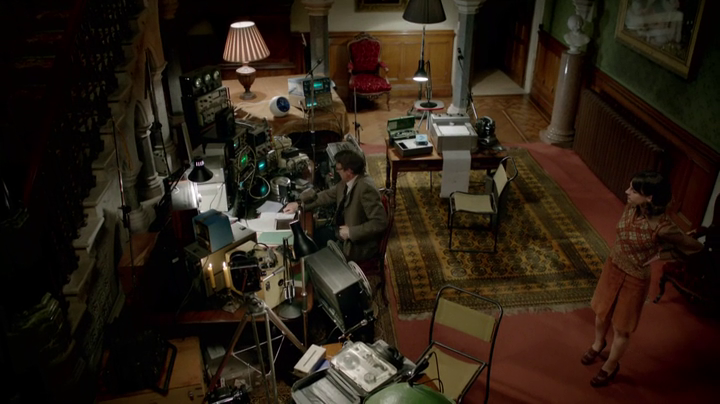
Thursday, August 29, 2013

"Journey to the Centre of the TARDIS"

"If only we could travel space without setting our own ship on fire.
The impossible dream."
It's a mild relief to have a title reference Jules Verne rather than a trashy film for this episode, although it's still pointless intertextuality. That being said, how much despair can we postpone upon realising that this episode is penned by none other than Stephen Thompson, Moffat's go-to guy for pointless filler, in both Sherlock and Doctor Who: moreso than Gatiss, I mean. Apparently part of the premise of "Journey to the Centre of the TARDIS" was Moffat being "haunted" by the poor location work used for the bowels of the TARDIS in "The Invasion of Time." That was because they couldn't get the sets they wanted due to a worker's strike at the BBC. What's New Who's excuse? "The Invasion of Time" is a weak serial, but acting like this dreary corridor stomper is in any way compensatory is to draw a very long bow indeed.
"Tell Murray to drop the tuba and get a microphone!
I had beans for lunch!"
We begin with a huge spaceship vaguely reminiscent of Spaceball One being pushed along by huge thrusters on its front, which presumably burn away the sides of the ship that it's blasting alongside every few seconds. It's crewed by three blokes, one with weird eyes and a barcode, which apparently means he's an android. Alongside the android there's a grouchy guy with a crew cut and a big guy who talks like he has brain damage. The latter two are, apparently, 'equal partners' in some kind of scrap hauling venture where they nab space debris. Things are getting pretty exciting. Meanwhile on the TARDIS the Doctor and Clara are having a tizzy before the Doctor decides to let her have a go piloting the vehicle. We get a very dubious moment where the Doctor smirks upon denying that he's putting the TARDIS on easy mode for Clara because she's female as the Doctor's craft gets identified by the scrappers, who gear up while generic rock music blasts in the background. Somehow they have a device which can shut off the power to the TARDIS and we get some shaky camera, sparks and the Doctor and Clara yelling incomprehensible dialogue at each other while Murray Gold drowns everything in liquid brass.
"Now which one of you fellas wants to shine my shoes, eh?"
The TARDIS gets pulled into the salvage vessel with a big CGI crane down a big CGI corridor, after which it is inexplicably half-submerged into cables. The big one who can't talk properly goes to abuse it with a sledgehammer and what looks like a Dead Space laser cutter thingie but the android objects. "She's suffering," he moans. "I can feel it." Angst so early in the episode, and being deployed via empathetic machinery? I can feel a cringe coming on. The Doctor pops in while these fellas are debating what to do and encourages them to help him rescue Clara, promising the 'salvage of a lifetime' if they aid him in solving the problems caused by their illegal salvaging equipment. Somehow they buy this, just inexplicably believing his 'salvage of a lifetime' routine despite the evidence of their own eyes - a blue box lying in front of them. I would have much preferred had he told them it was a TARDIS and that they recognised the name and decided to go with him for that reason.
"This polystyrene metal is so much more
convincing than in the old show!"
Meanwhile Clara's lying around inside the TARDIS with a burned hand due to some thing she touched before the incident. She decides to get the episode's main conceit going by walking around some corridors. She opens a door to reveal a big explosion rushing forward, which she flees from for about a second before resorting to a light jog - apparently the deadly explosion decided to just give up and go away. Why are the TARDIS corridors so dark? They look boring, scarcely better than the dodgy location footage from "The Invasion of Time" even if they do have strange scratches along the walls. Back in the salvage ship everyone's gearing up. None of these three guys can act to save their lives, it's appalling. Their anunciation is completely toneless and flat, especially the big one. The android even has a bizarre slogan: "No fear, no hate, no pain." Does he need to say that every time he does something android-like? It just makes him sound like a knob. They enter the TARDIS, finding themselves walking on flat ground rather than an angle so they don't have to tilt the camera. I actually didn't mind that idea, really. It's about the best we get in terms of dimensional hijinks in the episode.
Welcome to my nightmare.
Once inside, the Doctor decides to discourage his three new chums from just junking the place by setting the TARDIS to self destruct in thirty minutes if they don't find Clara. Some people I believe didn't like this but I actually quite enjoyed it. It made the Doctor seem suitably dark in a way that having him stare into middle distance with a grim look on his face while Murray Gold abuses the string section just doesn't. Incidentally, I quite like the Smith's costume in this episode where he's eschewed the big purple overcoat. Having the waistcoat as his outer attire actually looks quite snappy, I think, and gives him a bit of an old fashioned adventurer vibe which rubs me up the right way. We go for a trip not very far down memory lane as Clara finds herself in a room full of junk from series gone by, such as the Doctor's alleged cradle from 2011 and Amy's model TARDIS from 2010, along with the rather unrecognisable original Seventh Doctor umbrella, the one without the question mark handle. But oh no! Arbitrary monsters are here! Clara legs it pronto and our attention is returned to the Doctor and the three stooges. The leader, whose name I will look up when I could be bothered, has a scanner that's capable of reading what's in the TARDIS. If the TARDIS is so advanced, how can this thing scan it? Realising its value, he suggests they split up, to which the Doctor gullibly agrees. I'm not sure why the Doctor didn't suggest this himself. What was the point of bringing these three absolute plums along if all they were going to do was wander around in a group?
A six storey library? What other unimaginable
wonders doth the TARDIS hold?
Back in some other anonymous corridors, Clara walks past an observatory and swimming pool seen through windows while her laughter is inexplicably dubbed over the top. This TARDIS interior is completely unambitious. How does this make up for "The Invasion of Time"? It's all just corridors! Eventually she finds herself in a library which she is very impressed by, but upon revelation is many layered and sizeable but not really especially huge. I think it should have stretched off as far as the eye could see. In the console room, the big guy is cracking open the console, and we hear some random voice clips of people like Susan for some reason. The leader chap's scanner detects a door behind which is "everything you could possibly want." This has got to be the stupidest and most unrealistic-sounding thing I have ever heard a scanner say in a science fiction programme. Behind the door is a big droopy tree looking thing with glowing baubles hanging off it which apparently constructs the interior. After the leader yanks one of these bulbs away the door disappears, much to the Doctor's consternation. The android reproaches his colleague, offering the utterly bizarre line "The ship's in torment. You can't hurt it." Which is it? Is the ship or is it not in pain? To which the leader retorts nonsensically "What's the matter, TARDIS? Scared to fight me?" It's this kind of awful dialogue which holds scripts like this back, apart from the general lack of an interesting story. In the library Clara finds a book of Time War history for the sake of some New Who back-story wank, followed by some boring hiding from the returned monster, and the spilling of a bottle which is apparently part of a 'Gallifrey Encylopedia.' It's just random set dressing with absolutely no significance behind it. What's the point?
"The sooner you start cradling them the sooner you can stop."
The TARDIS corridors are changing, Smith's suddenly reserved performance in this episode a relief from the zaniness but serving to make him seem ineffectual and impotent. Clara hurries to the control room, where the big guy falls down a ladder and gets killed by the monster. This whole bit takes ages, incidentally, but can be completely summarised in so few sentences. Upon realising that his brother has snuffed it the leader, whose name I have now bothered to discover is Gregor, figures they just have to get on with the job, much to the consternation of Tricky the android. Is this guy a sociopath? If not that then it's just utter script mediocrity combined with either an incompetent actor or a failure on the part of the director to get a decent performance out of his guest cast. Now it's their turn to get attacked by monsters and run squawking off down the corridors, while we get the episode's next grudging concession to the dimensional potential of the TARDIS with Clara's efforts to leave the console room constantly returning her to the console room as the corridors loop around on themselves. I would have preferred this had it actually shown something beyond, possibly, the TARDIS turning one of the corridors into a ring.
"I nearly had to appear in a cliffhanger!"
One the Doctor and his two remaining plums arrive back in the console room Ms. Oswald is nowhere to be seen, but it turns out that's because they're in an 'echo' of the console room being generated by the TARDIS to protect them. Why is it dicking around changing the corridors then? Clara gets menaced for yet another repetitive time by the monster which she ducks back and forth from around the console like something from a cartoon before she gets rescued by the Doctor using his magic wand, all the while screaming her head off like a lady of the Classic Series, undoubtedly a nod included for the sake of us Classic fans. In true sci-fi comedy tradition the Doctor reveals that the TARDIS self-destruct was a fake. That worked really well in Red Dwarf, didn't it? Shame Red Dwarf isn't Doctor Who, although I'd rather watch Series X than this. As amusing as the Doctor's remarks about the "old wiggly button trick" and the serious voice and face are regarding tricking the plums into helping him, there was much wailing and gnashing of teeth regarding Clara's concerns that "Good guys don't have zombie creatures. Rule one, basic storytelling!" Spare us the self aware postmodern crap. It's as bad as her joke about buying the haunted mansion last episode. This girl needs herself some character-building dialogue!
"We have to go to the most dangerous place in the universe:
Jon Pertwee's eyeline."

It turns out however with all the embarrassing predictability of drunken incontinence that the TARDIS is, in fact, blowing up due to the engine damage suffered at the hands of the Plum Beam from the beginning of the episode. Really? And would that destroy the whole universe again like last time? It'd be more novel to see the TARDIS get knobbed about with if this wasn't the fourth time at least that it's happened in the course of Moff's meagre three series. We get the arbitrary dropping of the episode's title as the Doctor, Clara and their two dead weights determine that they really do need to go to the centre and it's back to the boring corridors again for more stumbling around. Clara observes the Doctor behind her, but it's just an illusion as the TARDIS is 'leaking the past.' The term "Future Echoes" comes to mind for some reason. How is it that New Who is playing with narrative devices done over twenty years ago by Red Dwarf? We get more running around the set from the monster before the Doctor reveals that due to the heat build up from the failing engines the cooling rods are going to start bending. Or at least, that somewhat approximates the bogus explanation for why huge bars of metal start arbitrarily bursting from the walls, one of them penetrating the shoulder of Tricky the android. He stands there insisting Gregor remove his arm and that he feels no pain while he's screaming with the rod sticking out of his army, looking a right wally.
NOT LIKE THIS
At this point the Doctor drops the bombshell that Tricky isn't an android at all, he's just a cyborg. Gregor reveals with all the compassion of a sexually transmitted disease that he and the other one, Bram, tricked him into thinking he was an android as a joke. This absurd plot development, presumably added to derive some pointless angst from the guest cast, is an astonishingly mindless piece of script writing. How could he not figure out he was still human? It does go some way to explaining Tricky's bizarre behaviour, and intentionally or not it does indeed suggest that Gregor's character is just meant to be a complete dick. I hope that's meant to explain his earlier lack of empathy about his wooden brother's demise. This pointless bit of padding dealt with, the Doctor pops into the room they're outside, the engine room or something similar. Gregor establishes that Tricky lost his memory in an accident and that the other two convinced him he was an android to usurp his position as captain. That nonsense is the most realistic explanation about anything we're going to get in this episode. For some reason the Doctor decides that the other three can now follow him in - maybe they get chased in by the monster, I've already forgotten - and they stand around on a gantry between some pits. Off to one side is the Eye of Harmony, last seen eating the Master in the 1996 TV Movie. It's a weird concession to the TV Movie's interpretation which I guess is just another attempt at fan service. So where's Paul McGann?
"And if you listen closely, you can hear some remarks
about dressing for the occasion."
Both doors are now being thoroughly abused by monsters, and the Doctor's revealed that they can't stay in the engine room for long because they'll burn up. Gregor's scanner suggests that the monster behind the door is in fact Clara, and she demands from the Doctor an explanation. He gives her a lot of guff about how "secrets protect us," coming across as really a bit of a conservative tool promoting things like government surveillance in a weird way before revealing that they can't become the monsters if they "break the timeline." Oh good. Much like how a novel sets the future in stone, now touching people does too. The Doctor pulls Gregor and Tricky apart to stop them becoming the two fused monsters at the other door, but one ends up having to rescue the other, they touch and then instantly transform into the monster that was just attacking them. The Doctor complains that they have to stop before "the future reasserts itself." Is the future in the past now? And why did they burn up? If it was the engines, how is Clara still fine? If it wasn't the engines, why does touching cause them to instantly turn into the monster? Asking for explanations is like pissing in the wind: the relief won't compensate for the disappointment, and people will just claim it was a bad idea from the start.
An overplayed TARDIS commercial on Gallifrey.
So the Doctor and Clara hot foot it out of the engine room and find them on an illusory cliff somewhere. He decides that this is an appropriate moment to blow up at Clara, desperate to find out who she is, but she doesn't have a bloody clue, which is exactly what Emma told him last week. Finally realising this after forcing an embarrassing confrontation, the Doctor realises that the cliff is a "snarl." "The TARDIS is snarling at us." Apparently the TARDIS is now a cross woodland animal trying to deter them, but its aggression can be defeated by jumping into the empty air. The Doctor and Clara now find themselves among random bric a brac suspended in a white void like the frozen demolition of some industrial-themed installation art. The unimpressive assemblage of oddball and rather crude metal pieces which we cannot even conceive of as assembling some kind of meaningful heart, 'centre of the TARDIS' or, more generally, goal of the story, shows us how arbitrary and disconnected this narrative has become, where it's possible for Clara and the Smith to move from a gantry next to a dying star to a foggy cliff face to a hallucinogenic junkyard with no genuine impression of movement in story. Like so much New Who it's all just meaningless spectacle and set pieces strung together, where order is barely relevant.
"We can definitely get a whole room in the Doctor Who Experience out of this."
The burn on Clara's hand is revealed to be a message, and having gone all the way to the centre of the TARDIS Clara and the Smith are now somehow immediately back in the console room, the Doctor having had a revelation. What was the point of all that, then? What was the object of this story? The Doctor scrawls a message on the bauble that Clara burnt her hand on in the first place, and there's a 'crack in time' conveniently enough right there in the console room that's just big enough for him to step through. Clara makes a big hoo ha about seeing the Doctor's name in that book from earlier but honestly, who cares. Having passed screaming through the Time Crack the Doctor chucks the bauble to his past self, declaring that "This will reset time!" What? How? The Doctor pushes the literal reset button and we're done. Back on the salvage ship in true Moffat-Who condition the three brothers are reunited with, somehow, vague memories of their life-changing experience such that Gregor treats Tricky with more kindness and we get to see an awkwardly-photoshopped-looking picture of them with their old dad. Back in the TARDIS the Doctor and Clara seem to remember the incident somewhat but conveniently Clara's forgotten the Doctor's name and their confrontation about her identity. While making a bit of general chit chat the Doctor rather surprisingly spanks Clara on the arse with a dust cloth. The end.
"Once I make contact, the infinite time loop of
a gif on Tumblr awaits us."
What the hell was the point of all that? I've absolutely no idea. Reset buttons are, by their nature, bad storytelling: if you can't afford to kill a character, don't kill them. Don't cop-out and try to squeeze through your 'emotional drama' and get character development out of it at the same time. The monsters in this story feel completely needless and their identity is unbelievably predictable for anyone with the slightest awareness of science fiction convention. The three guest actors are wooden and unconvincing with a shallow sub plot that makes no sense and terrible characterisation. The TARDIS is just boring corridors, some CGI backdrops and junk. They spend half the episode wandering around doing nothing. The best part of the episode is Smith as the Doctor, because he puts in a very watchable performance here, but he can't carry the whole episode on his own. I was bored out of my mind rewatching this for the review and, as with much New Who, I'm astonished the script was considered to pass muster. This episode, like "Cold War" particularly, is a pointless piece of filler with nothing approaching an interesting plot or compelling characterisation for anyone other than the Doctor and the unique setting is utterly wasted in predictable, tired corridor stomping that is no better than it was in 1978. At least if you journey with Tom to the centre of the TARDIS you might get a few drinks out of it, and then a few more.

Sunday, August 25, 2013

"Hide"

"This one shows the kitchen, the library,
this one's for the bathroom, your room..."
Doctor Who had a particular penchant for horror during the Hinchcliffe era - that's the most popular period from when Tom Baker was the Doctor, you ignorant pleb - during which there were numerous pastiches of classic horror stories. There were mummies in "Pyramids of Mars", a Frankensteinian monster in "The Brain of Morbius" and creepy dolls among other things in "The Talons of Weng-Chiang." All of these are fan favourites from the period, although the Classic Series did horror at other times as well with varied success. Since the revival the use of horror has largely been relegated to historical episodes, with ghosts, werewolves, witches and vampires all putting in their token appearances. Having apparently exhausted this, the episode "Hide" turns towards pastiche of contemporary horror trends which, after the collapse of the 'torture fest' style Hollywood production line has become very interested in old fashioned ghost hunts, largely motivated by Paranormal Activity and the like. Of course it's Doctor Who so we also have to have some weird barely-scientific stuff crowbarred in as well.
He doesn't like it up him.
"Hide" begins as these things so often do with two people in a spooky mansion full of generic 'beep boop' paranormal investigation paraphenalia. Resident ghost hunters du jour are cute but slightly ethereal young lady Emma and awkward middle-aged man Alec. Something's haunting the house. "She's lonely," Emma announces rather clunkily, bringing us some angst right away. Alec mumbles "Excellent, excellent," sounding weirdly like Rory Williams. Emma reaches out to the spirit in the house with some typical "I am talking to the lost soul" type invocations and the machines stark freaking out, a white silhouette appears and Emma collapses, announcing that the spectre present is "dead." A spirit haunting a house is dead? Strike a light. But wait? Who's that knocking at the door? By this point upon first viewing I was relatively intrigued. The two guests are quite decent, particularly Dougray Scott as Alec, and a haunted house premise is always promising. Then the door gets open and behold, the face of Matt Smith springs into view, observing that the two ghost hunters are, in fact, ghost hunters. "And you are?" asks Alec.
"Ghostbusters!" declares Clara.
Shut up, Clara.
Cue titles!
"The ghosts love it when I do this..."
I've got to admit that I found this opening better the first time, and really the whole scenario is awfully trite by now. One day can't the woman be the technical expert and the man being the psychic sensitive? Having seen too many decent horror films since, such as The Conjuring, I find it hard to get behind this episode. I'm not surprised to learn that Neil Cross, who wrote this and "The Rings of Akhaten", also co-wrote Mama, a spook-flick from early this year that started off as a decent-ish horror film and ended as a rather bemusing horror-fantasy. I remember finding the Smith more annoying in this episode than I did; I can't help but find his "Boo!" moment vaguely funny, but then he runs around all over the place like a headless chicken rattling off info about Alec and Emma and going on about how he likes the word "toggle." Let the actor's performance inform the eccentricities of the character; they don't need to be part of the script. There's been an awful Catch-22 with the Smith where he started as a sort of quirky young-man old-man type figure and now he's scooting all around the place and making absurd statements left and right, like "It's ghost time." Urgh.
Spot the difference.
I like the way Alec assumes that the Doctor is from military intelligence but the way we get a huge backstory dump about Alec is very heavy-handed to inform us that he's a spy, rather than letting it emerge organically over the episode to inform his character development, and the sense of gravitas which was possessed of the first scene is totally diminished by the flippancy of the Doctor and Clara. Clara has this long-winded joke about how bizarre it is for Alec to have gone to the bank and told them he wanted to buy the haunted house and it just emphasises how little there is to her apart from self-referential postmodern navel gazing, which is a shame because I really think Ms. Coleman could be afforded something better.
"These are all the places Steven's been seen not writing scripts..."
Having wasted no time dumping Alec's entire backstory on us the Doctor now does so with Emma, revealing that she's an empathic psychic and that psychics are very lonely and so on. I've heard that there's a "Writer's Bible" for New Who featuring the sacred laws set in stone by RTD at the beginning of time featuring the dos and don'ts of how he thinks Modern Doctor Who must be written. Evidently there is no law stating "Show, don't tell." This episode is just as guilty of ignoring this concept as any which have come before. In the spirit of this Alec gives us the low-down on the spirit haunting the house, a "Caliburn ghast" which features as early as in "Saxon poetry" - something I, a student of Saxon poetry, dispute very much given how utterly little has survived - and that it has a bunch of other typically ghostly names like the "Maiden in the Dark" and the "Witch of the Well." For all of this, Dougray Scott is pretty class as Alec, doing the best he can to make the whole thing seem legit.
"If we get four more we can do a Hannukah special!"
We must thank him for this because it's followed by an incomprehensible scene in which the Doctor encourages Clara to follow her out of the corridor for reasons unknowing while muttering unfathomable suggestions at her. I have no idea what is going on, but watching her accompany the Smith down the spooky corridor holding a candelabra the idea that Clara is the most generic companion ever suddenly springs into my head. There are some stupid jokes as they wander around to eliminate any sense of tension. Back in the other room, Emma wonders whether the Doctor is really a spy. Alec replies that he has the "right demeanour." This should be enough, but then he has to explain it: "capricious, brilliant." Is any of this necessary? He goes on to give a really heavy handed speech about how "experience makes liars of us all" to show that obviously he's got a bad case of romantic feelings for Emma but doesn't want to act on them and son on. This episode is set in 1974, right? And the Doctor told us that Alec served in the Second World War. How old is he? Dougray Scott is 47, apparently, but assuming Alec was, say, 20 when the Second World War began in 1939 that would make him about 55 by the time of this episode, and that's being conservative regarding his age. It just makes him seem implausibly old to me, and certainly a touch too old for the obviously much younger Emma, at least from my fusty old-fashioned sensibilities. I guess that might explain why he's so uncomfortable around her? But it never comes into it. I just think setting the episode in the mid-Sixties might have been a little more plausible.
I know how they felt.
Meanwhile, Clara and the Doctor feel like they're being watched, he draws a chalk circle on the floor which starts steaming for some reason and after they get spooked by something after wandering around some boring and not very scary corridors a giant spinning disc appears out of nowhere revealing to the reunited four characters that the ghost is in a forest somewhere. This incident rather inexplicably causes the words 'HELP ME' to appear on the wall. How did that happen? Afterwards we discover that Emma can't take her liquor and Clara agrees that whiskey is disgusting. Praying for anything to afford Ms. Coleman with some character development I think she should have knocked back a couple of fingers of the neat stuff with satisfaction, personally, but no, they'd rather have a nice cup of tea. Now that I think about it, having the companion chugging down on spirits like a champ would probably not sit well with the show's family-friendly image.
"And these are the pictures from the shower-cam."
In the photo lab the Doctor is still fanning out over Alec and he gives yet another big spiel about how hunting ghosts is the task he's appointed to himself as a response to all the deaths for which he was responsible during the war. Once again Dougray Scott sells this stuff well but it just feels too much like we're getting to read the author's character notes rather than having the character presented to us organically through their actions. In New Who characters just talk and talk and talk and then do whatever the plot demands of them so that there's a character schism between speech and action. We're repeatedly told, for instance, to swallow what a good or bad person the Doctor is while he's doing the exact opposite. It's too clunky for me.
"Now let's have a lovely chat about knitting and making sandwiches."
Back in the study Neil Cross spectacularly fails the Bechdel Test as he has Clara and Emma have a big chin wag about Emma's feelings for Alec and whether there's anything going on between Clara and the Doctor. Clara tells Emma that she's got to get all aboard the Alec train, while Emma for her own part warns Clara that the Doctor has "a sliver of ice in his heart." Where on earth do these writers get their metaphors from? The Hollywood Guide for Maximum Cliché? Observing that the ghost is in the same pose in all pictures, the Doctor whisks Clara off to the TARDIS, which apparently dislikes her in a grudging concession to the ongoing series arc, and then he throws on David Tennant's bright orange space suit following some quip-laden dialogue, investigating the same location on Earth at the dawn of time, the present and the end of the world.
"No, even this won't be early enough for
Steven to get the scripts done on time..."
This brief experience of the entire life of Earth gives Clara the willies, so she complains that the Doctor seems very blasé about the whole thing and how "we're all ghosts to you" and "we must be nothing," to which the Doctor retorts that "You are the only mystery worth solving." It's not much of a juxtaposition of ideas and certainly no real effort is made by the Doctor to contextualise the situation. There's no attempt at, say, comparing the immense complexity of a brief human existence to the vast 'broad strokes' of astronomy at large. It's hardly up there with the Sixth Doctor's speech to Peri about matter coalescing and so on, and before we know it the Doctor's charging back out of the TARDIS without a care in the world. Clara complains to Emma that she just realised that "Everything ends." "Not everything," Emma replies. "Not love. Not always." Are we still harping on about that? I thought she couldn't suss Alec out.
"Can we... switch roles... with you two?"
Anyway the big dénouement comes with the Doctor revealing that the ghost is actually a projection of a woman in a space suit, a crashed time traveller running through a pocket universe where time is flowing much more slowly relative to our own. In this scenario Emma is some kind of "lantern" linking the two, and like an obnoxious lover lurking behind the dressing screen my old nemesis Magic Thinking reveals himself with a triumphant flourish as the science-magic of psychic powers is detailed as a completely adequate explanation for what's about to happen. The Doctor needs Emma's psychic ability to rescue this lost woman, 'Hila Tukurian', who is being pursued by some big horrible gribbly identical, seemingly, to the thing that was spooking them earlier in the boring corridors. The Doctor mispronounces the name 'Metebelis III' of Third Doctor fame, putting the emphasis on the antepenultimate rather than the penultimate syllable, the latter of which he also accidentally shortens when it should be a long vowel, and soon the room is full of more pointless junk. In addition to Metebelis III the Doctor makes a needless reference to the Eye of Harmony and informs Clara that due to the laws of technobabble the TARDIS can't just pop over to the pocket universe because entropy would drain its engines.
"Now tell us why you want to become a model."
I was so bored by this point in the episode that it was a struggle to get through the rest of it. After Alec's had to deliver yet another heavy-handed speech about how Emma should feel no obligation to risk her life to save Hila Tukurian she puts on a stupid helmet the Doctor gives her, talks at the air for a bit and a portal opens which the Doctor dives through wearing a harness attached quite simply to a length of rope, revealing that the 'Well' of 'The Witch of the Well' is a wormhole. So is he saying that at some point before now the wormhole opened in the house, someone saw it and thought it looked like a well? After falling through a generic time tunnel the Doctor lands in a generic mist-laden creepy forest on a dissolving island in space, which is apparently what a pocket universe is like. I would have preferred an area that wrapped around itself or something interesting like that rather than just Discworld.
Thinking of the sweet day when Capaldi takes over.
After running into Hila she and the Doctor run around a fair bit, trying to escape the monster, reaching dead ends and turning around and what not. Why did the Doctor take his harness off? He's lost the wormhole, and it's just pointless time wasting as he tries to figure out what to do next. The plot is really poorly paced in this episode, because by this point it feels like Cross has more or less run out of ideas and is trying to pad the script sufficiently to meet the run time. Regardless, Emma somehow creates an image of the house to help them find the wormhole and Hila escapes, but she can't keep it open any longer and the Doctor gets trapped. Why didn't he just jump on? Get to the point. Now we get more time wasting as the big gribbly chases the Doctor around while Clara chucks a wobbly at the obviously tormented Emma for leaving him behind. She then promptly pisses off to the TARDIS, which despite being locked for some reason activates its visual interface thingie to talk to her, a duplicate Clara appearing. The bit where Clara goes "Whoa" amuses me a tad, but in terms of the overall mood it's all over the place.
The whole episode's budget down the tubes.
Alec gets to deliver yet another big speech, this time to Emma about how she saved him from his dark past. Meanwhile Hila sits around like a plum getting no lines. No effort is made to establish her as a character. After some convincing Emma dons the Truth Helmet again to save the Doctor, but Clara also convinces the TARDIS to take her to the pocket universe somehow. The projection of the house reappears, suggesting that the Doctor probably should have stuck around, and we get yet more time wasting as he tries to figure out where the monster is. "I am the Doctor," he announces, "And I am afraid," in a line of dialogue presumably filmed specifically to be used in the series trailer. He keeps blathering on tediously like this, calling the alien "big boy" and such, until the TARDIS flies in and knocks it away. The Doctor grabs on and somehow they reappear back in the real world in the room with the other three. Did the TARDIS do this by itself, or was Emma's involvement also necessary? It's not clear, nor is it clear that the TARDIS was not present in the other universe long enough to survive. The Doctor and Clara consider it an appropriate time for a high five as Emma writhes in pain on the floor.
"Tennant got away with it, why not me?"
So it's time for all good boys and girls to go their separate ways. It's revealed that the whole reason the Doctor and Clara are present was so the Doctor could have Emma psychically read Clara, but Emma insists that she's "ordinary." No actual progress on the plot arc, then, just pointless teases. Hila reveals that the Doctor can't take her home because "History says I went missing" and it's a fixed point in time. Ugh, again? At least it's not famous past Earth history for once but come on, what a cop out. The Doctor reveals that she's a descendant of Emma and Alec, and that Emma was able to bring the two universes together due to "blood calling to blood" to strengthen the psychic energy or whatever. So, magic, then?
A fangirl's impression of Capaldi.
At the last minute the Doctor realises that the big monster in the pocket universe and the big monster in the house are two different things, a separated couple. We get a very unsubtle line about how "every lonely monster needs a companion" and with all the subtlety we've come to expect from New Who Cross delivers the finishing blow as the Doctor announces that their entire experience "isn't a ghost story, it's a love story." Just about sums up what every genre New Who purports to be and what it ends up being. So the Doctor asks Emma to endure the awful agony of opening the wormhole again so he can rescue the alien, which looks awfully similar to the form of the ghost from Mama in some respects, and reunite it with its lost mate. An interesting twist but crammed in hard at the end.
"Are you looking forward to Christmas? I am!"
To me "Hide" really sums up the weakness that has insinuated itself into the Matt Smith era. There are different kinds of bad episodes: the kind that are full of holes but entertaining for what it's worth, like the finale of Series 5, episodes that are self-indulgent shambles, like most of the arc episodes Moffat writes these days, and episodes like this. "Hide" is just poorly paced and boring. It has some decent ideas going around, the foundations of a good atmosphere and a strong cast, but the writing just isn't strong enough to support it in terms of both the plot and the character development. The entire narrative lurches to a halt about ten minutes in before making strange diversions which are not absolutely necessary. In between these pieces we have huge chunks of exposition, backstory and character explanation dropped onto us like a piano from the twentieth floor. Dougray Scott and Jessica Raine do the best they are allowed as Alec and Emma, with particular kudos to Scott for selling so many utterly leaden sentimental speeches so convincingly, but it's not scary and any sense of tension is ruined by the way the Doctor and Clara are written. In the past, New Series Doctors have made me cringe. Smith these days sadly just makes me yawn. I can predict how he's going to move and what he's going to be made to say or do with utter precision. Jenna-Louise Coleman is simply given nothing. I wouldn't go so far as to say that watching "Hide" is a horrific experience in itself, because that would mean that it inspired more than ennui.

Thursday, August 8, 2013

Broadchurch

Pronounced something like "Brudcharch" in my head after watching too many episodes and mentally assimilating a Scottish accent, I was recently informed of this series and gave it a watch. I went in with absolutely no preconceptions. All I knew was that Broadchurch was a crime drama starring David Tennant. It's been established that I like a bit of crime fiction, but you may be wondering why I would want to watch something with Tennant in given my antipathy for his most famous performance. Before this, however, I had only watched him in three roles. The most recent was the grotesque mishandling of the Doctor in New Who. Before that there was his brief spot as Barty Crouch Jr in Harry Potter and the Goblet of Fire, a ridiculous bit of ham virtually indistinguishable from his portrayal of the Doctor. The earliest thing I've actually seen him in, however, is as humorously mediocre jobbing actor Rob Harker in a memorable episode of Chris Langham's little-remembered mockumentary series People Like Us. I was convinced, having seen this and his guest spots on shows like Never Mind the Buzzcocks and QI, that Mr. Tennant could do more than just portray manic-depressive wackos I wanted to punch in the face. Thus, observing him in action was actually impetus towards watching Broadchurch rather than a problem.
By the end of the first episode I had discovered several things. Firstly was that David Tennant and his offsider played by the dependable Olivia Colman in a surprising non-comedic role were only the most important protagonists of a much larger ensemble piece. The second was that Broadchurch was a show which was focused around the solving of a single crime, and was not the serialised detective fiction I was expecting. The third was that the show was, to my horror, written by Chris Chibnall of all people, that very same mastermind of bad sci-fi writing who is condemned to eternal disapproval for asking pedantic questions of Pip 'n' Jane Baker in the Eighties. All of these things caused me to adjust my preconceptions. The large cast was, fortunately, still grounded in the two detectives, which gave a certain focus to the action. The investigation of a single long-running mystery was I think laboured at times, but it did avoid a Midsomer Murders scenario in which some small English hamlet becomes the biggest crime hotspot in the country. The third helped me understand the source behind some of the melodramatic and clunky dialogue.
The premise of Brudcharch is briefly this: 11 year old local child du jour Danny Latimer has been murdered. New ball-busting senior officer from elsewhere, Alec Harding as portrayed by David Tennant and his permanent five o'clock shadow, has just taken over the running of whatever the detective part of the police service is called in the town where the murder has taken place, a West Country beach destination of all places called Broadchurch. He's assisted by Ellie Miller, Olivia Colman, who was passed over for promotion to make room for Tennant, who's notorious for having bungled a similar case elsewhere. Over the course of the series the digging required to unearth these secrets basically ends up airing all the dirty laundry of this entire community. Also Tennant has a heart condition, is divorced and never sees his daughter, which isn't the most original characterisation ever devised.
So Tennant's the grumpy one who occasionally doubles over clutching his chest, Olivia Colman's the frustrated local who's having her trusting nature and naïveté stripped away by the investigation, and the rest of the town is a hotbed of dark secrets, where true to the conventions of 'edgy' modern storytelling 'dark secrets' basically means that every second inhabitant of the town is some kind of sexual pervert - as opposed to the other kinds of perverts, I guess. So there's the people having affairs, the people who had or are having underage liaisons, the people who abused children and so on. One of them used to be an alcoholic, that's about the extent of the variety as far as it goes. It's an incredibly Freudian account of the conflict between human nature and laws and social norms. While it's fine to explore these issues, the things Tennant and Colman unearth are so single-mindedly sexually pervy in nature that it becomes almost absurd, especially as the middle episodes devolve into a series of red herrings involving people needing to be plied to provide alibis because they're covering up some dodgy secret from their past.
I think if I'd been watching Broadchurch from week to week I would have become frustrated with it, but fortunately I was watching in a few big blocks so I didn't become bored or frustrated with the pacing too much. The biggest problems are, as I've stated, the monotonous nature of people's secrets, the meandering investigation and an occasional bit of scripting awkwardness where characters have to deliver lines or perform scenes which are clunky, unrealistic or serve no purpose. For instance, in the first episode, there's a bizarre scene where David Tennant and the Chief Superintendent stand around on a pier eating soft serve ice creams for some reason. People regularly meet up in the most picturesque location possible only to tell each other that they need to go somewhere else. At the start of one episode David Tennant experiences a somewhat pointless dream sequence where he's yelling at several suspects standing on the shore. The direction also has a tendency to employ heavy slow motion to exaggerate moments of suspense and pathos, which was particularly flawed in the finale when it was used to drag out the revelation of a killer whose identity had become staggeringly obvious by the end. There's also this stupid sub plot involving a guy who claims to get psychic messages who seems to be afforded way too much attention in such a notionally realistic drama. I never understood why David Tennant didn't just throw him out of the police station after he first mentioned it. It's a few schlocky moments like these which occasionally let the story down a bit.
I did, however, find Broadchurch a decent watch. The mystery of the town's inhabitants did keep me going, and especially, of course, the mystery of the killer's identity, which takes several twists and turns even if they do end up almost always just involving someone obfuscating the truth to disguise some other, unrelated obscenity in their own past. The performances are generally strong, particularly from Tennant and Colman. I found Tennant especially watchable, in fact, and found his portrayal of the relentlessly dour, blunt and brooding DI Harding to be a welcome relief from my mental image of him running around and gurning like a maniac. Olivia Colman's good too, especially when the character is forced to confront some rather serious revelations at the series' conclusion, and the rappor between Tennant and Colman is strong. The other townsfolk all get the job done, with special mention worth being afforded to the family of the murdered boy who do a pretty convincing job of conveying the shock and grief one would expect to be associated with this situation. An extra special mention must of course be given to the ever-reliable Arthur Darvill as the vicar, who brings a standard dose of comedy awkwardness mixed with a portrayal of unexpected conviction and strength of character.
I suppose now the question is: would I watch the inevitable second series of Brudcharch? The answer to that question at present is yes, as long as it still had David Tennant in it, as unbelievable as those words seem, and preferably the Tennant-Colman dynamic without too much baggage. There's a weird moment in the series where David Tennant tries incredibly ineptly to proposition his hotelier and to my immense relief she turns him down. Writers need to understand that I, the viewer, immediately lose all empathy for these kinds of mysterious solitary protagonists as soon as they start getting their ends away. Chibnall dodged the bullet there. Keep Tennant as a guy whose main concern is the job. So yeah. That's Broadchurch for you. Not the most amazing TV I've ever seen but I've watched much worse, and especially from this writer and some of these actors too. If you don't mind a bit of character-driven detective drama, can handle some incredibly uncomfortable taboo storyline elements usually involving children and underage goings-on and don't mind a show where, in spite of the aforementioned story, on-screen there's no sex and very little violence, it might be your cup of tea. I really think this actually explains a good deal of why I enjoyed it. I did think it was trying really hard to make me cry at a few points (good luck with that) but exploitative slow motion and music aside it didn't muck about with pointless titillation. So to sum up, Broadchurch helped to remedy my mental image of David Tennant as an actor, and that's probably a good thing.

Tuesday, July 30, 2013

"The Cuckoo's Calling" by "Robert Galbraith" aka J.K. Rowling

I love Harry Potter. I'm not afraid to admit that. I've read all of the books countless times and I consider myself something of a reasonable authority on the subject of Wizarding lore. When The Deathly Hallows was published I found it to be a satisfying conclusion, and I have no reservations about saying that I enjoyed J.K. Rowling's fantasy series from beginning to end. I would have been curious to read more by her, but it wasn't until 2012 that The Casual Vacancy arrived. It had been five years since Harry Potter had reached its close, I had a fair bit of other reading going on and I wasn't especially interested in what I heard about the book so thus far I have not read the latest publication by J.K. Rowling under her own name. When it was recently revealed, however, that she had pseudonymously published a detective novel under the pen-name 'Robert Galbraith' I was intrigued for a variety of reasons.
The first would be that I enjoyed J.K. Rowling's work in Harry Potter as genre fiction. Detective fiction is another genre which interests me, although I'm mostly just a diehard for Sherlock Holmes stories. I already consider Rowling to be, therefore, a strong genre writer, so as such I was more interested in The Cuckoo's Calling than I was in The Casual Vacancy. The second reason is that as much as I like detective fiction I don't read a great deal of it, so it would be a welcome change after completing A Tale of Two Cities, which was good, but extremely heavy. I was in the mood for something a bit fluffy and lightweight, which I could predict that The Cuckoo's Calling would be. Finally, I was keen for something of a page-turner, which is what I got.
As I've established, The Cuckoo's Calling is not some heavy piece of literature. It's unashamed genre detective fiction, and no worse off for that fact. It doesn't have as much to say, nor the dense plot of Harry Potter, and even in comparison to that it's not as involving. It's just a good mystery. Our detective du jour is the implausibly-named Cormoran Strike, an ex-army private eye who's down on his luck. He's hired to investigate the mysterious alleged suicide of a supermodel, and off we go.
I needn't go into the plot in any detail. As is standard for modern detective fiction there is an expanding web of intrigue and deceit which must be unravelled by Strike and his temporary secretary Robin, featuring plenty of scandal and derring-do. The novel makes an interesting exploration of the superficialities and hollowness of the wealthy and super-wealthy classes, the abuse of privilege and the responsibility or lack thereof in the hands of modern media. Strike is the outsider in this system capable of moving between classes in order to better interrogate their relationships while he is more literally questioning his suspects. It's a fairly merciless portrayal of the wealthy in particular, although it casts a critical eye on people from all walks of life. The parallel of Strike's personal history with the case under investigation goes a long way towards establishing this theme, although it would take more time and energy than I'm willing to devote at the moment to provide a substantial reading of the kind of arguments it is making about fame and fortune.
If I had been given this book before its author was revealed and had been informed that it was an author I'd already read using a pseudonym I don't think I would have struggled to guess that it was Rowling. Not unlike Harry Potter with swearing, the general tone operates on a scale from whimsical to snarky without ever descending into entirely cynical or harsh territory. The prose is rarely difficult or dense and generally feels consistent with previous writing, even lacking, I would argue, a good deal of the bleakness of some of the later Harry Potter novels. One thing I found somewhat noticeable was Rowling's predilection for describing her characters in great detail and, in some instances, fixating on elements of their appearance. I sometimes felt like I had a much better idea of what characters looked like than who they necessarily were as people. Strike is perhaps the exception, although I personally felt like I didn't have as firm a grip upon him as I would like, occasionally feeling more like the plot-driver with an unpleasant backstory. Robin was perhaps a little stronger in this regard, although in general Rowling makes some of her points more explicitly than others. Robin's desire to continue working with Strike, for instance, is made abundantly, even unconvincingly clear. We don't see why she puts up with her fiancé, on the other hand, who comes across as an unsupportive grump.
The plot is largely a sequence of conversations, Strike interviewing more and more witnesses and suspects until he discerns the truth, and in that regard it can feel a little repetitious at points, if not altogether unusual for detective fiction. It moves along, however, at a decent pace, and there are numerous minor mysteries which more or less combine to form a cohesive whole.
I enjoyed The Cuckoo's Calling and it's largely for that reason that I don't feel the need to go on and on about it. Personally I think it's more or less as readable as Harry Potter, if not necessarily as imaginative, and that fans of Rowling's previous work might enjoy it. It's no masterpiece but in terms of giving me a few days' worth of decent entertainment it got the job done. A sequel is already on the way, I believe, and I for one will be interested to read another adventure featuring Cormoran Strike.

Tuesday, June 4, 2013

"Cold War"

"One push and all Classic Who fans will be eliminated..."
Given that RTD was in charge first to reintroduce the biggest Classic-era villains, but only resurrected the Sontarans and the Nestene and Autons from the remaining stock of recurring villains, it's been left to Moff to bring back the leftovers of the somewhat-known opponents of the Doctor, first with the Silurians in their rather bizarrely mammalian offshoot in Series 5 and now with another race of reptile rapscallions, the Ice Warriors, last seen in 1974's dreary Third Doctor shameless rehash serial "The Monster of Peladon". This was a laboured plodder which was a sequel to an excellent earlier Third Doctor adventure, "The Curse of Peladon". One of the many things which made this serial interesting was that the Ice Warriors, who had appeared as enemies to the Second Doctor in two serials, "The Ice Warriors" and "The Seeds of Death", were revealed in a twist to actually be on the same side as the Doctor in the original Peladon story, despite his mistrust of them. "The Monster of Peladon" undid this clever character development by reverting them back to being the villains, although this was explained in a bit of cop-out dialogue as being only a rogue element of the Martian military with most of the Ice Warriors, off-screen, still firmly on the side of good. It's a mediocre story and the last we see of the Ice Warriors until now, where apparently after much pleading by Mark Gatiss they're finally returned to our television screens. Let me give you an episode pitch for an Ice Warrior story we could have had but which the New Series would never bother to do in a million years: Clara wonders if humans ever colonise Mars; the Doctor endeavours to show her, but arrives either too early or too late during a period of Ice Warrior supremacy. The Ice Warriors are under attack by some enemy whom the Doctor has to help them defeat. We get an alien but not too unfamiliar location, some action and some discourse because the big green guys are now the friendly locals in need of help. Too easy. Shame we got this instead.
"I have ssslept for thirty-nine yearsss.
Where is Missster Pertwee?"
We find ourself on a Soviet submarine where everyone speaks the Queen's English in pleasant regionless accents; the Captain announces that they're about to destroy the world when he's interrupted by an old man loudly singing Ultravox's "Vienna" along with his casette player. It's the Eighties! It's the Eighties, everyone! There were nuclear tensions and cheesy synth pop in the Eighties! I can't hate Gatiss for some reason, possibly because he still feels like he's somewhat trying even though he rarely succeeds, but he writes with all the subtlety of a kick to the crotch. Turns out this apocalyptic moment was just a drill, which the lieutenant demands be repeated so that the crew can be as prepared as possible; lots of very ham-fisted dialogue gets tossed about between him and the captain about NATO "sabre-rattling" and "American aggression". The captain has the big beard so that you know he's the sensible one; the lieutenant has the stupid pointy sailor hat and smug bastard face so that you know he's the smug bastard one. He does remind me of a Classic Series obstructive secondary antagonist, but after voicing his opinion he flounces off in a huff. The captain asks the old man, a professor, about a block of ice on board, speculating that it's a mammoth. Cut to another room containing a man-sized block of ice with a visibly anthropomorphic shadow inside. How could anyone think that was a mammoth? The nearby sailor decides to not wait until the return to Moscow; he's just going to disobey orders with no motivation and unfreeze whatever this is now. Predictably enough, it reaches out and grabs him. Serves him bloody right. What if the episode had begun in Moscow with an Ice Warrior freshly defrosted and at risk of causing an international incident? I suppose that wouldn't be enough of a boring base-under-siege story, for which the politically correct term is "homage to the Troughton era."
When this sub's a rockin.
After the title sequence the Ice Warrior starts wreaking havoc, as they do. It's a reasonably conservative costume update as they go, rather sleek and suggestive of reptilian armour as opposed to the hairy green coconuts with arms and legs of yesteryear. It also lacks the classic LEGO man hands, now having a couple of big chunky fingers and a thumb like a Sontaran. While it's true that the classic Ice Warrior design would, sadly, be too 'rough' for modern audience consumption, this is a more genuine visual update than that which was afforded to the Silurians (with breasts and human faces), the Sontarans (baby-blue action figure armour and, again, human faces) and the Cybermen (don't get me started), still being evocative of the original design in regards to the segmentation and especially the helmet; it's largely the texture which is different. Put simply, it could be a lot worse, and sells the idea of a big green Martian soldier with red eyes as something impressive. Hopefully kids like it; it does look like a bit of a big toy. It's also voiced by Nick Briggs. Does he have to do all of them? In a shocking coincidence, just as this Ice Warrior's gone on the loose the TARDIS materialises exactly on the bridge of the submarine. Why couldn't it have landed on polar ice where the sub was resting or something? It's a particularly implausible entry for the Doctor and Clara, who burst out expecting Vegas. The Doctor swiftly earns the Captain's trust because the sonic screwdriver somehow magically tells him that the sub can still be steered laterally despite its sinking, and so the little model submarine in Gatiss' bathtub can be awkwardly brought to rest on a nearby rock formation like it's being dangled on a fishing line.
"You refuse to talk? The periscope colonoscopy it is!"
The Doctor needlessly gives Clara a brief run down of the period, with nuclear tensions, tacky fashion and so forth, remarking that "it's the Eighties, everything's bigger." Someone needs to print the words 'show don't tell' on a billboard and hang it outside these writers' houses. The Doctor gets searched and in the vein of Tom Baker et al has a load of random crap in his pocket like a Barbie doll and some toffee apples. Then the TARDIS pisses off for no particular reason and Clara rather arbitrarily passes out as the submarine chucks a wobbly. When she comes to she's in the corridor, but apparently no time has passed because they still haven't figured out that there's a rampaging Ice Warrior on board until he comes into view during a corny sequence where the Doctor has his back turned. Prior to this, however, he abandons all pretense due some waffle about not having the stupid psychic paper or whatever and blatantly tells the Captain "me and Clara, time travellers." Plot expediency is the order of the day, apparently, and the Captain swallows this without excess fuss. Now the Ice Warrior's in view. "It never rains, but it pours," the Doctor remarks, which inadvertently lampshades how absurdly contrived this whole scenario is. Forty-five minutes feeling a bit tight? The Professor reiterates that he thought he'd found a mammoth. Doesn't say much for Soviet qualifications. The Doctor replies that it's not a mammoth, but an Ice Warrior. Isn't 'Ice Warrior' technically an old standby term for them? Shouldn't they just be referred to as Martians?
"Tell your parentsss that I only cossst sssix
poundsss ninety-nine on the BBC online ssstore..."
It's believed that this particular Martian has been frozen for five thousand years; quite a rest. The Doctor makes a valiant effort to negotiate, which I don't object to, until the Ice Warrior reveals himself as a certain Grand Marshal Skaldak. Why does he look like an ordinary Ice Warrior soldier, then, rather than one of the 'Ice Lord' type characters with the bigger helmet, cape and what not? Anyway Skaldak gets zapped by the generically evil second in command, Stepashin, with a cattle prod. "You idiot," the Doctor complains. Smashing dialogue. The Smith reveals that Skaldak is a warrior of fearsome reputation, attributing loads of lame pseudo-medieval-sounding titles to him like "Sovereign of the Tharseesian Caste" and "Vanquisher of the Phobos Heresy", honorifics which could be held by any character in a pulp fantasy novel, and yes, I know Phobos is a moon of Mars. The Doctor demands that Skaldak be locked up. Why couldn't he be a nice Ice Warrior? Why couldn't he be "Grand Marshal Skaldak, Defender of Innocents and Founder of the Martian Institute for War Orphans"? But no, you need a nasty monster or else you can't have fight scenes. Skaldak regains consciousness chained up in the torpedo room I believe, complaining about his five thousand year nap. I wonder if he thinks it's five thousand Mars years, which is somewhere along the lines of nine thousand four hundred Earth years, Mars taking not quite twice the time to orbit the sun; he could have an even worse impression of the time scale. These are the kind of questions with which my mind occupies itself while watching boring New Who.
"Episssodesss two and three ressstored with animation?!?"
So the Doctor explains that the Ice Warriors are a bit cybernetic, their armour keeping them nice and cosy on their cold homeworld, which I believe is a new idea of Gatiss' invention which may explain why Skaldak's less of a large tropical drupe than we're used to. The Doctor makes a point of Skaldak being particularly dangerous. We keep hearing about the nuanced, complex culture of the Ice Warriors but we never see enough of it, just being teased by it during the episode's many meandering conversations. This one includes Clara wondering about being able to understand the Russians. Isn't she surprised that she can understand Skaldak, who's presumably speaking a Martian language? Incidentally, how can the Russians understand Skaldak? Did the TARDIS get them in on the translation circuits too? Does it just translate for any Johnny who's been near it recently or who's involved in the plot? Stepashin's having none of this waffle; he wants to act, believing it all to be a Western conspiracy. "The Cold War won't stay cold forever," he remarks. That's a serious piece of dialogue. He really comes across as unnecessarily, arbitrarily sinister, before once again flouncing out of another of these awfully roomy submarine chambers. The Doctor claims that the attack on Skaldak was a declaration of war, and that since he's sending a distress call to his Martian chums they need to talk to him, but everyone around are soldiers with whom any self-respecting Martian would not converse. The Doctor suggests going in himself, to which the Captain suggests that Skaldak would recognise him as a soldier too. Oop, suggestion that the Doctor's got a bit of a dark side! How confronting!
"Doctor, all this ham is giving me a heart attack."
We get a terribly cliché 'bicycle joke' as the Doctor flatly refuses to send Clara, the only "innocent" in the vicinity, to communicate with Skaldak, and guess what happens? We smash cut to her entering his chamber to do just that. It's very reminiscent of the plot of "Dalek", although as I recall Rose's encounter with the Dalek in that episode was largely accidental. I can't remember, to be honest, and I'm not going to look it up because I'd rather drink acid than rewatch parts of an RTD episode to try to figure out plot flow. A lot of people have complained that "Cold War" is a rip-off of "Dalek" but to be honest I think it's only in terms of a few set pieces rather than details. Clara has to recite a lot more pulp fantasy bollocks to Skaldak, like "by the moons I honour thee" where Skaldak complains that he shouldn't be chained up if he's not their enemy, which is a fair point, and only further emphasises how stock and unambitious this plot is. I do, however, think it's a wee bit cute when Clara does the Martian salute. Then Skaldak gets to have a Swords 'n' Sorcery rant about being "Fleet Commander of the Nix-Thassis" and how he "Sang songs of the old times, songs of the red snow." Um, okay? Do people realise that having characters reminisce about made up stuff usually sounds really cheesy, and especially cheesy if it's dressed up with some really generic poetic imagery? Starting to turn into little more than a scaly green Klingon, he gets himself really worked up, having a big cry about his long-dead action girl daughter, while the Doctor hastily reassures him about how "Your people live on" all over the galaxy and how "Mars will rise again." That sounds cool. Why couldn't we have seen it? Why are we stuck in a Soviet submarine with a bunch of two dimensional supporting characters?
"Is it not true that you feel nothing but the deepest,
blackest rancor for that walking vomit stain the world
calls Arnold Rimmer?"
 In a surprise twist that's about as shocking as someone rubbing their socks on the carpet and zapping you Clara discovers that Skaldak's vacated his armour, swearing revenge on the belligerent earth folk: "By the moons, this I swear." He sounds like an Asterix character, by Toutatis! He sweeps by Clara and the others unseen, their horrified expressions meant to fill our minds with wonder at what nightmarish creature might inhabit an Ice Warrior's scaly carapace. The Doctor deduces that, receiving no reply to his distress signal, Skaldak has assumed that his race is dead and, very originally, he has "nothing left to lose", suspecting that he's going to use the sub's missiles to start a nuclear war on the dance floor to wipe out all life on Earth. Bit of an overreaction isn't it? Meanwhile, Stepashin's sulking when his head and shoulders get groped by the big rubber hands of doom. Obviously it's meant to be scary as we're teased by the unseen presence of Skaldak, but it just looks ridiculous. I hope there was a guy squatting behind him with those two things on sticks. They remind me of the claws of Rimmer's self-loathing monster from the Red Dwarf episode "Terrorform", but that was an intelligent comedy. This just makes all the jabs about 'wobbly props and tin foil' look hypocritical. On the bridge, the Captain helpfully tells the crew that given the sub's damage they're probably all going to die, but nonetheless they need to help him avert a nuclear war, the prevention of which they now have no stake in due to the apparent inevitability of their watery demise. Frankly, I would have saved that part for later. Stepashin, like all good nasty second in commands, suggests an alliance to get war started on earth again, claiming that "we're both warriors." I always hate this kind of characterisation. He then goes on to explain the concept of the Cold War and Mutually Assured Destruction for Skaldak and the thickies in the audience.
"Massage the shampoo into the scalp..."
Back on the bridge the Doctor tells Clara that "history's in flux, it can be changed," to explain how a nuclear war could occur. Apart from those bloody fixed points in time, huh? They split up to hunt down Skaldak, the Doctor gets the god damn sonic screwdriver back, and the Professor suggests they all sing a song: "Do you know 'Hungry Like the Wolf'?" he asks. "Duran Duran." For god's sake Gatiss, we get it! I don't mind Clara's remark that singing would help "If this was Pinocchio," but it comes at a price: this scene is followed by a maddeningly cliché horror set piece where one guy waffles into middle distance obliviously while his buddy is yanked into the ceiling by the big rubber hands of death. Upon discovering their hideously mutilated corpses the Doctor observes that Skaldak is being "forensic", discovering human strengths and weaknesses. Doesn't he just want to blow them up? While the Doctor's arseing about not doing very much as far as I can tell Clara chews the fat some more with the Prof. "Clara, what is it?" he asks her, apparently concerned despite his complete lack of inflection and the fact that Clara doesn't look especially distressed. It's a rare moment of understatement which goes too far in the opposite direction. Clara observes that seeing the corpses of the murdered sailors makes everything seem real. That's because someone actually died in Steven Moffat's New Who!
"You're the one that I want, one that I want,
Ooh hoo hoo!"
Skaldak's not the only one snaking around like a slippery reptile man; Matt Smith reappears and slides down corridors on his soles like he's about to burst into Jerry Seinfeld's apartment, still searching. It's a good thing this sub has really quite large corridors with separate crawl spaces for the alien to scoot around in. There's a bizarrely awkward conversation between Clara and the Prof where he demands to know if Ultravox split up, regurgitating the same joke for the third time, and Clara now gets grasped by the rubber hands of destruction. The Prof, luckily, is a fast-shootin' Tex who gets her out of hot water only to get his own head grasped. The Doctor shows up as Skaldak observes that "Martian law decrees that the people of this planet are forfeit." It's very similar to the Atraxi's whole "the human residence will be incinerated" thing from "The Eleventh Hour". Skaldak has to have a huge nihilistic breakdown because that's what you do when you're a New Who baddie. As he laments that there's nothing left but his revenge it can be observed that he's a big shadowy frog face hanging from the ceiling. The Captain bursts in insisting that "I will do whatever it takes to defend my world." Like with the whole time travel issue, he's unrealistically accepting of the cosmic scale which has suddenly been taken on by events. The Doctor tries to calm everyone down, reminding them that they need "jaw-jaw, not war-war", a quote immediately attributed to Churchill because New Who can't resist passing off explaining how clever it is.
"Don't worry, Chief, I'm always on duty."
Along the theme of people bursting into the room, Skaldak's armour lumbers in for a third dramatic entrance, directed by remote control. "Sonic tech, Clara," the Smith explains. "The song of the Ice Warrior." What? What song? His sonic control? Why does everything always have to be explained with amateurish faux-poeticisms? Every single time! Incidentally, why did they waste this really quite decent Ice Warrior costume on an episode where the Ice Warrior doesn't wear it for half the run time? Skaldak heads for the bridge, declaring that "now there will be a second red planet." Surely as a Martian he'd recall that Mars is really a sort of brown? "Red with the blood of humanity." Oh, really? I thought you were going to paint everything. Skaldak is much more effective in his chunky armour charging down a couple of hapless sailors with AK-47s (in a submarine?) than he is as a pair of big rubber hands and a shadowy frog face in the ceiling. It's a real missed opportunity. Once he's on the bridge, you might find yourself wondering how he'll activate this primitive alien technology, especially with his big chunky fingers. Well fortunately for him he has some telescoping Go-Go-Gadget tendrils which emerge from his fingertips perfectly capable of hijacking an 80s Soviet missile sub's firing system. The Doctor catches up and berates Skaldak for judging the innocents of Earth and suggesting he show the honour of mercy, or he'll use his screwdriver to blow up the ship. "I'm a TIME LOOOORD!" he yells dementedly, putting weird emphasis on those two words. "I know a thing or two about sonic technology." I thought sonic stuff was more a speciality of his, not a general Time Lord trait. They're not... 'Sound Lords'. To show that he means business the sonic screwdriver glows red at the end. How imaginative.
"Now if you'll excussse me, I need to appear
in a generic video game cutssscene..."
The Doctor demands that Skaldak look him in the eye, and so the Ice Warrior turns and confronts him, his big toothy frog face plopping out of his tight fitting helmet for pure shock value I suppose. The design's neither here nor there, although I think it spoils the illusion, but at least he doesn't have a human face. I kind of never distinguished between the helmet and what might be underneath; it's still reminiscent of how the Silurian snake faces were just masks. Clara questions why Skaldak didn't kill the Prof at her suggestion, implying that she reminds him of his daughter. Just when it's deeply unclear whether Skaldak's going to kill everybody or the Doctor is a magic beam of light lifts the sub all too rapidly to the surface, where it now sits despite the fact that it was sinking before, having smashed through the ice unscathed. The Martian ship has a rather eccentric design, with lots of silver and purple. I was expecting green. Skaldak teleports away, Clara sings a snatch of "Hungry Like the Wolf" for some reason and, in a display of mercy, our resident Ice Warrior deactivates the missile system. Clara gives the Doctor a hug and they all go up to the conning tower to stare at the ship. The TARDIS has relocated to Antarctica apparently, as a result of the HADS, or 'Hostile Action Displacement System', a concept not mentioned on TV since 1968 in "The Krotons"; just a pointless Classic reference. The Doctor asks for a lift, the Captain cracks up like it's the end of an Eighties cartoon, the Smith salutes the Martian ship and it pisses off. That's it.
This should have been a giant flying Ice Warrior head.
I barely even know how to describe "Cold War". It's a pointless episode where nothing happens, serving only to resurrect the Ice Warriors in a form presumably intended to sell action figures. The submarine crew are all complete cyphers with no character beyond some incredibly simplistic traits: Stepashin's a bastard who gets killed off halfway through, the Captain's mostly reasonable and the Prof's an eccentric who likes stereotypical Eighties music; that's all there is to them. I don't object to Skaldak being talked out of his plan because it's nice to see an antagonist with something approaching a conscience, who doesn't get blown up or kill himself by the end of the story, but there's a severe dramatic imbalance in the fact that he's never taken to account for the many lives he takes over the course of his unarmoured escapades; the Doctor even salutes him at the end. If he hadn't killed anyone it'd be fine, but it seems like the Doctor takes an uncharacteristically utilitarian approach, implying that individual lives don't matter in the face of nuclear catastrophe. That might almost be justified if it was suggested in any way through dialogue, but the Doctor pays almost no attention, in contrast to, say, the incident in "The Beast Below" where he thought that making the Space Whale into a vegetable was the most vaguely acceptable option, if still a bad one. Here, the Doctor calls Skaldak's bluff about wanting to annihilate humanity, but he never suffers any retribution for the actual murders he committed. No one seems to care about Skaldak's victims apart from a brief, awkward moment with Clara which is focused on her shock, and to me that's the episode's greatest flaw. That's on top of the fact that it's quite simply boring and unimaginative, a base-under-siege tale we've all seen a million times before, and it feels dull, stale and needless. I daresay the budget would not stretch to more than one costume, and so they made a weak compromise leading to a mediocre story. They could have done so many interesting things to bring back the Ice Warriors. This generic piece of cliché, which no writer should have been able to compose without realising its utter imaginative and dramatic bankruptcy, binning it and starting again, was not one of them.