Sunday, August 28, 2016

Red Dwarf V Episode 5: "Demons & Angels"

Arguably the weakest part of Series V, "Demons & Angels" is nonetheless still a funny episode with some strong effects and costuming work and amusing performances. As I believe has been pointed out elsewhere, one issue is that the episode tries to get through two whole sets of "alternate personalities" for the characters in the space of half an hour. Admittedly it does a surprisingly good job of this, perhaps largely because the "high" or "good" versions of the characters are so homogenous that their personalities are all more or less the same. The show really shines through the diversity of the "evil" characters introduced later in the episode. Perhaps the other issue with the episode in general is just how "magical" the entire scenario is, with good and evil qualities being extracted from the original source somehow. What defines "good" and "evil" and how would a machine be able to separate the relevant components? It's a bit arbitrary. In some respects this plot device reminds me a little of "Timeslides", which also has a quite ad hoc approach to its core concept, especially because the triplicated objects are revealed part-way into the episode to have a limited lifespan, conveniently adding another threat to the story.

The joke that I primarily think falls flat is Rimmer's "Dorksville" gag early on, which is pretty weak. The rest of it is pretty strong; I like the way Cat runs in at the end of the scene to encourage them to do the "Awooga Waltz" and the way Lister says the chances of Red Dwarf exploding are "one in... one" as it actually does explode. The way Rimmer mocks the others with "Okay, homeboys, let's posse!" is a funny reflection on the way the other characters act at times in Series III to V, taking the piss out of stuff like "the Red Dwarf shuffle" of "Backwards". There's another Pot Noodle joke in this episode as well, much like "Marooned". Rimmer's explanation for why he thinks Jesus was a hippy amuses too: "He had long hair; he didn't have a job. What more do you want?"

The High characters are funny when they do the dance sequence, and I've always enjoyed the hopping walk High Rimmer and High Kryten do out of the bunk room, but their mindless optimism later in the episode becomes a bit repetitive after a while as they are all easily killed off. It's not quite clear why they lack the intelligence or common sense of their counterparts; is the implication that this is a "Low" trait? Still, there's a good laugh from this after High Kryten gets shot and, as he's dragged away, exclaims "He accidentally shot me five times! Oh how I love him!" As I said, the dance sequence is also a top moment, especially when High Cat jumps in with his hand to his ear. The way Danny John-Jules says "No part of me would ever be seen alive in sandals," is really funny for some reason; the delivery more than the line. Low Rimmer is another classic element, especially "And then... I'm going to have you." The title of the horror film "Die Screaming With Sharp Things In Your Head" is memorable, setting up a recurring joke of ludicrous horror film names in later episodes, although I find it weird that Lister's love of horror movies is seen as a "low" trait. It's also interesting to note that "Weapons Magazines" are among the Lows' inventory, a suggestion which I'm sure would piss off some viewers. I've always liked the way Kryten says "Cinema hot dogs?!"

The remote-controlled Lister sequence is a good bit of action, and the delivery of "Look out, I'm gonna kill ya!" has stuck with me for years. More could possibly be done with the spinal implant gag, although it might get annoying after a while I suppose. Of course the instant it comes into play at the end, the nerdy part of me thinks "How would it work if Lister sat on it?" It's also a rare moment of the Cat and Rimmer sharing a joke. At the end of the day I do think "Demons & Angels" has a few issues in terms of what it's trying to do. The strengths are found not just in the jokes but in the costuming of the different versions of the characters and the set-dressing used to differentiate the different versions of the ship. It's worth noting that this is one of the only times the bunk room set is used in Series V, and as with "Quarantine" it's not used as itself. Perhaps the overall issue is that it adds one too many "alternate versions" of the characters, given that an alternative Lister and Kryten appear in "The Inquisitor" and more interesting and memorable versions of the main characters would appear in the next episode.

Red Dwarf V Episode 4: "Quarantine"

The birth of Mr Flibble. "Quarantine" is very much an episode in two halves, the first feeling more like a horror show than anything else, with the second half going more for straight comedy. Dr Lanstrom is effectively unsettling, and I like the exchange about how they never meet anyone who is nice or who can shoot straight. This is also the episode that first proposes that Kryten is not actually an android butler but rather an android toilet cleaner, and reflects on the idea of his becoming, due to his bravery and scientific expertise, the effective leader of the team, which rankles upon Rimmer. I wonder if aspects of this characterisation were dropped in later series, in favour of making Kryten more interested in domestic activities and more fussy and short-tempered, in order to avoid him becoming too heroic a character and therefore not conducive to good comedy.

The "We're going to... live" line is funny, as is the speech leading up to it. I also like that this episode, much like "The Last Day", features a brief bit of Chris Barrie impersonating Robert Llewellyn-as-Kryten when Rimmer says "Space Corps Directive". I have to admit, the first part of this episode does contain some material which isn't terribly funny, largely Rimmer calling Kryten names and being deliberately difficult over the radio. The best bits in my opinion are Lanstrom's lines, particularly her first one: "Schopenauer said 'life without pain has no meaning'. Gentlemen, I wish to give your lives meaning." We get some more good bits later, including Lister imagining vultures reading 'What Carcass?' magazine and Rimmer's "I hope the next eighty-four days pass as swiftly and pleasantly as the Hundred Years' War." A similar joke is used in Series VI's "Rimmerworld". I note that Rimmer says he's going to play them music by "Reggie Dixon", while in previous series it was "Reggie Wilson" who was Rimmer's favourite hammond organ musician.

The whole scene with the argument in the Quarantine room is good, particularly the stuff about Kryten being "tetchy", the Cat's "feckles, heckles, hackles, schmeckles", and particularly Kryten wondering why Lister always looks at his handkerchief after he blows his nose: "I mean, why? What do you expect to see in there? A Turner seascape, perhaps? The face of the Madonna?" Something I've always wanted to know in this scene, given that the set is just a repainted and adjusted bunk room set, what the thing is that the top bunk's been turned into, because it looks like a roller door and I want to know why it's not possible for anyone to sleep in there.

Some of the best stuff in this scene is, of course, from Rimmer. I've always enjoyed the way he says "...and army boots", and the line "If there's one thing I can't stand, it's crazy people." I do think it's a bit odd that they never thought to use the luck virus earlier, however. It's a bit of a cheap plot device but it works in this episode because of the overall use of "disease" as a concept (which is why it doesn't work in "Back in the Red"). The idea of "positive viruses" is pretty ridiculous, however. I like the way Mr Flibble is used, which seems to rather invoke Sooty. The bit where Flibble "whispers" in Rimmer's ear and he says "We couldn't possibly do that. Who'd clean up the mess?" is particularly good. It's just such a silly concept in general. I also enjoy the calm way Kryten says "I have a medium sized fire axe buried in my spinal column," although I think the resultant joke goes for a little too long. The final gag of Rimmer waking up in quarantine to see the others dressed like he was is a satisfying ending after the show's turned him into an outright antagonist. By and large, "Quarantine" exemplifies the slightly dark and sinister humour of Series V, although it's perhaps a little light on funny jokes in the first half. Nonetheless it gave us Mr Flibble, another example of how every series the show could add something else to its repertoire of relatively minor elements that would come to somewhat define the show's humour and unique qualities.

Red Dwarf V Episode 3: "Terrorform"

One of the reasons this episode is noteworthy is, in my opinion, due to the very effective use of location shooting. The psi-moon swamp and its surrounds are, to my mind, entirely convincing and seem sufficiently otherworldly for the purposes of suggesting a hastily-assembled dreamscape. The model work is also very good, with the shots of Starbug sinking into the swamp looking far better than one might imagine could be achieved with miniatures on a BBC budget in the early Nineties. The sparing use of the self-loathing monster is sensible, and the line drawing attention to the "unconvincing red eyes" of the silly "hooded hordes" makes them more amusing, especially the shot, which I particularly love when it's featured in the title sequence, of the three hooded things peeping over the top of the mound by the swamp in sequence.

This is another Rimmer-centric episode, but attention should be paid to the opening sequence featuring the damaged Kryten, another example of the kind of highly convincing detail which Red Dwarf's special effects crew could achieve, particularly the various puppets of the severed hand. The typing scene with Lister and the Cat is classic, although amusingly dated given that the Cat thinks Lister is playing a text adventure, which even by 1991 was becoming a pretty outmoded genre of video game. Lister's line after fixing Kryten about how material tends to be left over after do-it-yourself is clever and deserves a bigger laugh. On the other hand, how on earth does Kryten know about psi-moons? This is one of the many episodes in which the amount of exposition Kryten is expected to deliver borders on the ridiculous. It's a very dark and in some respects quite unpleasant episode, exposing that Rimmer's greatest problem is self-hatred, something also implied by "Holoship".

Despite these rather serious musings, there are some top notch jokes in this one, especially Rimmer's "boy am I glad to see you" when the self loathing beast appears, although it's delivered in a very Blackadder kind of way. The Copacabana music playing when Kryten goes offline always amused me, as well as the swashbuckling Rimmer-metaphor's over-the-top declamation "may your foulness rot in hell." I also like the line "I nearly had a knobbly thing the size and shape of a Mexican agave cactus jammed where only customs men dare to probe." The "jet powered rocket pants" exchange is a classic too. Kryten's actions as he says "four way hug situation" are a favourite as well. It should be noted that this is the second episode in the series in which Rimmer gains the ability to physically interact with the world, presumably as a result of the "psychic" nature of the setting, something which leads to the implementation of the hard-light drive in Series VI.

This episode clips along at a fair pace, and sometimes I'm surprised at how briskly all the pieces are set out, but it ensures that all the funny bits happen without anything outstaying its welcome. The end joke is a classic, and it really emphasises how much of a winner the writers were really onto with the character of Rimmer, whose neuroses could be endlessly mined as a source of plot and humour. It's also important for introducing me to the phrase "sit here like lemons" which I've always found to be a useful expression. Ultimately, it's an interesting, funny, largely convincing and atmospheric example of just how engaging Red Dwarf could be in terms of writing, performance and effects when all hands were on deck.

Red Dwarf V Episode 2: "The Inquisitor"

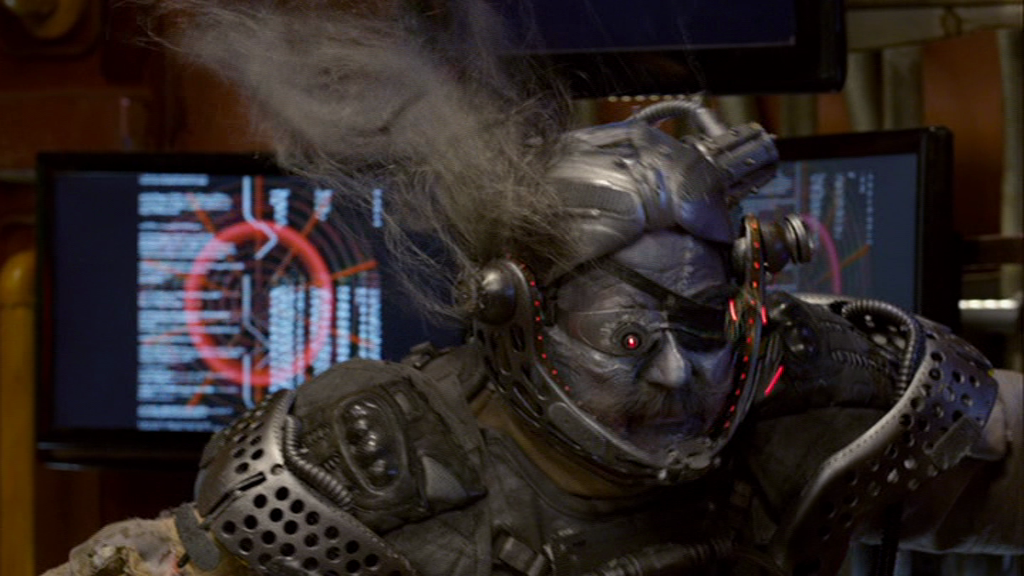
The character of the Inquisitor himself is, in my opinion, one of the great costuming triumphs of the show. One of the most interesting aspects of behind-the-scenes material for Red Dwarf is, in my opinion, Howard Burden's insights into costuming and how much thought he put into the design of the characters, and the Inquisitor is a very memorable element of that. While he's obviously a takeoff of Darth Vader and looks rather like he wouldn't be out of place as one of the main villains in an Eighties cartoon series, the mask, gauntlet and cloak strongly evoke that slightly rugged "Red Dwarf" quality and make the character unique. He's also the second simulant character to appear on the show; I've always thought that simulants were one of Grant and Naylor's best inventions for the series (even though over time they've become a bit of an easy fallback when an arbitrary villain is needed) and the character here is fresh and interesting, a deranged artificial life form who compensates for his own existential dread by trying to force the universe into a meaningful shape. I actually think this aspect could have been explored a little more.

The episode, however, is ultimately about Lister and Kryten, wedged between two episodes about Rimmer. It's the first episode since "Timeslides" to really even dabble much into Lister's psyche, and continues ideas initially raised in "Balance of Power" in the very first series: the idea that Lister has potential and is quite an intelligent and competent person, but that this has been obstructed by laziness and a lack of a sense of identity in his youth making him feel purposeless and directionless. In this respect, Lister is in some respects presented as the opposite of Rimmer; Lister is capable but lazy, while Rimmer is ambitious but incompetent.

Kryten's erasure, by contrast, is a little more confusing, but I suppose the implication is that he hasn't applied himself since breaking his programming. In any event, the whole premise of "The Inquisitor" is possibly a little too clever for its own good; for instance, if the Time Gauntlet erased people from history, would the erasure of the Inquisitor himself from history necessarily cause the people he erased to be brought back? If someone "never existed", it seems that even causing to never exist the person who caused them to never exist wouldn't matter... but then surely if you erased someone from time, that would erase the action of erasing; it doesn't really make sense. I also don't quite understand how the erasure of Lister and Kryten would just result in the existence of a slightly different Lister and Kryten who otherwise seem more or less the same. Has the Inquisitor judged them? Have they led worthwhile lives? It's also odd to think that the Inquisitor is judging Rimmer, the electronic replica of a long-dead man, rather than judging the flesh-and-blood man upon whom he is based.

Also, what's with the bit in which Lister claims to be reading a comic book adaptation of Virgil's Aeneid, but the story's obviously that of Homer's Iliad? As a former Latin nerd I can't distance myself from the knowledge that the narrative Lister is describing (the Trojan Horse in particular) scarcely features in the Aeneid. Highlights from this episode include Lister's long description of Rimmer to prove that he knows him, Kryten's "have you got through those damn manacles yet?" and all of the gags surrounding the severed hand; "I'll beat you to death with the wet end" is probably my favourite. The delivery of Kryten's "blood chilling terror" line might be the funniest bit in the entire episode, however. I also like Rimmer's "they've come here to hijack the ship and do, ooh, weird things to us."

The highlight of the episode is probably the four scenes of judgement, and the strongest of these is certainly Rimmer's, especially when the Rimmer-Inquisitor repeatedly interrupts normal Rimmer before he can say anything. Cat's judgement is a classic moment as well: "A shallow guy with a great ass." Kryten's sudden time-travelling appearance is good too. I think the bit when the Inquisitor turns Lister into a kid and an old man are a bit crap, though. I'm glad they didn't go down the route, as shown in the deleted scenes, of giving the Inquisitor a visible face. In the end, the Inquisitor is a serviceable and suitably dark instalment of Series V, but ultimately I think the strongest material, as usual, comes from brief moments of the characters analysing themselves, and less so from running around corridors fiddling with time gauntlets and the like. The idea of a "worthwhile life" and how we should judge ourselves probably should have been explored more than lasers shooting out of fingers.

Red Dwarf V Episode 1: "Holoship"

One thing this episode establishes straight away is the high visual quality of Series V. With very little location shooting (and that used effectively) the show is able to focus on its visual strengths: sets and model work. The Holoship model is very pleasing to the eye, and its sleek semi-transparent appearance is pleasingly juxtaposed to the bulky utilitarianism of Red Dwarf. While the Holoship sets naturally maintain the classic "nineties hotel lobby" aesthetic of much futuristic imagining of the period, they similarly work effectively as a contrast to the dingy corridors and cargo holds emphasised elsewhere in the episode and series. Perhaps the only shortcoming, apart from the natural contextual tackiness of the sets, is the contemporary computers which should, in my opinion, have instead been presented in the same way as Captain Platini's props, on coloured semi-transparent plastic (the keyboards in particular) to give them a less tactile, more "hologrammatic" quality. Interestingly, before desktop computers were around, this kind of interface was something achieved effectively in the 1969 Doctor Who serial "The War Games".

I'd say the sets and costumes are almost certainly meant to pastiche Star Trek, particularly the Original Series films and The Next Generation, and the characterisation of the "notoriously arrogant" individuals who make up the "hologrammatic cream of the Space Corps" seem rather evidently to be a mockery of the entire concept of Starfleet and the Federation, suggesting that such individuals would be more likely to be sneering, condescending snobs than high-minded altruists. Jane Horrocks' enormous hairdo as Crane seems almost certainly to be a takeoff of the extravagant 'dos of Trek past, with the mix of British, American and Russian officers similarly suggestive of Trek's multiculturalism. The "sexual recreation" policy also evokes the constant romantic entanglements which seemed to compose much of The Next Generation's filler content.

One curious aspect of the episode is that in terms of characterisation it emphasises the "misunderstood" quality of Rimmer, who only needs someone, in this case Crane, to appreciate him. It implies that Rimmer is more of a "softy" than he's given credit, but that he needs an attractive member of the opposite sex to take him seriously for this quality to emerge. On the surface, I'm not entirely convinced that Rimmer's plot in the episode is that meaningful given that the rest of the show is so intent on emphasising to us how charmless, graceless, rude and irritating he is; I suppose, however, it's summed up by Lister's "bon voyage" gag, which argues that he would fit in with the holoship crew, who are as arrogant and pretentious as he is, albeit with vastly superior intellects. Thus perhaps the Holoship really is the only environment in which this side of him could emerge, and in that respect the narrative is actually a success.

Lister, Cat and Kryten have very little to do in the episode, but I do like their scene interviewing the potential new hologram, and the scene in which Lister is mocking Don Warrington's Commander Binks is a classic. It's worth noting that Harrison, the hologram they interview, likes "horse riding and ballet". It may not be opera, but is this character inadvertently the model for, or at least an accidental foreshadowing of, the second Kochanski? I wonder if Doug Naylor was responsible for her lines. Kryten gets some smashing gags in this one, such as asking if anyone besides him thinks the sexual culture of the holoship is "just a little bit tacky" and informing Rimmer that if St Francis of Assisi ever said anything about never giving a sucker an even break it was "strictly off the record." Some other classic woofers in the episode are "Quick, let's get out of here before they bring him back" and "IQ unknown." I also like the little touch, which I only noticed recently, that just as Red Dwarf's holographic computer is called "Holly", the Holoship's "stochastic computer" is called "Stocky". Post-mind patch Rimmer is a little odd, but his effort to solve both exams at once is amusing, and his "I've come to regard you as people I met" farewell is very memorable. To an extent, "Holoship" feels weirdly out of kilter with the rest of this series given its lack of horror, violence and existential dread, but it's still an entertaining entry and a strong indicator of the concentration of talent in the show at this time.

Red Dwarf Series V Overview

When talking about the "classic" years of Red Dwarf, the "Grant Naylor" era in which both creators were writing for the show, sometimes it's a little hard to think of things to say other than "this is good and I like it". This series is, as I understand it, often considered to be a particularly high point in the show's history, and while I'm not sure I personally have a "special" affection for it, I definitely think it's probably the most consistently strong set of six episodes from Series III to VI. More or less every series (apart perhaps from VIII, I'm afraid to say) added some new memorable thing to the "fabric" of the show, and Series V gave us Mr Flibble and Duayne Dibbley. There's far more to it than that, however, and Series V stands out somewhat from the eras of the show around it.

If one thing in particular strikes me about Series V of Red Dwarf is that it generally feels "darker". The characters appear to be in some kind of mortal peril in all but one episode and the quandaries they deal with typically seem to be of a heavier nature: the meaning of their existence and their inner demons and neuroses. In fact, virtually the entire series is about this in some capacity. It's also noteworthy that the characters spend more time on Starbug or in dark and dingy parts of Red Dwarf itself rather than in the brightly-lit quarters, which are actually only used in the very first episode and are then revamped to serve as the quarantine accommodation and the quarters of the good and evil versions of the crew in later ones.

The characters themselves are a little visually different as well. The addition of a long overcoat to Lister's fur hat gives him an oddly Russian look, while Cat looks more feline than ever with some quite heavy eye makeup. Kryten sports his most "boxy" head in this series, and arguably a more expressive one, but also quite pale compared to other series, contrasting starkly with the dark body. Although the green costume appears briefly in one episode, Rimmer primarily sports a red uniform in this series, which is quite distinctive but further adds, I feel, to the more intense visual scheme of the series, making everything look more darkly warm. Notably, this series would set the scheme of red as being the dominant colour of "soft light" holograms, recurring in Series VI and Rimmer's brief switch to soft light in Series X.

The series also sees some character changes. Something reflected on in "Quarantine" is the fact that Kryten comes across in this series as the "leader" of the group, and they seem to spend more time exploring nearby space and salvaging vessels, which sets up the narratives of three of the episodes. Kryten not only has to deliver reams of exposition but also seems to make many of the major decisions. Cat almost reverts to a Series I style role of hanging around to throw out the occasional one-liner and almost functions at times as "Lister's sidekick", whereas Lister himself takes on a more proactive role, perhaps implicitly instigated by his experiences in "The Inquisitor". It's particularly noteworthy that in "Holoship" it's discussed that he spends most of his time mucking around, playing games and eating curry, but we see very little of that in this series; there's less of the idle time-wasting that seems to preoccupy him in the previous two. Rimmer, who at times seemed to have rather mellowed out in the previous two series (with the exception of "Meltdown", mainly) comes across as more vindictive and unpleasant again in this series. The series is in many respects heavily Rimmer-centric, with the plots of "Holoship", "Terrorform" and "Quarantine" all substantially involving Rimmer in some position separate to the other three protagonists. Watching this it seems no wonder that many viewers, as I understand it, came to see Rimmer, rather than Lister, as the "central character" of the show, and I wonder if this is simply because, as the more psychologically complex character, Grant and Naylor found him more interesting to explore.

Series V is probably also the zenith of the show's self-insight and reflection on the characters, with multiple alternative versions of the characters appearing, most prominently in "Back to Reality". It's also probably the series which crams the most musing and philosophical thought into the nature of being into half-hour sitcom episodes, with plenty of consideration of what makes a worthwhile life in "The Inquisitor" and "Holoship" and the fundamental building blocks of identity in "Terrorform", "Demons & Angels" and "Back to Reality". The plot devices, particularly in "Terrorform" and "Demons & Angels", at times feel a bit "magical", but as this services interesting ideas and effective comedy it doesn't really matter. Series V shows how, at its peak, Red Dwarf could keep doing new and interesting things, and more or less encapsulates the show's combined strengths as both a character-driven sitcom and a contemplative science fiction show.

Friday, August 26, 2016

Red Dwarf X Episode 6: "The Beginning"

The Dwarfers get menaced by some rather camp simulants and Rimmer discovers the truth about his parentage. Another episode written in haste after the scrapping of the location budget, this model-heavy finale is apparently adapted from the abandoned "Red Dwarf Movie" project. The plot of that supposedly involved the Dwarfers returning to Earth only to find it populated by human-hating "sapienoids", highly-evolved cyborgs intent on wiping out the last vestiges of their precursor species using "death ships". Here we have the logical replacement, simulants, and a tighter narrative about the Dwarfers figuring out how they're going to survive this latest threat from these recurring villains. It's worth noting that a deleted scene from this episode implies that the reason the human race is extinct three million years in the future is because they were wiped out in a war against the simulants.

While I think the film project was almost certainly misguided, and that in my opinion Doug Naylor was probably somewhat naïve to think that funding it was ever a realistic possibility, it's nice to know that, through this episode, it still made it to the screen in some fashion. In this regard it's a pleasant thought to realise that the character of Hogey the Roguey, originally read for by Richard O'Callaghan in the early 2000s film script read-through, was finally brought to life in this episode, played by O'Callaghan, who also portrayed the Creator in "Back to Earth". Hogey is a pretty silly character but I still like the idea that a role that was practically cast for the unmade film was ultimately realised, albeit not quite in the same way.

The big thing in this episode is Rimmer's character development, particularly his discovery that his horrible emotionally-abusive father is not really his biological parent. I think some people objected to this, but I didn't have a problem with it, particularly because it fits well with Rimmer's mother's reputation for having many liaisons; a common belief is that John, Frank and Howard were fathered by "Uncle Frank", so this doesn't matter. That being said, Rimmer's background is a bit inconsistent anyway. In episodes like "Dimension Jump" he appears to come from an affluent family with a large complex on Io, their own botanical gardens and the like; we know he attended a boarding school in what appears to be a parody of the typical upper-middle-class childhood, and in this episode his father claims descent from "Austrian princes and French royalty." By contrast, in "The End", the very first episode of the show, Rimmer complains about the disadvantages he's faced by not coming from "the right nobby background". It doesn't affect the character's previous behaviour in any way that matters. It also provides a mildly clever twist on the classic Star Wars revelation which has been parodied countless times.

There's plenty to enjoy in "The Beginning", from Cat's sleeping arrangements and Lister saying "Smeg off, Rimmer, I'm trying to sleep," to Hogey, to Hogey describing himself as "clever as a hedgehog." I like the idea of a character who shows up from time to time to annoy the Dwarfers and how exasperated he becomes that they won't get involved in his desire for a dramatic conflict. Gary Cady and Alex Hardy are both very amusing as Dominator Zlurth and Chancellor Wednesday of the simulants, particularly the former's camp villainy and the latter's pained noises after he mistakenly disembowels himself. The council of sycophantic Chancellors reminds me a lot of the film producer sketch from Monty Python's Flying Circus. Philip Labey is quite convincing as Young Rimmer, and I like that they made sure that Rimmer's father, as portrayed by Simon Treeves, looked similar to Rimmer's father as he appears in "Better Than Life". Rimmer's "battle plan timetable" is a nice parody of the old revision timetables, and Rimmer's "fear" speech, while again quite Pythonesque (it's reminiscent of the Spanish Inquisition) is a nice mockery of those kinds of pronouncements.

Possibly my favourite line in the whole thing is the way Chris Barrie delivers Rimmer's incredulous "Two forks and a pencil sharpener?!?" after Kryten completes the weapons inventory, reinforced later when Lister says "Kryten, bring them forks; we might need them." Kryten's speech about the "berserker generals" of the simulant death ships seems to be deliberately invoking his over-the-top description of the Inquisitor in Series V, which is amusing, and Cat's playing with string is similar to a scene from "Waiting For God". The thing about Rimmer's last words will obviously sit uneasily with anyone who knows that his last words were "Gazpacho soup", although Lister is obviously just joking. Rimmer's pretending to write a letter to the Geneva Convention while they were under attack also seemed to play well on Series VI gags, particularly from "Legion" and "Gunmen of the Apocalypse", about surrendering and claiming prisoners' rights.

There are definitely some purely exciting moments as well, like Rimmer's line about how "sometimes you live, you die, and then you live again" and "the slime's coming home." I like the solution to their dilemma; unlike, say, the Doctor Who 50th Anniversary, which used a similar solution, this is set up and foreshadowed effectively throughout the episode. Furthermore, the model work in the episode is terrific. It's worth watching the 'Making Of' documentary for Series X to see how fortunate they were to get the Death Ship and Annihilator models, as well as the other work done. It's all put together very well, with the end resulting being a space sequence that can sit easily alongside some of the classic model shots, including those of "Bodyswap", "Dimension Jump", "Terrorform" and pretty much everything from Series VI.

This episode also played up to the idea of resolving what happened at the end of Series VIII, and unsurprisingly it doesn't beyond suggesting, as could be expected, that Rimmer did something by fluke or accident to save the ship. It's nice to see the acknowledgement of this situation as well, despite the fact that any resolution would be pointless and probably be something ridiculous and extremely complicated. It's just another pleasant addition to an episode that seems to weave together a number of eras of the show, including one that never actually happened (the film). In fact probably the only thing I would really criticise about the episode is that I think the sets on board the simulant ship are just a little too sparse, although obviously this was a limitation of time and the budget. Ultimately, however, "The Beginning" is a strong finale for what I think was a strong tenth series; if they hadn't made any more of the show, it would have been perfectly acceptable as the last instalment of Red Dwarf. As it is, it's another funny and generally enjoyable instalment to round off a series which largely, to my mind, recaptured a fair bit of the magic of the show's best years.