Showing posts with label Batman. Show all posts

Sunday, November 17, 2019

"Joker"

"Are you aware that we live in a society?"
I seem to recall finding the news that DC and Warner Bros. were making a standalone Joker film unconnected to their wider "Extended Universe" (unofficial title, apparently) project utterly laughable – so now there were two Jokers; one the useless Jared Leto version, presumably now abandoned, and a more "realistic" version to be played by Joaquin Phoenix. But it was worth putting aside preconceptions, because not every superhero film has to be part of a cinematic project; indeed the success of this film at the box office has shown that Warner Bros. was wise to do so, extricating the concept from a mess for which Aquaman and Shazam! were only mildly able to continue Wonder Woman's ability to rise above.
"Hey clown! Why do you live in a society so much?"
In saying all this I have to admit that while I enjoyed Phoenix in Her, the only film I can recall ever seeing him in due to my extremely patchy and sporadic knowledge of cinema, I didn't have much interest in a Joker origin story. I've always been fond of that dismissal provided by the Clown himself in his own pseudo-origin, the Killing Joke comic book, that his past was "multiple choice", a concept exploited effectively, of course, by the characterisation of the Heath Ledger incarnation in The Dark Knight. And I've also always had my own conception of the character that's never been fulfilled, even in the die-hard "definitive" animated version voiced by Mark Hamill. I've always thought that the Joker should find everything funny, even when it's at his own expense. But that's a dream which shall continue to be only so.
"And this wiseacre claims that we live in a society!"
There's not much to say about Joker that hasn't been said already, to be honest. People seem to either think that it's brilliantly unique and refreshing for a very old and tired Batman character, or that it's just a derivative pastiche of Scorsese films of days gone by, something the filmmakers were quite openly inspired by. I must admit, having watched Taxi Driver not so long ago it was hard not to see Joker as pure simulation in that mold, and thus I tend more to fall into the second camp of opinion. It felt to me like a psychological thriller for people who probably don't watch many psychological thrillers and haven't experienced some better, older examples of the genre, but that's fine, really. If it could have the same impact on someone who probably wouldn't watch that kind of film as Taxi Driver had on me, there's no real harm. I have little knowledge of the alleged political controversies surrounding the film, and no interest in them; I daresay they are the usual manufactured internet media clicking-points.
"Remember, remember, we live in a society."
But with the media in mind I might as well at least discuss the film in a broader context and in regards to where I thought it succeeded. My favourite part of the film, much to the surprise of my theatregoing companion, was the moment in the film in which the Joker's alter ego, Arthur Fleck, is watching De Niro's character's talk show and fantasises about being invited onto the stage as an audience member to talk about his life and experiences, to fulfill his perceived destiny to make people happy. This part in particular struck me as a unique moment which seemed somewhat rare in this kind of film, something I've only ever seen in contemporary media represented in the indie computer game Actual Sunlight, which features a recurring element of the player character, a severely depressed office drone, fantasising about being interviewed so that he will have an audience for his, as he sees it, uniquely interesting opinions and worldview.
 
(Update: Oh wait, this aspect was ripped off from another Scorcese film, The King of Comedy. Which I've now seen and was also a million times better than Joker. So no points scored there.)
 
"Bruce Wayne, you don't even know
the society you live in."
I think imagining oneself being interviewed and having a captive, sympathetic audience to which one may disseminate one's (supposedly) unique personality is a common daydream, and I was struck by the effectiveness of this moment early in the film. It characterises the Joker as a man who fundamentally craves attention, who sees himself as "special" and who only needs the everyday people to recognise his quirky uniqueness to feel complete. Indeed, I was so struck by the perceptiveness of this moment that I was disappointed that I felt like nothing in the film after that quite lived up to it for me, and I dearly wished that when Joker finally appeared on the talk show for real that he had been able to adopt the confidence and sympathy of his fantasy only to reveal that, as a result of his own mental health issues, society's negligence and a willingness to succumb to his negative impulses, a desire to inflict violence and cause chaos had emerged through his achievement of his dream, fantasy or delusion.
"We all live in a society."
But it was not to be. I know I'm too immersed in the Batman lore from years of watching films and cartoon shows, playing Batman video games and reading comic books, but I never quite saw the Joker in Arthur Fleck; his ranting fury on the talk show didn't say "Joker" to me, his insistence on not being political soured by his focus on how society ignored him. This was not the elemental agent of chaos depicted in The Dark Knight or in the many incarnations voiced by Hamill. However, I'm obliged to recognise that my own heavy preconceptions coloured my impression.
"Travis Bickle lived in a society too,
and look what happened to him."
What I do think is interesting in regards to all of this, however, putting aside how "Jokery" I thought Phoenix's "Joker" was, is how this film sits as part of a recent trend of films dealing with the relationship between mental health issues and contemporary media. Both 2014's Welcome to Me and 2017's Ingrid Goes West (which incidentally features a secondary character who is obsessed with Batman) explored how modern culture's media- and social media-driven fixation with the pursuit of fulfilment through public attention can react explosively with poorly-treated mental health issues, and as a further exploration of that theme Joker is at least functional as another remark in the conversation. Whether it, or indeed any of these films, gives a reasonable answer, is another matter; then again, perhaps there is no wholly reasonable answer. I'm certainly inclined to listen to arguments which hold both views: that the film advocates a more social approach to mental health care, and that it unfairly implies that people with mental health issues are violent criminals just waiting to emerge. Phoenix's performance, if not the direction or story in particular, at least invite discussion of the film as part of that recent thematic trend in filmmaking.
"Can you introduce me as...
someone who lives in a society?"
Joker is an adequate film with some interesting moments and, as many have said, a strong core performance. I merely thought that it hit its peak, for me at least, much too early. My chief recommendation, as I made to some friends today, is that if you've never seen Joker but you've also never seen Taxi Driver, watch Taxi Driver first (also watch The King of Comedy). And watch Welcome to Me and Ingrid Goes West too; they're both worth your time, maybe more than another chin-in-hands frowning over DC's eighty-year-old clown.

Monday, July 25, 2016

"Batman v Superman: Dawn of Justice" (Ultimate Edition)

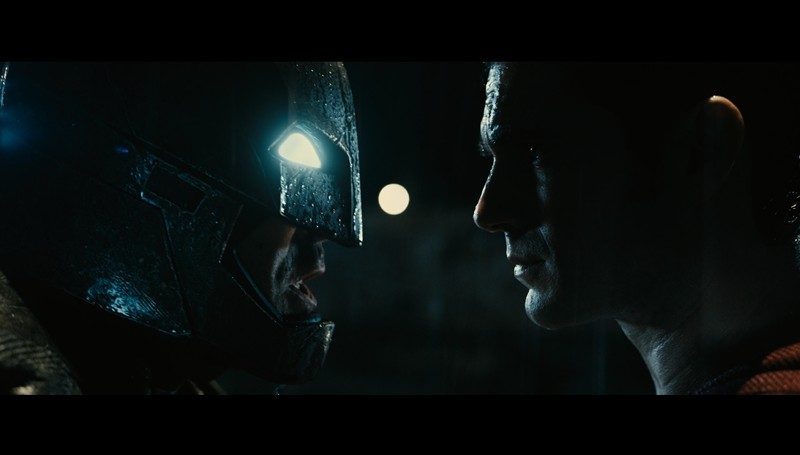
"I can't hear you with this helmet on."
Despite expecting, even desiring, badness, I actually quite enjoyed Batman v Superman: Dawn of Justice when I saw it in cinemas. Now don't get me wrong, Batman v Superman is not, in as "objective" a sense as I can muster, a very good film. It's too long with a dodgy screenplay, heavy-handed symbolism, questionable performances, thin characterisation and a fairly bad plot. For reasons I can't explain, however, that didn't bother me the first time I saw the film and it didn't bother me when I rewatched it recently in the shape of the "Extended Cut" released on the Ultimate Edition blu-ray. Despite going for two and a half hours in the cinema and three hours in the extended edition, the film didn't bore me, and it didn't annoy me particularly. Before I get onto my brief review of the film proper, however, I thought I would discuss the "Extended Cut" by answering the following question: 

Does the Extended Cut add anything significant to the film?
In my opinion the answer is "no." The Extended Cut fills in a few elements of the plot in a little more detail, but other than that I don't think it contributed that much. I'd say it feels somewhat like a more rounded film due to some added scenes about Lois's investigation into the mysterious bullet and Clark's research on Batman, but it doesn't really add any more Batman or Superman action or fill in any existing plot holes, like how Lex knows Superman's secret identity. All in all I could probably take or leave the added scenes, and although some people have, I believe, argued that the Extended Cut would have been better received than the theatrical version, I don't think that's very likely. I think people had a problem with what was already there, not with what they felt was missing.

"Stop a bullet cold, make the <Central Powers> fold..."
Anyway, here are my thoughts on the film in general:
My biggest problem with Batman v Superman is that it feels like two and a half or even three films jammed together: a decent Batman film, a mediocre Superman film and a bad Justice League prologue. The actual "Batman fights Superman" element is so perfunctory and incidental to the main plot that it doesn't really feel like a part of any of these three stories, so perhaps in that sense it's almost four films, with the fourth strand being an ideological conflict between DC's two flagship heroes. Yet, despite everything, I still feel as if the film does a decent enough job of handling these elements and synthesising them to an adequate degree. The ugliest graft onto the structure is the "Justice League prologue" element, which the film would have been better off without. The scene in which Wonder Woman watches videos about Flash, Aquaman and Cyborg on her laptop for a few minutes while the action stalls are particularly egregious. Personally I didn't find Wonder Woman to be particularly interesting and could have done without the additional heroes in the story.

The Superman Aspect
"My only weaknesses are Kryptonite
and my Irritable Bowel Syndrome."
The problem with Henry Cavill's Superman is that he always looks like he's trying to do a shit. In general we also don't get enough of a sense of who Clark Kent really is, I feel, such that it's hard to find Cavill's Superman too interesting. There aren't really any moments where we see Clark Kent enjoying himself, for instance, apart from the bit where he jumps in the bath with Lois, and all the dialogue in that scene is still pretty heavily plot driven. I feel like we need to see Superman just being a person because his character is a little lacking at the moment, I think. Jesse Eisenberg's Lex Luthor is okay, although I agree with the criticisms that he feels like Heath Ledger's Joker. Personally, however, I feel like his ranting about gods and demons and Prometheus and stuff makes him feel like a hybrid of Ledger's Joker with Kevin Spacey's Luthor from Superman Returns, which was itself a slightly more serious version of the Luthor of the Reeve era Superman films. Thus I feel like their Luthor feels heavily dependent on existing film representations rather than doing something new (or, indeed, even adapting the comic books very closely).

If only Superman could read this Lois's mind,
his job would have been a lot easier.
Lois's role in the film seems to mostly be to cause problems; not quite a damsel in distress but more of an instigator of chaos, because almost everything she does in the film, such as going to visit the warlord at the beginning or throwing away Batman's kryptonite spear just seems to make Superman's life more difficult. As for Doomsday, well, he looks like an orc from one of Peter Jackson's Hobbit films and as far as big CGI battles go the conflict with him is pretty generic. Superman already fought a Kryptonian enemy in Man of Steel, and in this he's basically just fighting a worse version of Zod again. They could have done something a bit different. I really wish they'd do Brainiac in a film.

The Batman Aspect
Batman voice courtesy of eating the set.
I don't know Ben Affleck from anything because apparently I haven't watched any films for the last twenty years or so, so I didn't respond with derision when he was cast as Batman. I didn't know what to think, really. When I saw the film, however, I was pleased. Affleck seems to get the role of Batman down easily and comfortably and I personally thought that he was the most successful part of the film. I was interested in his ever-increasing feelings of despair and impotence as he becomes more confronted by the powers of Superman and I liked the general aesthetic of his costume, the fight choreography used with him, the image of the bombed-out Wayne Manor and so on. I also enjoyed Jeremy Irons as Alfred; I felt that he fitted the role rather well. Personally I would be very keen to see the solo Batman film made by Affleck that is meant to be in development.

"I'll just get him, sir."
I believe that some have argued that Batman comes across as stupid or unlike a detective in this film, and I agree at times he doesn't appear to be as "in control" as people have come to expect, and I wonder if that's a result of them plopping this supposedly hardened, veteran incarnation of the character into our midst. For someone like me who has read many of the notionally "essential" or "definitive" Batman comics like The Dark Knight Returns and The Long Halloween perhaps it's easier to imagine what this Batman's past might have been like without having to be shown it, but I can appreciate that less nerdy viewers might be more in the dark. That's the thing about this film, I suppose; it relies upon the knowledge of the characters in popular consciousness rather than establishing versions of them in their own right. This leads me to:

The Batman vs Superman Conflict
"Are you taking a piss behind the lectern?"
"No comment."
Despite the fact that I like the fight scene, and enjoy robo-Batman beating the shit out of Superman, who seems to still use the same Kryptonian concrete in his hair as he had in Man of Steel because it still never gets mussed up, even when Batman grabs him by it, the whole conflict feels like it would have been more effective if there had been multiple Superman, Batman and Superman-and-Batman films leading up to it, such that they had an established friendship or at least relationship that was falling apart. As it is, it feels like we as an audience are expected to more or less know or understand the ideological differences between Batman and Superman based on their pre-established, existing presence in popular culture and the popular consciousness, such that the filmmakers appear to want to impress us without the bother of doing groundwork for it.

"You'll ruin my hair!"
This, I think, weakens the conflict, such that the plot is forced to pit Batman and Superman against each other rather unnaturally, with Luthor threatening Superman that he will kill his mother if he does not kill Batman, apparently to force the world to see that Superman is violent and dangerous, not benevolent and just. Yet it feels very contrived, as it's established that Batman is seen as practically a legend, if he's known at all, which makes you wonder what effect Luthor's plan would really have, or what the purpose of it is. Batman's own attempt to goad Superman into fighting him so that he can "save the world" from him is a little more interesting, but I don't feel that it's sufficiently clear why Batman sees Superman as such a threat apart from the dream sequence and the Capitol bombing, which surely an intelligent person like Batman would recognise as an effort to frame Superman. Interestingly, the Extended Cut has Lois investigate the bomber's apartment, but not Batman, which is perhaps a missed opportunity derived from the film's need to have a scene in which Batman and Superman fight for no good reason. Similarly when Superman first confronts Bats with peaceful overtures and asks for his help, Batman doesn't listen and Superman, despite being (as far as he knows, not realising Batman has kryptonite weapons) invulnerable, starts beating down on him simply because he's sick of Batman's sass or something. So they both come across as a bit dumb.

It's a fixer-upper.
The ending is also stupid. We know Superman's not going to stay dead, and the fact that he had to sacrifice himself to kill Doomsday just seems pointless, a forced dramatic moment that almost anyone in the audience would realise would only be a temporary situation. It would have been more effective to have shown the future team beginning to assemble by having Batman use the spear, given that he spends most of the fight against Doomsday simply getting twatted around the place trying not to get killed. Even Wonder Woman could have easily used the spear. I don't know; it just seems contrived to me.

Batman visits any comments section on the film.
Conclusion
Personally, I think Batman v Superman: Dawn of Justice is an adequate superhero film, even enjoyable, but I know my opinion is even more unusual than usual in this regard. I found it much more engaging than Man of Steel and probably more entertaining than Marvel's rival instalment, Captain America: Civil War, which could have easily been called "Cap v Iron Man: Dusk of Avengers". Maybe I'm just getting bored of the Marvel characters and enjoyed seeing something new; I'm certainly more interested in Affleck's Batman than seeing any more RDJ as Iron Man or anything of the sort. As I've already said, Batman v Superman is a very flawed film, but I can live with it, especially since the teaser for Justice League actually looked interesting. I can't explain my reaction to Batman v Superman. I know it's bad, but I don't care. What a hero I am.

Wednesday, July 18, 2012

The Dark Knight Rises

It's been six long years and Christopher Nolan's vision of Batman has finally come to an end. It all started way back in 2005 with Batman Begins, a refreshingly serious and realistic take on the Caped Crusader which was a very thorough and interesting origin story which had never before been fully explored onscreen for the character. This was of course followed with smash hit The Dark Knight, which amped up the gravitas and intellectuality of the concept to whole new levels. If I would aim any criticism at The Dark Knight, it would be that as much as I enjoy it as a film it doesn't feel like Batman. Batman Begins did a good job of blending certain more fantastic elements of the mythos like the League of Assassins (or "Shadows" in this continuity) and Ra's al Ghul, plus grotesquerie like the Scarecrow with his fear toxin into a satisfyingly gothic depiction of Gotham which nonetheless felt reasonably plausible. In The Dark Knight what we received was an excellently confronting and intense crime drama but one which felt very little like a superhero film anymore. In striving for realism and grittiness Nolan possibly began to perpetuate that issue which has always shadowed comic book superheroes since the mid-80s: an element of defensiveness about the inherently ridiculous nature of the genre, an effort to hide what is integral to the concept. You can make the Joker just a nut job in makeup and have plots about mob money and turn Two-Face into a rogue vigilante rather than a crime boss but in the end it's still a film about a billionaire who dresses in a bat costume to fight crime. There's only so realistic you can make it before it starts to feel, in my view, like it's somewhat missing the point.
Unfortunately this descent into morbidity and hyperrealism only continues in The Dark Knight Rises. Following the conclusion of the previous film, Batman has retired and Bruce Wayne has spent eight years as a recluse. The film hybridises elements of the The Dark Knight Returns, Knightfall and No Man's Land storylines into a film about Batman returning to work to fight Bane who has cut off Gotham from the outside world and placed it under mob rule. The film owes a lot, narratively, to Batman Begins more than The Dark Knight, and it's obvious that Nolan was trying to make the film feel like an effective sequel to both previous instalments simultaneously. The League of Shadows is heavily referenced, Ra's al Ghul appears in a brief cameo and Batman is returned to far-flung and exotic parts of the world but simultaneously much is made of the death of Two-Face and Commissioner Gordon's efforts to cover up his killing spree at the end of The Dark Knight. What makes this jarring is the complete absence of any mention or reference whatsoever of the Joker. It was increasingly obvious to me over the course of the film that Heath Ledger's death had thrown an even more massive spanner than was already expected in the proverbial works in terms of making an effective sequel to The Dark Knight. Nolan and co excised any account of the Joker out of respect for Heath Ledger, and while this tact is commendable it feels awkward when they reference the events of the previous film. He is, to put it simply, conspicuous by his absence.
The main villain, therefore, takes the form of Bane. I wonder if, perhaps, given Joker's absence, it was a mistake for Nolan to have eliminated Two-Face in the same film, arguably Batman's next most dangerous villain, or to have reduced Scarecrow to such a secondary antagonist. It feels like Nolan was scrabbling around for another Batman foe who could be portrayed as realistic; obviously characters like Mr. Freeze, the Penguin, Poison Ivy and Clayface were out of the question and it would be impossible to make Riddler realistic without putting him in the position in which he so often finds himself as little more than a poor man's Joker. Personally I always thought that Black Mask would have been a good choice of enemy in Nolan's Batman-verse but perhaps having a skull-themed villain so soon after Captain America wouldn't have worked anyway. Deadshot might also have had potential as a supporting foe, or perhaps Professor Hugo Strange.
Nonetheless we get Bane, and I suppose he's one of the more plausible members of Batman's rogues' gallery. However instead of a luchadore-masked Venom addict criminal mastermind, this film portrays him in a rather more bland "realistic" style as a terrorist trying to fulfil Ra's al Ghul's legacy with the assistance of a mask which provides him with constant anaesthesia, necessary after sustaining never-fully-disclosed injuries in his past. Instead of being Hispanic he speaks with a rather bizarrely exaggerated English accent and always walks around the place clutching his lapels. At first I thought it was an interesting depiction of Bane as an affably evil monster, and satisfying to see him depicted as the genius brute portrayed in the comics. However as his aims as a boring movie terrorist were increasingly established and he developed a propensity for delivering tiresome, cliché-ridden monologues I became increasingly exhausted with his presence. Some would argue that it would be impossible to have another villain as successful as Heath Ledger's Joker but I believe they made a mistake in turning Bane into a jovial English gent. It would have been more effective, in my opinion, to have had a villain which contrasted to both the humorous insanity of the Joker and the collected self-assurance of Ra's al Ghul by depicting Bane as still calculating and intelligent but furious and raging. Sadly it was not to be, and Bane becomes increasingly tedious as the film continues. Tom Hardy does as good a job as he can in the restrictive mask to portray Bane but he's let down by a weak script which leaves the character ultimately unfulfilled.
The other classic Batman character introduced in this film is Catwoman. Never referred to as such, only on a newspaper headline as "the Cat", Selina Kyle is once again a master thief and cracksperson intent on discovering a device called the Blank Slate which can erase one's existence from all records. The film maintains the typical depiction of Catwoman as a relatively neutral and self-interested character who turns to good only in duress or out of affection for Batman but in this case she's also trying to start afresh by erasing her criminal past. Shame she's got to commit crimes to stop being a criminal! Anyway if any character felt like a forced love interest for Batman in this film it was her. As the ultmate successor to Rachel it seems as if they just wanted Batman to have someone with whom to settle down. She disappears about halfway through the film and seems to have been practically forgotten about by the writers until the end. To be honest, I've never been much of a fan of Anne Hathaway in anything I've seen her in and this didn't change my mind. The film takes the predictable route of making Catwoman into a hybrid action girl-femme fatale as usual and doesn't really achieve much with the character. She changes her mind about being completely selfish and saves Batman in the end. Whoop de do. Maybe if Bat-fans hadn't seen this exact scenario last year in Batman: Arkham City it would have seemed more original, but probably not.
We get a couple more new faces as well in the shape of Marion Cotillard's Miranda Tate and Joseph Gordon-Levitt's John Blake. To be honest at this point with these two plus Michael Caine, Tom Hardy and a small role for Cillian Murphy returning as ever as the Scarecrow the film starts to feel like Batception at times. Miranda Tate serves as an initial romantic interest for Bruce Wayne in a contrived and implausible love story as well as a protector of the Wayne Enterprises financial interest due to bizarre economic factors which are over my head. Of course, spoilers beware, she turns out to be none other than Talia al Ghul, daughter of Ra's, out to complete her father's mission. John Blake, on the other hand, is a "hot head" police officer, a straight-edged "good cop" who helps out Batman and Commissioner Gordon and, as revealed by his birth name at the end of the film, serves as Nolan's extremely realistic interpretation of the character of Robin or effectively any sidekick to Batman. It is of course heavily implied at the conclusion of the film, in a revelation as predictable as possible due to an early scene where Bruce Wayne tells Blake that "anyone could be Batman" and in a later one where Batman suggests that he wear a mask, that he will become the new Batman. Indeed Batman himself spends a good deal of the film incapacitated, imprisoned or otherwise unavailable and as our supporting protagonist Blake fills the void of a hero very well, but it only serves to compound the impression that Nolan wants to make a Batman film which is as far removed from Batman as possible. You could believe, I think, that Nolan wouldn't have objected to making a film where Blake himself was the main character without any kind of comic book elements.
This leads me into the narrative of the film. It's all rather disappointingly simple; Bane is gathering a secret army of terrorists underground. When the time is ripe he blows up all the ways into and out of the city, has a scientist turn an experimental fusion reactor into a bomb and gives the citizens of Gotham a month or so of total anarchy before the bomb blows them all to Kingdom Come. This is all revealed to be part of Talia's effort to live up to her father's plan to destroy Gotham. Ultimately it feels far, far too much like nothing more than a re-hash of the plot of Batman Begins. Terrorists appalled at the decadence of Western civilisation want to destroy the city. Both of these plots end with a vehicle chase in which the relevant weapon of mass destruction must be hunted down and eliminated before time runs out. They both have a character twist where an associate of Batman is revealed to be orchestrating the entire plot. It is of course in the serialised nature of superhero comics to repeat some of their narrative conceits from time to time but this is ludicrously overt and, in this regard, seems to detract from Nolan's efforts to divorce the series from the less realistic aspects of superhero comics.
There's also a subplot where Bane injures Batman's back and leaves him in a prison in what appears to be the Middle East somewhere from which he must escape by mastering himself in some fashion. It's all awfully similar again to bits from the first half of Batman Begins. Once he's out he heads off to Gotham, there's a big battle and he apparently sacrifices his life flying the bomb out over the bay to save the innocents. Of course it turned out in reality he survived and is off living a wonderful old life with Catwoman in Europe. How lovely.
My point is that really it feels like a whole lot of nothing. The film drags on and on, going for nearly three hours, and at no point, in contrast to its title, does it really rise above its precursors and deliver something new to the plate. We are beaten over the head with neon signs advertising hard-edged psychological realism and character trauma but none of it feels especially profound or moving. Batman needs to recover value in life; that's about it. I realise that Nolan wanted to provide closure to his take on Batman and it's satisfying to at least see the property treated with that kind of literary seriousness; we don't end with alarm bells and someone shouting out that Killer Moth has just robbed the bank as Batman swoops back into action or anything. This feels conclusive and final, but it doesn't change the fact that it's long-winded, dull, and takes itself way too seriously. Batman Begins had, as I've said, elements of the fantastic and gothic, and while The Dark Knight moved perhaps a little too closely to the real the Joker's unique worldview was another important intrusion of the outlandish. The Dark Knight Rises lacks these elements in anything beyong a reprisal of what has gone before. The ticking time-bomb plot is devastatingly unimaginative and stale, Batman's inner journey takes him nowhere special and the other characters are underdeveloped and underused. The mere fact that Batman spends so long locked in a prison rather than out fighting crime as Batman, which is what we all want to see, is teeth-gnashingly frustrating. Perhaps Nolan understands this and wants me to be frustrated; perhaps in wanting to bring the normally endless world of a comic book hero to absolute closure he knew that we had to want it to end. Maybe in that regard the film is a success; it's an ending that left me not wanting any more, and I guess that's the best kind of ending.
Technically it's all very good and the direction is up to Nolan's usual high standard. The action set pieces and effects are all well done and the horrific unpleasantness of anarchy in Gotham is impossible to ignore. It is, perhaps, as good an end as could be expected while bringing the series to a realistic conclusion, but in this way it again reinforces the notion I can't shake that trying to make superheroes realistic is an interesting experiment but ultimately misses the point. There are a number of funny moments, although perhaps not enough, but the script is inconsistent overall and even in the time it takes it tries to do too much. It is, in my view, definitely the weakest instalment in an otherwise very good series, and feels too much like Batman-minus-Batman. If it taught me anything, it's that superheroes shouldn't be realistic - because they're not.