Showing posts with label holly. Show all posts

Monday, September 19, 2016

Red Dwarf II Episode 5: "Queeg"

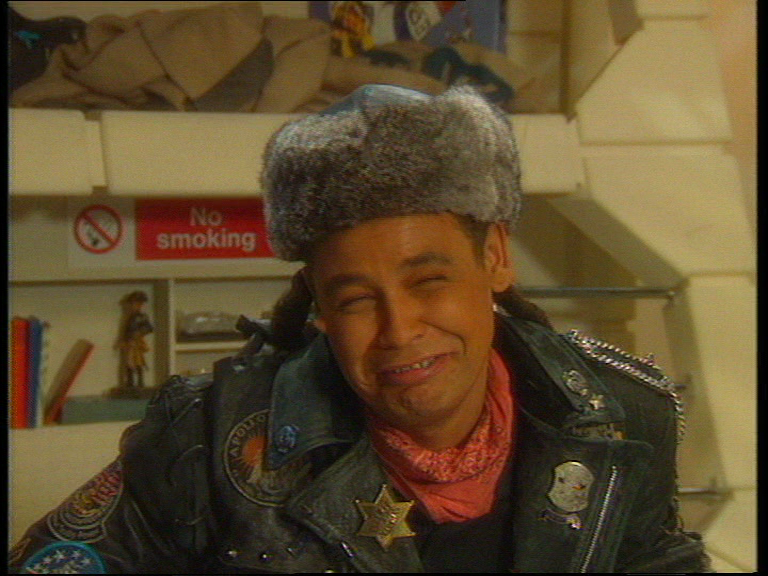
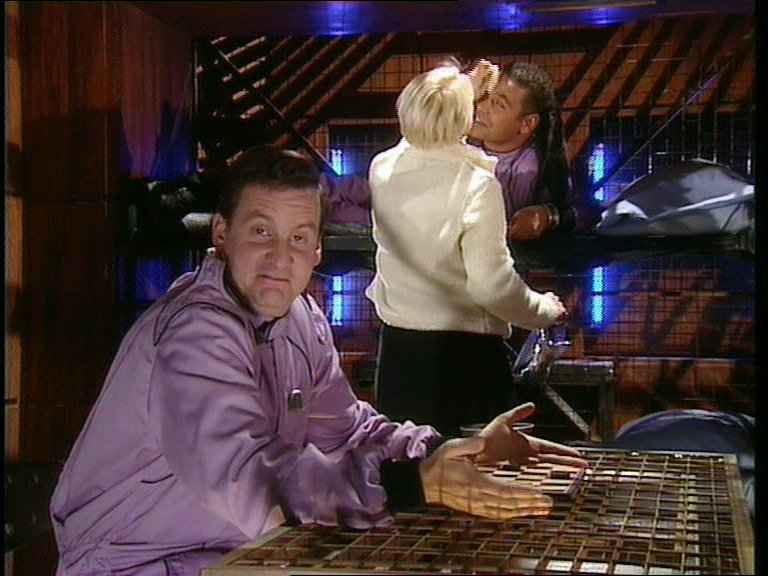
Lister gets blown up and Rimmer gets all sweaty. Another of Series II's top episodes, the obvious standout in all of this is the guest role of Charles Augins as the titular antagonist, although there are numerous other good bits, including Rimmer's forced exercises, Chris Barrie impersonating the rest of the cast, Lister's pea on toast, the Porky Roebuck story, and of course the final cavalcade of woofers at the end. In fact there's scarcely a dry moment to be found, apart perhaps from elements of the opening scene, bits of the scene of Lister and Cat cleaning the floor and parts of the chess game, which still facilitate a number of good jokes. It's not the most deep and philosophical episode, and doesn't have a huge amount of sci-fi rumination apart from a joke about the consequences of machine intelligence, but this doesn't matter because the situation is so ripe with potential and the jokes are so strong. In that regard, it may be one of the best "pure comedy" Red Dwarf episodes ever made, if not the best. Even Holly's opening joke in this one, about the "collection of singing potatoes", is one of the funniest they did.

Among the huge number of woofers at hand, I have a number of personal favourites. I like Rimmer's gasped interjections as Queeg forces him to do trunk curls, forcing out a different exclamation each time: "Mummy! Mercy! Help me! Holly and I had this little understanding!" I also like Holly's alternative game suggestions during the chess match, my absolute favourite being "Cluedo? You can be Colonel Mustard?" At the risk of over-explaining the joke, I just find something incredibly amusing about the idea that Colonel Mustard is the "best" character in Cluedo. There are some decent effects bits too, include Rimmer's detached legs and of course the whole "Or was it the yellow cable" explosion, one of the only "action" sequences in the whole of the first two series. Cat's impersonation of Queeg's voice is good, as is his refusal to work: "I got a note from my mummy." I enjoy Rimmer saying that Holly's "not in for a single meal" and the conversation about whether Holly really has an IQ of 6000: "So you want me to prove it, do you?" The Space Scouts salute is amusing, as is Lister's revelation about Inflatable Ingrid: "I've been seeing her behind your back." Notably, the rubber doll would be re-christened "Rachel" in all subsequent appearances.

To be honest, there are even more woofers worth mentioning, so full of funny bits is this episode. Rimmer's comparison of Holly to a "blind old incontinent sheepdog" is good: "Take him out to the barn with a double-barrelled shotgun and blow the mother away." I also like Rimmer's genuine interest in the "shoes have soles" story. Chris Barrie's performance as Queeg is meant to be taking control of Rimmer's body is great, including his unconscious jogging and his amusing appearances running through other scenes. I also like Lister's early story about his geography teacher who "didn't think men were better than machines." I find the joke of Rimmer playing draughts with the Skutter a bit silly, however, particularly the piece with the little 'Rimmer' flag on it, and the "dramatic" chess game montage is a touch dry, but it's all made up for by the final reveal, the nature of which seems like a logical extension of the Norweb joke from Series I. A lot of the best humour in the episode overall derives from Norman Lovett's deadpan delivery of Holly's lines and the casual manner of those lines: "So you like a bit of chess, do you?" Another good example is from the "farewell" scene: "Perhaps not the most efficient computer ever invented, but we had a giggle." In terms of sheer impact, "Queeg never existed. It was me all along," is the line that sticks in my memory from the end.

As a "Holly episode" it's good, although you can easily see why there wasn't much potential for future episodes along those lines. Some of the stuff in "Future Echoes" and the Holly bits of "White Hole" feel like the only other interesting possibilities for the character, really, apart perhaps from Holly acquiring a body and having to experience life outside a monitor screen, or something of that nature. Norman Lovett's very good in this episode, and in general, but the role is clearly limited in terms of what it can do. What's there for him to do besides deliver one-liners and the occasional bit of exposition? Still, this is a top episode with a classic ending. Charles Augins is great as Queeg, conveying a surprisingly large amount; on the one hand he's scary, intense and intimidating, but consider the moment when, for instance, he frankly informs Lister that Rimmer fainted during the run. Queeg's not standoffish or unreasonable; he just enforces rules that are unnecessary and irrelevant in the characters' predicament, and thus reflects what Holly could be if he used his near-absolute power over the ship, and thus over the complete livelihood of the characters, in a less generous and easygoing way. I suppose it could also be said to suggest that, as our lives become more and more dependent on automation, it's equally essential for us to ensure that the intelligence which governs said automation is benevolent, and that in itself is a worrying thought about how we would be willingly making ourselves, effectively, the wards of such intelligences. This makes it a nice little character study for Holly in addition to being one of the standouts of the show's history.

Red Dwarf Series II Overview

Despite the maintenance of the submarine-grey sets and beige uniforms, Series II of Red Dwarf is quite a departure from the series that began it all. Series II tends to be driven more by character action rather than specifically character conflict, while still delving into the characters' differing philosophies. Lister is still fairly slobby, but less so, and starts to move towards his "philosophical space bum" role, while Rimmer, despite probably being more neurotic than ever, is less like Lister's aggravatingly petty and pompous boss and more like his slightly sad roommate. Cat feels a bit like "Lister's sidekick", as rather than occasionally showing up he seems to be around more regularly, and the two of them hang out together in "Better Than Life" and "Stasis Leak", and work together in "Queeg". Holly gets some more verbal tics and personality quirks. There's more adventure and an early sense, in episodes like "Kryten" and "Queeg", of the characters as a team rather than individuals with markedly separate agendas.

As such the crew starts leaving Red Dwarf regularly, and this is ably supported by some excellent model work and composite shots, which for the moon visited in "Thanks For The Memory" and for the observation dome on the ship are remarkably effective. Some of the location shooting in "Better Than Life" doesn't really work, but other than that it's generally quite nice to watch despite obvious budgetary limitations. The sets have also been brightened up as much as possible, from screens in the remodelled drive room down to blue paint on the rivets in the sleeping quarters. The obvious standout addition is of course the huge inflatable banana, which draws the eye in Lister and Rimmer's accommodation to the extent that I almost think of Series II as "the one with the banana." Despite the fact that this was apparently just a random piece of set dressing by assistant floor manager Dona DiStefano (who appears as Kochanski in the final scene of "Stasis Leak") I find something whimsically amusing about it within the fiction of the show, as if one decoration Lister and Rimmer could definitely agree upon was having a big inflatable banana by the window. It also seems to tie in nicely with the underlying concept, expressed in the theme song, of longing for an escape to a tropical paradise.

Series II also moves away from Series I's tendency towards having what almost constituted an ongoing plot in order to portray more distinct and self-contained events. Unlike what occasionally happened in Series I, events are generally resolved by the end of the episode, such that the next episode is something largely unrelated. This would similarly set the tone for Series III, and in that regard, despite retaining much of the "look" of Series I and the fact that it's still largely the original four characters, it moves substantially towards the "settled" feel of Red Dwarf for the subsequent few series. Effectively, however, it's something of a halfway house, with episodes exploring the characters, like "Thanks For The Memory", perhaps evoking Series I to an extent, while "sci-fi gimmick of the week" episodes like "Better Than Life" and "Stasis Leak" start to crop up, which would become more commonplace in Series III. Series II is still fairly light on action, but it strikes a fairly good balance in terms of what had been the show's initial strengths, and the strengths that would be developed more fully in later years.

In general, Series II is strong, although I'd argue that "Stasis Leak" and "Parallel Universe" somewhat represent dips in the effectiveness of ideas or fulfilment of the narrative. On the other hand, I would argue that "Kryten", "Thanks For The Memory" and "Queeg" are some of the best episodes in the show's original run. Personally I find that the movement towards a more episodic writing style made the less effective episodes more difficult to disguise, as by contrast I think that Series I, with its very limited cast and sets, feels more consistent across its run than this. Nonetheless, it's natural that with a bit of experimentation and movement away from an established form, as well as the need to produce more stories, there's the chance of elements being hit and miss. It doesn't alter the fact that Series II is definitely one of the overall highlights of Red Dwarf's history.

Tuesday, September 6, 2016

Red Dwarf Series III Overview


Series III is when the look and feel of Red Dwarf would come to be a bit more "settled". Grant and Naylor would take a more hands-on role in production, and a new look in terms of both costumes and sets was established through the work of Howard Burden and the late Mel Bibby respectively. The show also built upon some of Series II's tonal shifts to delve further into an action-adventure setup in addition to the sci-fi comedy, with a new rock-guitar fast-cut opening sequence reflecting the shift to a livelier universe than the one found in the first two series, now featuring strange space phenomena, genetically-engineered monsters, time-travelling developing fluid and deranged domestic androids.

The series is also noteworthy for two major cast changes: the recasting of Holly with Hattie Hayridge in the role and the casting of Robert Llewellyn as Kryten, turning the guest role portrayed by David Ross in Series II into a regular character and making the show more of an ensemble piece. The cast move further towards being a sort of squad or team, with their computer in support. Perhaps it's just that I knew he was coming, but Robert Llewellyn fits in effortlessly as Kryten, and the character feels like a natural addition to the cast. Holly has less to do than ever, unfortunately. I wonder, had Norman Lovett's travel arrangements been sorted out such that he could stick around, if he would have moaned and complained enough that Holly got a bigger role.

These changes also make for a bit of a departure from Series I and II's common focus on long conversational scenes between Lister and Rimmer in which they spar with each other and discuss their various life experiences. While one episode, "Marooned", is still devoted to this, these staple scenes only really crop up elsewhere in Series III in "Bodyswap", in which they largely service the plot, and "The Last Day". Supposedly this was to a degree instigated by a somewhat poor offscreen relationship at the time between Craig Charles and Chris Barrie, although the extent of this seems questionable. Craig Charles seems to attribute such a situation these days largely to his own immaturity at the time, although Chris Barrie charitably seems to accept some of the blame, describing a "competitive" environment in rehearsals. I get the impression, in any event, that stories of friction between them may have been somewhat exaggerated, and it's probable that Grant and Naylor wanted to change things up anyway. It seems highly unlikely to me that "Marooned" would have been made if the show was to any extent trying to avoid having the two actors doing that kind of one-on-one material together.

One thing I've noticed about Series III on rewatch, if I was to criticise it for anything in general, is that at times it can be a bit, well, "twee". Things like "the Red Dwarf shuffle", Smeg and the Heads and the "special mechanoid menu" come across at points as rather corny from a modern point of view, not unlike Miranda the Mermaid or some of the female-opposite jokes from Series II. I'd also argue that "Backwards", "Bodyswap" and "Timeslides" are all rather gimmicky episodes in which a central effects-driven conceit dominates the story, and not necessarily to its advantage. On the other hand, at times Series III can be quite dark and character-driven, as Lister faces apparent death with only Rimmer for company in "Marooned" and when Kryten confronts what he believes to be his doom in "The Last Day".

As is usual for Red Dwarf, the strongest episodes are those which explore the characters and what makes them the people they are, which is something we get in the two episodes I just mentioned, along with, to an extent, "Polymorph". Nonetheless, there is still a lot of good model work and the location shooting is, by and large, effective, and does not demand too much suspension of disbelief. Series III sets the standard for what Red Dwarf would find itself most consistently comfortable being, yet I feel reasonably confident in arguing that these were still early steps, setting a foundation for the show to improve in subsequent series.

Thursday, September 1, 2016

Red Dwarf Series IV Overview

To a comparable extent to Series III, Series IV of Red Dwarf feels like the show at, perhaps, its most "friendly". There's not a great deal of interpersonal conflict between the characters, when they're in mortal danger it's not treated in a particularly dramatic fashion, the science-fiction concepts are comfortably vague and unrealistic, and they meet a variety of oddball characters. I'd almost be inclined to say that, despite dealing with some reasonably weighty themes in several episodes, this is Red Dwarf at perhaps its most pleasantly light-hearted, as opposed to, say, the farcical comedy of Series VIII.

Series IV increases the amount of time the characters spend off the ship, visiting other locations and travelling either aboard the now-ubiquitous Starbug or through other means. It more firmly establishes a wider universe, as we begin to discover, as Red Dwarf makes its slow return journey to Earth, a galaxy littered with the detritus of an extinct human civilisation, the artefacts of which now are scattered across space. The show comes up with more and more interesting ways to have guest characters despite the lack of humans; this series notably first introduces the term "GELF", Genetically-Engineered Life Form, as well as the concept of simulants as danger lurking in deep space, both of which would become staples of the show in future years.

A couple of episodes explore Kryten's character, a couple explore Rimmer's and one juxtaposes Lister and Rimmer's attitudes towards war and violent conflict. The series also sees the previous storyline being adjusted somewhat in order to accommodate ideas Grant and Naylor developed in the Red Dwarf novels: the idea that Red Dwarf had a crew of over one thousand people, and that Lister had, in fact, had a brief relationship with Kristine Kochanski rather than simply admiring her from afar. Both of these ideas would resurface more prominently in the Doug Naylor-only era from Series VII onwards. Series IV also sees, for the first time, an episode adapting a story from the novels rather than the reverse, as the "pool with planets" concept originated in the novel Better Than Life.

Series IV, to the best of my knowledge, sees few design changes relative to Series III, as the show's look seems to have been firmly established at this point. I think Lister gets his even bigger furry hat in this series, which I think rather suits the character, and Cat has some particularly bizarre outfits, particularly in "Justice" and "Dimension Jump". I've often thought that Kryten has an extremely rectangular head in this series, but the mask is obviously an improvement over the previous iteration. The series also has some excellent models, including the DNA Ship, Justice World and Ace Rimmer's ship, the launch sequence for which is very pleasing.

If Series IV has any particular problems, they might be found in a couple of structural issues with the writing for some episodes and some location choices. I would argue that the ending of "Camille" is a bit too derivative (much as "Back to Earth" would be 19 years later), "DNA" doesn't entirely follow through with all of its ideas, and "White Hole" quite clearly feels like two different stories jammed together. The location work used for Justice World and Waxworld in "Justice" and "Meltdown" respectively is not entirely convincing. Other than that, I would say that Series IV is a solid string of interesting and entertaining episodes and a strong continuation of the show's Series III reworking which, as usual, introduced some now-classic concepts to the show's ongoing fabric and featured some of the show's best set pieces.

Sunday, August 21, 2016

Red Dwarf Series VIII Overview

Publishing note: I'm going to give my thoughts on some Red Dwarf in the leadup to Series XI. I'm starting with VIII because it's the one I most recently rewatched and it's also the easiest to criticise. 
I think it's obvious watching Series VIII that by this point, after being on the air almost continually for about a decade, Red Dwarf in its original run had well and truly had its day. That's not to say I'm upset that it's back; quite the reverse. I like "Back to Earth" (although I know many do not) and I like Series X. I think, however, that the show needed a break, and a long one, in order to do a bit of soul-searching. I first saw Series VIII when it was released on DVD in late 2006, and I was excited because it was more Red Dwarf I hadn't seen. While I didn't think it was as funny as previous series, I was willing to give it a pass largely because Rimmer was back and because of how much I fancied Chloë Annett (I was about seventeen at the time). With the benefit of ten years under my belt since then, and having not watched Series VIII in probably eight or nine years, I can still appreciate the return of Rimmer (and I still fancy Chloë Annett) but I can see with the benefit of a little age and somewhat greater maturity that Series VIII, with the exception of one episode and a few jokes scattered here and there elsewhere, is shit.

[Don't get me wrong, by the way; I think the people who made this, cast and crew alike, are all very talented people, and I'm not one of those psychotic Red Dwarf "fans" who loathes Series VIII and refuses to watch it (or, as seems to be the case surprisingly often, has a negative opinion of it despite not having actually seen it). I just think that it's misconceived and most of it doesn't work.]

In Series VIII, Doug Naylor wanted to do a "prison comedy", and that's fine, but it necessitates the knobbling of the premise of the show. The resurrection of the crew of Red Dwarf and the return of Chris Barrie, Norman Lovett and Mac McDonald to the main cast means that there are now far too many main characters for eight thirty-minute episodes. Furthermore, the show's growing ensemble cast is incompatible with Series VIII's aim, which is to refocus on the traditional dynamic between Lister and Rimmer. The series is trying to be too many things at once: an ensemble comedy, a double act, a prison comedy, a sci-fi comedy; the writers can't strike the balance. Danny John-Jules and Chloë Annett have virtually nothing to do a lot of the time (and few jokes) and even Robert Llewellyn, whose Kryten character had become pivotal in previous series, is comparatively sidelined as the show largely becomes "Lister and Rimmer getting up to all sorts of shenanigans".
While this might be seen as a return to form, if one is to ignore how much it makes the rest of the regular cast redundant, in execution it's let down by the fact that virtually all of the conflict between the two characters is eliminated despite the fact that Rimmer is meant to be the "old" Rimmer of the Series I era who was so uptight and frustrated by Lister. In fact, in Series VIII Lister and Rimmer come across more like two good friends who occasionally squabble, rather than the "odd couple in space" whose conflict drove the early series of the show. Chris Barrie and Craig Charles obviously have a terrific rapport, developed over many years working together, but it doesn't gel well with the broader premise of this particular series, which is notionally about using the prison setting to revive the old Lister-Rimmer tension.
Furthermore, while the humour in Red Dwarf always involved a fair amount of the silly and vulgar, in this series it becomes incredibly adolescent and juvenile, featuring more weak puns than ever (such as "lemonade", "post's arrived" and "rock, rock, rock"), as well as relying on a fair amount of really chauvinistic comedy, in which a sexual magnetism virus which makes people irresistibly attractive to the opposite sex is treated for laughs, as women are essentially drugged into having sex with men, and later when the male characters secretly watch women in the showers. There's a particularly horrible line in the deleted scenes, which was mercifully left on the cutting room floor, in which Lister remarks that he was hoping to use the sexual magnetism virus on Kochanski the next time she was drunk. Jesus Christ. While Rimmer might effectively get his comeuppance for using the virus, Lister's treated as being disappointed when it wears off after Kochanski starts making out with him in the lift, and later he uses it to try to get Rimmer raped in prison. Who the hell thought that was the way to characterise our reasonably heroic main protagonist? It's easy to appreciate why the cast, in hindsight, and other commentators, refer to this series as "Men Behaving Badly In Space", especially given that the show's only female protagonist is completely objectified in multiple episodes, and to a far greater extent than she was in Series VII.
The show also descends into ludicrous fanwank territory in this series, with countless references to episodes of prior series, in addition to the unfortunately quite unnecessary return of Norman Lovett and Mac McDonald, who are both reasonably amusing, but clutter up the show. The opening trilogy of episodes is particularly fixated on references to prior stories, not just in terms of wrapping up the ending of Series VII and bringing back old cast members but also seeing the return of the luck virus, the idea of multiple Rimmers and Hollys, references to "Future Echoes" and "Backwards", and of course the revival of Duane Dibbley.
While the cast's performance benefits from being back in front of a studio audience again, it suffers in the writing department, with jokes being few and far between in a number of episodes, particularly "Back in the Red, Part 3" and "Pete, Part 2". It's clear that, after this, the show needed to be rested. In any event, at this point Doug Naylor was apparently fixated on making a Red Dwarf film, an ambition that unsurprisingly turned out to be rather unrealistic. It's not entirely clear to me whether the show would have continued being made if he hadn't been focused on the film project, but while it's possible to imagine that it's a "shame" that the show came to an end because of this unrealistic project and after such a weak final series, I shudder to think what "Series IX" would have been like if it had been made only a year or two after VIII, without the long break which, in my opinion, appears to have given Doug Naylor the time to refocus on what made the show successful and entertaining.

SPECULATION
How could Series VIII have been good, besides having more funny jokes? Here are a few suggestions, which admittedly include altering the ending of Series VII as well:
1. It needed to be more of an ensemble production. With five main cast members, each one really ought to have been largely the focus of a single episode, as having episodes focused on a specific character was common in earlier series (although as we know the attitude tended to be "when in doubt, make the episode be about Rimmer"). Note that in earlier series, most characters tend to be defined in terms of their relationship with Lister, but in this most of Lister's one-on-one scenes are with Rimmer, such that it turns into "the Lister and Rimmer show with three supporting characters". I don't think Cat gets any one-on-one scenes with Lister in the entire series.
2. The crew (other than Rimmer) shouldn't have been revived. Remember that in "Psirens", Kryten observes that someone has stolen Red Dwarf, which in "Nanarchy" is revealed to have been his nanobots. This is kind of funny, but if they really wanted to make the show a "prison comedy" they could at least have had Red Dwarf taken over by GELFs or simulants or someone who captured and imprisoned the characters so that the premise didn't have to be so heavily altered.
3. It shouldn't have been a prison comedy. If they continued down the nanobot route, it would have been more refreshing, after two series of Starbugging, to go back to the characters having the run of the ship. Rimmer could have easily been the only crew member revived, or even just resurrected as a hologram again, perhaps because the nanobots thought he was part of the ship or something; this resurrection would have been to everyone else's annoyance. There also would have been the possibility of humorous conflict between Rimmer, who had enjoyed being in "effective command" for years, and Kochanski, who outranked him. The "run of the ship" scenario would also have eliminated another problem with Series VIII, the fact that it becomes cluttered up with recurring characters: Ackerman, Baxter, Kill Crazy and the like. Some of these characters have their amusing moments, particularly Ackerman and Kill Crazy, but they're not needed, especially with the reintroduction of two unnecessary regulars, Holly and Hollister.
In the long run, at least Series VIII wasn't the last Red Dwarf.