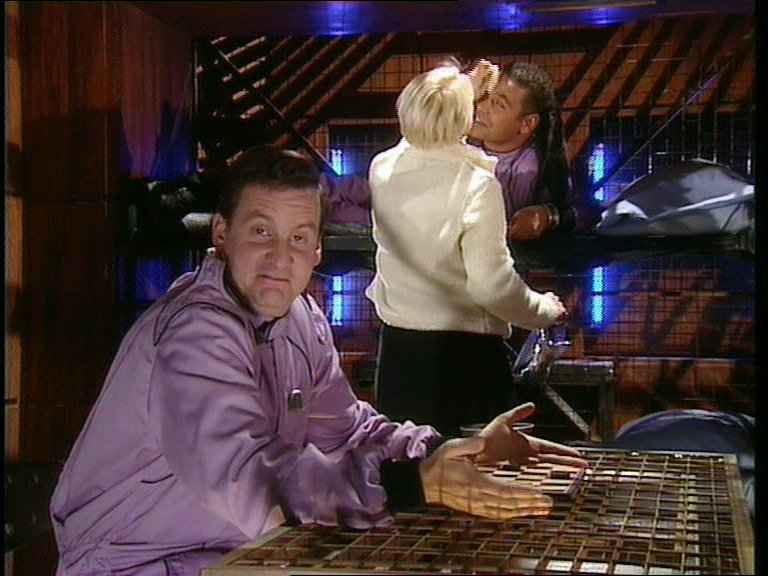
I really like "Back to Earth". I know that's not the most popular opinion among Red Dwarf fans. I've only ever been to one Red Dwarf convention in my life and even the MC felt the need to take a crack at "Back to Earth", and Craig Charles was almost apologetic about it, which I think is unnecessary. It's fair to say that it's not exactly bog-standard Red Dwarf, but that's surely the point; it was a set of specials celebrating the show and testing interest for a TV revival. I also hate to be one of those people who says that its critics have missed the point of it... but I kind of think its most vocal critics have missed the point. It's not meant to be three more episodes of standard sitcom fare, but more of a tragicomedy with a sci-fi premise.
Nonetheless, let's get what are, in my opinion, the major weaknesses of "Back to Earth" out of the way first.

1. The premise is a repetition of "Back to Reality", as both involve a group hallucination in which the characters appear to discover a terrible revelation about themselves. They even derive from the same source, a hallucination-inducing squid, albeit a different one (of course) to the one encountered in Series V. Nonetheless, it's another group hallucination, the main difference being that the world it takes the Dwarfers to is more realistic than the world of "Back to Reality" and they're not in nearly as much danger.
2. The idea of breaking the fourth wall is not particularly original. Self-aware storytelling can potentially come across as the place that narratives go to when they've run out of other ideas. It might also be said that even with the in-story explanation, something feels a bit off about the characters walking around in the 21st century looking at, and talking about, Red Dwarf merchandise and stuff; it feels a tad inconsistent with the tone of a lot of the programme.
3. The Coronation Street element might seem effortless and like a ratings ploy, depending on your view of Coronation Street. I don't really know much about it, but if you're aghast at the idea of soap operas receiving acknowledgment in your favourite sci-fi comedy show, this element could be considered annoying, reminiscent perhaps of that Doctor Who thing, "Dimensions in Time", although in this it's a fairly small element which only takes up about five minutes of the third part.

4. The Blade Runner parodies and pastiches become pretty heavy-handed fairly early on. To someone unfamiliar with Blade Runner they might seem weird and pointless; to someone who does know the film they might seem laboured and obvious. I'm certainly curious about the claim both within the show and outside it, as Doug Naylor says this in the director's commentary, that Blade Runner was a big influence on Red Dwarf. Was it? Perhaps the idea of holograms is related to the idea of replicants, but the most Blade Runnery things in the show, like simulants and planned obsolescence, only seemed to emerge in the years following the show's initial production. I can't see too much Blade Runner in Series I and II.

5. I might argue that there's not enough payoff for the character of Katerina, who features quite heavily in the first act of the sequence and then only appears in one scene afterwards. While she more or less serves her purpose as Rimmer's antagonist in the specials, I can't help but feel like that aspect of the narrative doesn't have quite the structure it could have. I feel like she could have appeared slightly more once they got to "Earth" to make this element seem more cohesive.

All right, we've got that out of the way. Those are my main issues with "Back to Earth". Other than that, and the fact that admittedly some of the jokes aren't funny, which is inevitably going to be the case in any comedy, I enjoy the specials a lot. It could be said that they suffer from the lack of a live audience or background laughter, but in this case I think this emphasises the more dramatic qualities of the specials and the sense of loneliness and isolation that this was trying to recapture. In terms of the things I enjoy about "Back to Earth", there are a few major highlights:

1. The restoration of the "classic" premise. It's just Lister, Rimmer, the Cat and Kryten alone on Red Dwarf. There's really no need for any explanation of the Series VIII cliffhanger. Suffice to say "it was resolved somehow". Lister's back to being the last human alive and Rimmer's a hologram again. I really like the idea that the characters have been together for so long that they don't really annoy each other anymore, which is captured perfectly by Rimmer's reaction to Lister ironing his sneezes, as he imagines Lister "going down to the supply decks, trawling through the crates, getting half hysterical at the thought of my face." I also like that it seems the Cat is mostly back to mucking around and singing while grooving around the decks like in the early series.

2. The design and costuming. The specials really recapture the distinctive looks of the different characters. I do think the "Back to Earth" Rimmer uniform is a little overdesigned, and prefer the Series X one, but the Kryten costume seems to capture the blockiness of some of the best past Kryten get-ups, Cat's suit is a nice progression from the old days and a transition past the "pvc undergarment with changes of jacket" ensemble of Series VI to VIII, and Lister's biker costume is distinctive and classic, matching Craig Charles' appropriately grizzled appearance.

Furthermore, while arguably the bunkroom is a little too bright and clean by the standards of previous series, it looks nice, and some great details are visible; observe for instance that Rimmer's bunk has his revision timetable, the old newspaper headlines and his duelling pistols, while Lister's has a picture of Fiji, the picture of his grandmother, his Zero-G football poster and so on. A nice addition, retained in Series X, is a couple of photos of Kochanski. There's even a book about aliens on the table, presumably Rimmer's. One thing I will say is that the table looks a bit too much like a cross between the TARDIS console and the computers from Star Trek: The Next Generation. Nonetheless, the ship looks good, including the CGI backdrops, and as the cast point out in the commentary the CGI work in the cargo bay, for instance, gives an excellent sense of how truly vast the ship is and how alone the crew are within it.

3. The exploration of Lister's character and of the concept of the revival and continuation of the show. Appropriately, these specials focus on Lister as the central character of the show, although admittedly the first part does arguably focus a little more on Rimmer. It's an interesting concept, however, because it explores the premise of Lister being stuck on Red Dwarf for what must be nearly half his life, of him losing hope and purpose and gradually finding it again. It also doesn't beat around the bush about the fact that the cast, and thus the characters, have aged, and tries to re-frame the show in relation to that. As has been pointed out elsewhere, the characters' quest for more life is Doug Naylor's appeal to the public for more interest in Red Dwarf and in that regard it obviously succeeds.

4. The action sequences are, in my opinion, very well put together and shot; I'm thinking here of the fight with the joy squid in the diving bell and the vision in which they run from the Creator in a parody of Zhora's death from Blade Runner. They're entertaining and, despite the limited sets, quite visually striking. The squid fight is probably a little confusing to watch, but rewards multiple viewings, especially if you look at the screens in the background while Rimmer's dancing and see Lister and the Cat furiously stabbing the tentacles and stuff. I've always liked the fact that in the street death vision they bothered to show Rimmer's light bee getting hit as he goes down.

5. The concept of the joy squid. Even though it is of course a rehash of the despair squid from "Back to Reality", and even though the idea that "the male causes despair while the female causes joy" is a pretty tired gender dichotomy, I think it's a clever and interesting idea, and a good way of catalysing Lister's character development. My one issue, probably, would be that it doesn't entirely seem to affect the other characters, although as has been pointed out, as a self-aware narrative it appropriately mainly affects Lister who is, after all, notionally the "main" character.

6. The Kochanski cameo. I think this was a really effective way of hybridising the fact that the special is a continuation of the previous show, in which Kochanski was ultimately a main character, with the fact that this special was in some ways a celebration of the "classic" concept, and therefore ought to focus primarily on the four best-known characters. Her appearance in this, as an actually rather sinister embodiment of Lister's dreams and doubts, also restores a bit of mystique to the character.
7. The opening titles. I can't quite explain why, but I personally think that "Back to Earth" has the best opening titles sequence of any Red Dwarf. It's put together well and the shots of the cast synchronise more effectively with their credits than in the Series X titles. The pacing of the clips matches the rhythm of the opening theme and despite the lack of material available the footage used is well chosen. The shots of Rimmer dancing and Kryten peeking through the mail box slot in particular have always amused me. That's a nerdy thing to like, but I've always liked it.

What else do I like about "Back to Earth"? The first joke that amuses me is "Who's next? The egg whisk? Two weeks in Mauritius?" Probably my favourite bit in the whole thing is when Rimmer dances in his chair to Ray Conniff's cheesy version of "Getting To Know You/I Whistle A Happy Tune" from The King and I, which sounds very much like something Rimmer would listen to given his love of other naff musical genres, while the others are flailing around in the diving bell fighting the joy squid tentacles. Their unique diving suits are also amusing; I like that Lister has the rugged old-school one, a nice contrast to the unflattering one from Series VIII's "Cassandra", and it's nice to see a return of Kryten's floaties (or "water wings" as I believe they're called) which he also used in "Terrorform". Rimmer's "what's in the bag" raises a smile from me as well, as does the Cat's "huge testicle" description.

The way Kryten says "Oh my gosh" when Rimmer informs him that there's a monster in the water tank cracks me up, as does his high-pitched "We're not real! What are we gonna do!" His best prop gag might be when Katerina says Rimmer is "bit crap", Rimmer says "What?!" and Kryten says "Look sir, confirmed," with the psi-scan also saying "bit crap." "Simple people, simple tastes" I always found funny, as well as Noddy at the sci-fi shop not listening to music. Noddy in general is an amusing piss-take at Red Dwarf fans, and as someone who plays with toy soldiers, his line "Sorry to interrupt the Warhammer" has always made me laugh. The two kids who talk to Lister on the bus are some of the least objectionable child actors I've seen, and the boy gets some funny lines, especially "Kiss her. I would." One of the best jokes in the whole thing comes in Part 3 on the set of Coronation Street, when Lister says "This is just like where I grew up, except there's less burning cars." Kryten's "I could get some new sponges" tickles my fancy for some reason. Lastly, Rimmer's suggestion that he could be in "a sitcom in a biscuit factory" makes me chuckle as well.

One effective thing I noticed on my latest viewing is a background element of the narrative that emerges over the whole set of specials. In Part 1, Rimmer tells Katerina that Holly is offline because Lister left a bath running for nine years. In Part 2, Noddy at the sci-fi shop has a bath prop that he says Lister was in when Kryten ran in and told him Kochanski had been sucked out of an airlock. In Part 3, he finds out that this never really happened. So what happened to Holly? Kochanski left Red Dwarf, Kryten decided to spare Lister's feelings and tell her she'd been accidentally killed, he ran in and told Lister, who jumped out of the bath he had running to find out what was going on; in his distraction and despair he never went back and turned the bath off. I happen to think that's quite neat bit of storytelling conveyed purely through incidental dialogue.

Obviously, "Back to Earth" has its weaknesses, but I've always liked it and I think it was a pleasing way of reviving the series. While the Blade Runner stuff is definitely overstated, I think it's funny and visually engaging, and a reasonably effective piece of self-reflective commentary for the show. The characters seem to reappear very naturally despite a long absence and it makes a number of sensible decisions about the premise of the show, indicating that the long hiatus after Series VIII was definitely in the show's best interest. If nothing else, it's what got us Series X, and that alone was worth it.

 Kochanski joins the crew and Lister finds out that he's his own dad. To its credit, "Ouroboros" makes a reasonable effort trying to establish a new protagonist for us who is meant to be Lister's longstanding love interest but is played by a different actress and who has a different characterisation. When framed in relation to the show's retcons, particularly the Series IV material establishing that Lister had a brief relationship with Kochanski rather than simply fancied her mostly from afar and hardly spoke to her, it works, but feels peculiar given that the original Kochanski, portrayed by Clare Grogan, only appeared one Series earlier (albeit several years earlier) in a hallucination. In prior series, Kochanski is incredibly "mythologised"; what starts as Lister's disappointment in discovering she's a pile of white powder in the drive room in "The End", and wishing to activate her hologram in "Balance of Power" and "Confidence and Paranoia", is transformed into an inexplicable belief he develops that somehow he'll "get her back" despite the fact that she's been dead for three million years; this arises in "Stasis Leak", "Queeg", "Back to Reality" and "Psirens".
 Thus when she appears in "Ouroboros" there's almost too little fanfare; the whole thing feels kind of off, which is exacerbated by the fact that she's a parallel universe version of the character (a plot element quietly dumped after Series VII and barely referenced after the fifth episode of). Perhaps if they ditched the whole "she has her own Lister" element it'd feel less weird, but maybe that would have eliminated a point of conflict between the characters. That aspect, however, is ultimately not dwelt upon enough to matter. Furthermore, if Holly resurrected someone to keep Lister sane, wouldn't he have done the same for Kochanski? Why would he have resurrected Lister? Wouldn't he have resurrected one of her friends or something? Perhaps she asked him to do it; why am I thinking so much about this? Ultimately, I think if they'd explained a little more clearly why she's such a different character the introduction might seem a bit less anticlimactic. It also strikes me as really odd that despite being reunited (sort of) with this woman he's been pining away for over the course of years, Lister doesn't really ever talk to her about anything significant; he only has a single one-on-one conversation with her near the end of the episode.
 What's funny in "Ouroboros"? Kryten's little titter after he declares how "hideous" Lister's broken tooth cap is raises a smile, although Lister's declaration that the Cat is "losing it" as he himself tosses tooth floss behind his ears requires too much repetition; it'd be better if he just shook his head and said "He's losing it, he really is." The "obscene phone call" after Lister shoots Kochanski in the leg is kind of funny, I guess. I like it when Cat says "You came in a box? That explains everything." Some of Kryten's whining about Kochanski and fear of abandonment is kind of amusing as well, but as I already stated the characterisation is pretty ridiculous and I don't like the way they altered Kryten's character so much. Too much of his jealousy also manifests in ways that objectify and sexualise Kochanski, which makes the character's role in the ensemble feel one-dimensional; the "make love to me you horny dude" line is pretty dodgy. I do find amusing the way he says Rimmer "didn't have any in-and-out bits, hardly at all."
 The use of the GELF ship attacking the weird blue interdimensional tunnel in order to separate Kochanski from her own crew is pretty weak, and the second use of it at the end of the episode is pathetic, especially given that after blowing a hole in the tube it never appears again. I also don't like the way they rehash the "GELF bride" from Series VI either. Weren't they fairly technologically limited? Where did they get the starship from? It comes back to the contrived introduction of Kochanski. All they needed to do was travel to a parallel universe and find her in stasis in a derelict Red Dwarf that was falling apart or something. There's no need for the blue tunnel, hologram Lister or any of the rest of it.