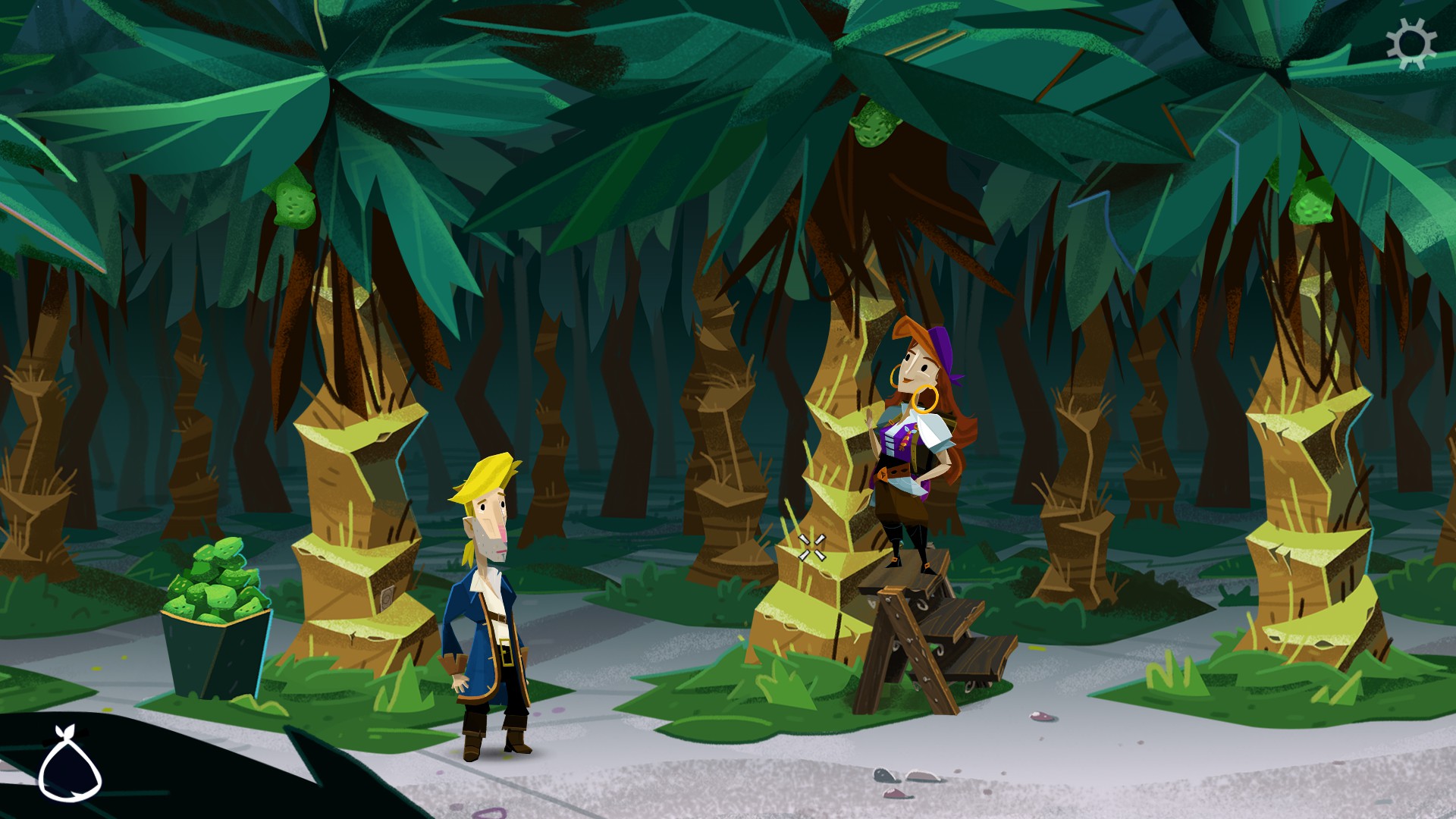
Full spoilers for Return to Monkey Island contained within.
I’m one of those people for whom Ron Gilbert and Dave
Grossman coming back to Monkey Island was a big deal. I’ve been a huge
enthusiast for these games since I was about four years old, having first
played The Secret of Monkey Island in 1993 and LeChuck’s Revenge not long
after, and playing each of the subsequent games in the series as they came out. LeChuck's Revenge is my personal favourite, and since I was old enough to understand that the development had changed hands
several times over the years I’d been aware of the desire for the original
designers to return, and with the announcement of Return to Monkey Island it
seemed like that was what was finally going to happen. When it did come out m’colleague
and I even did things as we would when we were kids, playing together and
passing the mouse back and forth.

Playing
Return to Monkey Island was a fairly intense
experience for me because of the significance it holds for me, but after
replaying it on Switch (my first play-through was on PC), and then again on PC, I think I’ve more or
less settled on an opinion: I like this game. I love parts of it. But it’s also
an absolute mess, with way too many ideas, uninteresting unfunny secondary characters
with too much dialogue who Ron and Dave clearly loved a lot more than I did,
plenty of elements that feel out of place even for a concept as ambiguous as
Monkey Island, an unnecessarily convoluted plot and an over-reliance on uncompelling
MacGuffin-hunting to structure the story.

By the standards of traditional puzzle adventure games, Return to Monkey
Island is very easy. It's certainly a good deal easier than Gilbert's previous adventure game, 2017's Thimbleweed Park, some puzzles of which stumped me for quite a while before I figured them out. I played Return on “hard” and didn’t need the game’s built-in
hint system whatsoever, although I admittedly solved a couple of puzzles more
by accident than because I grasped the logic behind them or found all the
necessary clues. As a result it also doesn’t feel terribly long, although the
original games weren’t either. It’s probably about the same length as the
second game, albeit with easier puzzles.

In terms of presentation, the visuals won’t be to everyone’s
taste, as pre-game discourse (and the now seemingly de rigeur online histrionics that accompany any pop culture artefact's fanbase) already established. While I didn’t have much of
an issue with the art style I do think some of the character design wasn’t
entirely successful and the animations at times lack a bit of weight and
momentum, especially compared to the other “2D” entries in the series. The
music, however, is as good as ever, with a number of tunes from the earlier
games appearing and some memorable new ones; my favourite new composition is the Brrr Muda
throne room tune.

As a new entry in the Monkey Island series, Return to Monkey
Island at times feels strangely out of place. The unsettling Terror Island and
the icy Brrr Muda feel more like elements from a fantasy game than a Monkey
Island game, as does the game’s eventual hunt for a set of golden keys. None of
these islands are fleshed out; indeed there are rooms on Terror Island that
serve no purpose, and it is possible to find a sunken machine-themed island
which was otherwise cut from the game due to a lack of time to implement its
content. The very piratey world of the first three games in particular is not
to be found here, which is a bit of a shame. At the same time, the game
reprises locales in the shape of Mêlée Island and Monkey Island, which Escape
from Monkey Island already did, albeit many years ago, so the novelty of
returning to them is not as fresh. I think the game would have been better
served by taking place in entirely new seas, much like LeChuck’s Revenge, Curse
and Tales.

Like the worldbuilding, the character work and plot of the
middle of the game also aren’t great. A lot of time and attention is devoted to
fleshing out new characters, especially the new Pirate Leaders and LeChuck’s crew, but despite the swathes
of dialogue devoted to them they’re not terribly interesting and most of them
you barely interact with after Part III. Madison, Lila and Flair in particular all feel rather interchangeable, and Trent is pointless. Only aspirational zombie cook/chef Putra and workshy demon lookout Flambe stick much in my memory. Returning characters similarly aren’t
amazingly engaging either. LeChuck has neither the menace of LeChuck’s Revenge
nor the ebullience of Curse, feeling like a relatively generic villain (although that may be intentional, but given the game's themes almost any criticism could be labelled as intentional or at least explicable). A
little drama seems to be building with Elaine and her disapproval of Guybrush’s
selfish actions, but this ultimately ends with her just offering him a warning
not to get too caught up in his obsessions rather than generating any genuine
conflict between the two of them. Indeed Elaine’s writing is so inconsistent
that at times I was wondering if it would be revealed that she wasn’t real,
wasn’t alive or wasn’t really Guybrush’s wife; in the end, however, it just seems that she's mildly concerned but ultimately not especially bothered by his shenanigans, and it all feels a bit tepid. Guybrush himself seems to be
more of the dopey incarnation from Escape and Tales, rarely exhibiting either
the wit and dry humour of Secret or Curse or the mischievousness of Revenge. The
earlier games, especially the first two, greatly benefited from the brevity of
writing necessitated by disc space limitations; this game has a “Writer’s Cut”
mode with “more blather, worse pacing”, but it feels like a lot of the blather
and pacing problems stayed in regardless. I completed my third playthrough with the voice
acting turned off so that I could read the dialogue at my own pace and this
improved things quite a bit, and I wonder if part of the issue is with the dialogue
not really having been written by Grossman to be performed aloud.

And from the characters I move onto the plot. It’s perhaps
intentional, given the framing device, but the plot is also messy, with
Guybrush chasing his goal to Mêlée, to Monkey Island, back to Mêlée Island, to
a bunch of other islands and then back to Monkey Island again, and with the
involvement of an over-large group of new antagonists who aren’t very important and don’t
contribute much of significance to the plot besides providing a few narrative
explanations for things that were relatively incidental. Unlike the Monkey
Island games of old, in which Guybrush generally had a relatively broad general
goal to work towards with several sub-goals, much of this game apart from the
fourth part and the overall quest for the "Secret" feels very much like a series of small consecutive incidents in the
manner of the story pacing of an interactive fiction game, but without the necessary character work that makes this kind of thing compelling in the best examples of the genre. The game opens up in
its fourth part with Guybrush searching for five keys, but the very arbitrary-feeling MacGuffin-hunt
nature of this is also not massively compelling. Searching for map pieces in Monkey Island 2 at least felt "piratey". While some have complained
that the game’s ending feels like a rehash of the second game, it’s probably
this part which has the most in common with it.

Perhaps it’s time for me to get to the best part of the
game, the framing device and the connections this games makes to the mysteries
posited in LeChuck’s Revenge. This game purports initially to resolve the mysterious
ending of that game, and in the eyes of many it does; little Guybrush and
brother Chuckie emerge from the tunnels of an amusement park — but no, now they’re
just pretending that the couple they run into are their parents, and soon
enough it’s revealed that these two kids are not Guybrush and child-LeChuck at
all, but rather Guybrush’s son and his friend Chuckie playing at “the end of
Monkey Island 2”. My interpretation is that this doesn’t affect the ending of
LeChuck’s Revenge at all and is rather these two kids re-enacting what they
think happened at the end of that game, just like two fans playing that game and then speculating about what it all means or what would happen next — note that they’re not brothers in this
game and the Big Whoop amusement park from the end of that game which initially
appears here is soon replaced with some run-down beachside facilities that still seem
to exist in the pirate world. This opening really leaves the
player with multiple interpretations: you can still have the original LeChuck’s
Revenge ending standing with all its own ambiguity, and it’s just a coincidence
or an extension of fantasy and deliberate ambiguity that friend Chuckie here
looks like brother Chuckie from back then, that the couple look like Guybrush’s
parents from the second game and so on; it also leaves Curse intact if you want
to believe that they’re just re-enacting based on a story they’ve heard and
that in reality Guybrush was under a spell in LeChuck’s evil carnival; and then
if you want you can imagine (although I entirely doubt this was ever anyone’s original
intention) that when we saw those two little kids in the amusement park in the
second game it was actually just these same two little kids pretending the
whole time. I’ve already seen people saying “this reveals that the ending of
Monkey Island 2 was actually Guybrush’s kid son and his friend pretending,” and I don’t
think that’s quite what we’re meant to take away from this, but the strength of
this device is that it leaves it entirely to the player’s imagination.

And this ultimately extends to the entire story, as Guybrush
is telling the tale of how he went looking for the Secret of Monkey Island to
his son, and we can choose how much or how little it or any of the other games are
true. Guybrush emerges from the tunnels beneath Monkey Island at the end to find
himself back once again in the alley of Mêlée Island, much as Dinky Island led
to it in Monkey Island 2, and it’s much more explicitly an amusement attraction this time. However, even this is captured in the framing device, and you can choose to believe
that Guybrush really was in an amusement park, or that it was just a
deliberately weird ending he made up to amuse (or annoy) his son; all that the ending
confirms (arguably) is that Elaine and his son exist and seem to in some respect live in a pirate world with galleons and maps to lost treasure, which ultimately suggests an amusing and engaging
kind of recursion in which Guybrush is a pirate who goes to an amusement park
in which he pretends to be a flooring inspector who pretends to be a pirate who
lives in a pirate world which is secretly an amusement park and so on. There’s
no beginning or end to what’s “true” and Gilbert and Grossman both give a common
but often forgotten insight about storytelling (“what’s true or not doesn’t
really matter as long as it’s a good story”) and, I think, display a certain
degree of benevolent indulgence of (or perhaps bemusement at) some members of the
Monkey Island fan community’s slightly ridiculous obsession with the “canon”
and continuity of a series of silly pirate adventure games. And indeed while the
framing device reflects a general passing down of stories from one generation
to the next, like original fans of the early games who are now old enough to introduce them
to kids of their own, in some respects older Guybrush is also like Gilbert
and Grossman, and little Boybrush represents the fans, theorising about the
mysteries of the game and needing to be nudged toward the idea that maybe said theorising was
always the best part of the experience.

Thus while
Return is in some respects similar to
Revenge, it’s
a much less cynical game than that one.
Monkey Island 2’s ending could be
argued as a rather negative or pessimistic one, cruelly tearing away a
comforting fantasy or, if you want to be more metaphysical, implying that, like
Guybrush, we are all victims of a vast cosmic hoax with no perpetrator and that
everything we think is meaningful is actually a façade maintained by the crude
mechanisms of existence hidden behind the scenes. But if Big Whoop was nothing, then the Secret
discovered at the end of Return is everything, whatever the player wants it to
be, and as the letter from Gilbert and Grossman unlocked after completing the
game attests to it’s a viewpoint that, at least in some cases, comes with age. Further, somewhat surprisingly,
Return to Monkey Island is quite comparable in
its message to another 2022 adventure game
I reviewed on this blog,
Who’s
Lila?, which also argued that the point of a truly great mystery was to be a mystery
and not necessarily to really be resolved.
Return also re-asserts the message of the first
game of the importance of the journey over the destination. But perhaps the
most important thing about this device is that Gilbert and Grossman quite generously set the
Monkey Island series
free from the notion that has plagued it for years that on some level it “belonged”
to Gilbert and his original co-creators and that only he could tell the true story. Instead, he and Grossman
say that all of the games are true because all of those stories are told.
Guybrush might be a guy who loves to have fantasy pirate adventures in an
amusement park or he might be a pirate who playfully embellishes the stories he tells his son with out-of-place nods to amusement parks and anachronisms, or both, or something in between.
Monkey Island thus isn't any one story and doesn’t “belong” to anyone in
particular; it’s been shaped by Gilbert, Grossman, Schafer and their colleagues
who made the first two games, but also by the teams who made
Curse,
Escape and
Tales, and it’s been shaped by the fans and indeed anyone who’s played it over
the years. The game even offers an out, albeit an amusingly somewhat mocking
one, for people who hate the idea that the
Monkey Island world might not be
real; you can use Stan’s keys to go back into the Monkey tunnels, climb back up
to the entrance and, to quote the game’s interface, “deny what I thought I saw downstairs
and return to the world I know.” That’s okay too — if a player really needs it
to be.

Overall, Return to Monkey Island is a mixed bag. It was
never going to be, nor was it ever intended as, the nonexistent “true” third game in contrast to Curse, and to be quite blunt,
even if it were intended as such, it wouldn’t have succeeded, because Curse is a
better, funnier adventure game than this. But as a commentary on the series,
its baggage and what it means to both the many people who have worked on the
various instalments over the years as well as its players it succeeds
admirably. It’s both less than I hoped for and more than I expected. But it was
probably always going to be that way, and the game knows it. Whether that’s
enough is up to the player to decide, but the game knows that too.

 Playing Return to Monkey Island was a fairly intense
experience for me because of the significance it holds for me, but after
replaying it on Switch (my first play-through was on PC), and then again on PC, I think I’ve more or
less settled on an opinion: I like this game. I love parts of it. But it’s also
an absolute mess, with way too many ideas, uninteresting unfunny secondary characters
with too much dialogue who Ron and Dave clearly loved a lot more than I did,
plenty of elements that feel out of place even for a concept as ambiguous as
Monkey Island, an unnecessarily convoluted plot and an over-reliance on uncompelling
MacGuffin-hunting to structure the story.
Playing Return to Monkey Island was a fairly intense
experience for me because of the significance it holds for me, but after
replaying it on Switch (my first play-through was on PC), and then again on PC, I think I’ve more or
less settled on an opinion: I like this game. I love parts of it. But it’s also
an absolute mess, with way too many ideas, uninteresting unfunny secondary characters
with too much dialogue who Ron and Dave clearly loved a lot more than I did,
plenty of elements that feel out of place even for a concept as ambiguous as
Monkey Island, an unnecessarily convoluted plot and an over-reliance on uncompelling
MacGuffin-hunting to structure the story.