The Opinions Can Be WrongCast - Red Dwarf X Anticipations
In the final week before the return of classic British sci-fi comedy Red Dwarf, we take a look back at the ups and downs of the show's original run and assess our hopes for the future.
Saturday, September 29, 2012

Tuesday, September 18, 2012
"Dinosaurs on a Spaceship"
Chris Chibnall is one of those divisive Who writers; I suppose most of them are, but he seems to be moreso than usual. His first writing gig for New Who was the very forgettable "42" and his second the rather hit-and-miss Third Doctor era tribute "The Hungry Earth" and "Cold Blood" so there isn't that much to go by but so far it hasn't exactly been the top stuff in any series, that's for sure. He also wrote some of what I feel are the particularly dreadful episodes of the generally abominable Torchwood, which don't really count but do at least give something of an impression. With that in mind it doesn't really need to be said that I went into this episode with a healthy amount of trepidation, and this defensive pessimism is probably what resulted in me being somewhat pleasantly surprised. That's not to say that "Dinosaurs on a Spaceship" is a good episode of New Who by any stretch of the imagination, but if I am to describe it as mediocre or bad it falls into one of two categories. There are those kinds of bad episodes that are offensively bad because they take way too much (including the audience) for granted; "Asylum of the Daleks" was one such episode. The other kind are the sort that are bad but are at worst nothings about which you simply don't care, or at best are enjoyable for what they are without really being much at all. "Dinosaurs on a Spaceship" falls into this latter category.
 |
| The Doctor views a small segment of the Cast List. |
We begin in ancient Egypt in a scenario which is sure to get my hackles up as Queen Nefertiti is trying rather forcefully to seduce the Doctor: it's these rather heavy-handed moments that occasionally conflict rather bizarrely with the otherwise extremely family-friendly tone of this episode's core concept which I find most disagreeable about the episode. The Doctor gets a message from the "temporal News Feed" on his psychic paper, but I had to go back and carefully check this scene: it's hard to tell how he gets the message considering how rushed the moment is so it's easy to think that he just inexplicably gets some honking noise in his pocket and then runs off. The Doctor reappears in the year 2367; it's nice to be in the future for a change. Did the white lettering really have to be in a beam of light though? It's kind of hard to read. The Indian Space Agency is worried about an unknown ship heading for Earth; this setting is an interesting if not fully developed piece of set-dressing which is palatable for its freshness if nothing else. The CGI's not great in this episode though and it's not helped by Murray Gold's usual musical assaults on our eardrums; shots of blobby-looking spaceships zooming along to brass band music is something which has become so wearisomely repetitive in New Who as to border on the offensive. The Doctor decides he needs to pick up some more buddies so off we go to oversaturate our support cast.
 |
| "I need your help; the whole of history has become inundated with giant floating letters and numbers." |
First we pick up John Riddell, a big game hunter camping out in Africa at the beginning of the Twentieth Century. Why does a big game hunter not strike me as the kind of person the Doctor would have as a friend? Amy even points out later that he's a man who harms defenceless animals for a living. It's a relatively throwaway role for Rupert Graves as well, but we'll get to that. He picks up the Ponds as well of course in yet another very forced reintroduction of our other two main stars and inadvertently brings Rory's dad Brian along, another essentially unjustified plot element only accomodated for by the casting of the reliable Mark Williams. This of course means that the Doctor gets to act like a complete idiot not knowing who Rory's dad is (was he not at the wedding?) but through some adequate dialogue and direction Matt Smith gets to portray this "zany" side of the Eleventh Doctor with a little more decorum and genuine humour than he has in past episodes like the previous Christmas Special. He remarks that he's "got a gang" so there's basically zero justification for this diverse cast of kooky characters beyond perhaps the sale of an action figure combo pack, and then goes on to say that he's "never had a gang before." Really, though, it's not too far from the even more over-the-top assemblage in last series' "A Good Man Goes to War" among other episodes, so it strikes me as a somewhat disingenuous remark as far as that's concerned.
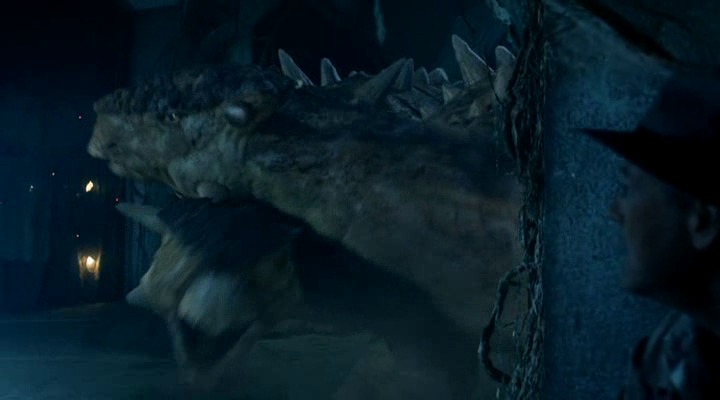 |
| Denver the Last Dinosaur? He's my friend and a whole lot more? |
Not long after this we reach our title drop because, as the Doctor and his "gang" explore the ship, the dinosaurs are unleashed. Personally I don't think the dinosaur effects are too bad in this episode; I found them to be reasonably realistic considering their level of interaction with the actors and the complexities of their movement. I guess they look a bit fake but really it's the scenario which is terribly contrived; it's painfully obvious that they've started with the idea of dinosaurs on a spaceship and written backwards from there. After the reptile-skin title sequence we get a more full look of this spaceship's interior. Frankly this set is the most disappointing of them all; it's very boring and just looks like a grey warehouse. Given that the ship's meant to be a sort of flying menagerie it's a little uninspired and falls back far too heavily on New Who's typical and inexplicable fixation on depicting the insides of spaceships as just bland industrial settings with pipes or pillars everywhere. In searching for the engine room, the Doctor, Rory and Brian get teleported to a beach and thus separated from the others for the majority of the rest of the episode, and it really shows that Chibnall doesn't really know what to do with so many characters; they've been included for their incongruity rather than out of any major interest in making dramatic sense.
 |
| Location filming in the bustling heart of Cardiff. |
So we discover on the beach that Brian Williams is an anxious traveller; "Thank you, Arthur C. Clarke!" he tells the Doctor in one of the episode's funnier moments. The beach looks awfully similar to the one used in the Weeping Angels two-parter back in Series 5 of New Who and apparently it is indeed the same one which lessens its impact somewhat. We cut back to Amy's half of the team to reinforce that Nefertiti is one of New Who's typical incredibly super hammy historical characters who spouts "olde schoole" dialogue at the drop of a hat. There's an extremely corny moment where they have to step over a sleeping Tyrannosaurus which just reinforces how pointless this plot currently is, especially since we immediately return to the beach again. The Doctor and Williams Senior and Junior discover that this beach is indeed the engine room of the ship, which is "powered by waves". We're supposed to just assume this makes sense. I know wave power is a real thing but all I see are waves crashing on an artificial beach. How does this power a massive spaceship? Then they get attacked by pterodactyls, which are in fact pteranodons apparently. Would ptero-anythings really be that dangerous? They don't appear to have teeth or claws, and it's believed that they ate fish. Nonetheless the Doctor and the Williams father-and-son duo scarper to an extremely convenient nearby cave which happens to be right there.
 |
| "What are all those people doing with that camera?" |
All these moments would seem completely frustrating in their absurdity had they occurred in some of the other worn-out stylistic templates of New Who but the absurdity is alleviated consistently by the very kid-friendly atmosphere of the whole episode; the plot moves along at a decent clip and the sense of threat from the dinosaurs isn't laboured. Basically the overall silliness compliments the concept, which is an improvement over something like "Asylum of the Daleks" where the plot holes were only enlarged by the episode's enormous confidence in its own profundity and gravitas. Such delusions of grandeur are simply not present here, to this episode's credit. This is compounded when the Doctor, Rory and Brian are captured by a pair of "funny robots" voiced by contemporary British comedy duo David Mitchell and Robert Webb. Essentially we've gone so far full circle that we've come back to the days of 1989's "Survival", Classic Doctor Who's final serial, in which a pair of shopkeepers were played by 80s comedy duo Hale and Pace. It's rather curious considering David Mitchell's earlier critiques of Doctor Who but I guess maybe it's been a slow year with only a new series of Peep Show on the cards or something.
 |
| I'll let this one speak for itself. |
So we return to Team Arbitrary Plot Exposition as Amy is now super competent with alien technology. Well actually, it's Silurian technology; the appearance of a New Who Silurian, played as ever by Richard Hope, is revealed with a series of ominous chords. This I don't really understand; at least some of the Nu-Silurians have been twice now depicted as friends and allies of the Doctor. Regardless, this is a good explanation for why dinosaurs are present; Silurians brought them along during a migration from prehistoric Earth. This was something which I think could have used a little more development; we know that traditionally the Silurians went underground to hide from cataclysmic events. Why was this group in space? It could have been tied, through a little plot re-working, to the idea from the end of "Cold Blood" that the Silurians would emerge from hibernation some time in the thirty-first century but sadly this opportunity was missed, and I guess it wouldn't necessarily explain the dinosaurs. Speaking of dinosaurs, returning to Team Wandering Around, Brian Williams is approached by a triceratops which starts sniffing his trousers. What could it possibly have to inspect there? "Only my balls," Brian Williams comments stoically. Really, Chibnall? We get a lot of innuendos like this about "powerful weapons" and so on which really are an odd contrast to the otherwise child-friendly tone. I guess it's just a traditional "something for the parents to chortle about" element; presumably it'd be over most kids' heads. Having distracted Mr Triceratops the "funny robots" bring the Doctor to a piratical spaceship which Amy has discovered to be lurking at the heart of the Silurian vessel. This is really where the CGI in this episode unfortunately hits rock bottom because the pirate spaceship looks very fake, like something from an early 2000s video game cutscene. Could have been done more realistically with a model!
 |
| David Bradley plays every 70s rock musician still living. |
The Doctor is introducted to slimy villain du jour Solomon, an injured and very obviously evil space trader in the traditional "mercenary attitude" vein played with his usual menace by a well-cast, if somewhat typecast, David Bradley. The Doctor also gets to make a somewhat homoerotic suggestion about Franz Schubert. Solomon gets the pointless robots to injure Brian so that the Doctor will repair his own injuries, and thus we get to have our subplot of Rory earning the respect of his dad as he becomes all protective and shows off his nursing chops. These scenes are nicely subtle and come across as reasonably sincere. It's a shame the "funny robots" simply aren't funny, although I suppose it reinforces how disturbing the robots are. I like the like when the Doctor says that "I never talk about myself with a gun pointed at me," when of course the real guns are pointed at his friends. This is a good indication of the Doctor's great compassion and, fortunately, isn't explained for the benefit of the thickies. It's also nice to see the Doctor doing some genuine medical work even if it isn't given much attention. I know he's a Doctor of Everything, not specifically a medical Doctor, but it's still satisfying to see his expertise taken for granted like this. Solomon also scans the Doctor to learn that he doesn't exist apparently, which lends further suspicion to how this "Doctor who?" thing is going to play out. It turns out Solomon killed off the Silurians on the ship to get at the valuable dinosaurs, and the Doctor accuses him of committing "piracy and genocide." The thing is though, why did the Silurians send out the distress signal in the first place? I'm not sure it's ever explained. The Doctor complains that the dinosaurs "are not objects to be sold or traded." Why did he bring Big Game Hunter Riddell then? To teach him a lesson? It's never explained. He suggests that Solomon not "ever judge me by your standards," despite having committed a little genocide in his time but I suppose in the Doctor's case it generally wasn't for personal profit.
 |
| This scene is why we're only getting five episodes this year. |
Anyway the Doctor, Rory and Brian with the smelly balls escape on a triceratops, which is a bit of a silly set piece, emphasised by what absolutely terrible shots the two robots are. "We definitely used to be faster," complains the David Mitchell robot, in probably the only genuinely funny and Mitchell-and-Webb-esque gag from the "funny robots" in the whole episode. Apparently riding this lumbering dinosaur is faster than running because our intrepid heroes pop around a corner and appear to have escaped by doing just that. Maybe they travelled further between shots? The Indians have launched their missiles, apparently being able to communicate directly with the Silurian ship so the Doctor can complain, but we know it's not a real threat. Similarly, Riddell busts out some "stun guns" which for some reason are cocked like pump shotguns and look like conventional human weaponry despite the fact that every other time we've seen Silurian weapons they've looked very unusual. Rory asks if there are weapons on the ship which prompts the Doctor to kiss him with joy; I found this bit surprisingly funny and am still surprised at how much it didn't irritate me. Anyway Solomon reappears because he wants to claim Nefertiti who has a "face stamped across history." This was not played up enough at all in my opinion, largely due to how frantic the character action is due to the excessively large cast and makes her seem like even more of an arbitrary plot device. This time he turns to killing off the dinosaurs, which offends the Doctor because he is a friend to all of god's creatures; this is contrasted to the complete inhumanity of the robots, which I suppose is a change. Nefertiti hands herself over so Solomon can make some very unpleasant salacious suggestions reminiscent of how practically every villain treated Peri back in the Sixth Doctor's day and the baddies scarper; they can't escape though, because the Doctor has "magnetized" Solomon's ship somehow. It's never explained how or when this happened.
 |
| "Hello there. How are you enjoying the programme so far?" |
The Doctor and friends meanwhile escape to the Silurian control room which looks like absolute crap thrown together on a budget which had mostly been devoted to CGI dinosaurs. In one of the most ineptly convenient plot moments in the episode, two people of the "same gene chain" are required to fly the ship so of course this falls to Rory and smelly-balls Brian. The Doctor cracks a joke about monkeys which would have been a lot funnier had he not said "comedy gold" just after. We get some equally heavy-handed foreshadowing of later plot developments as Amy and the Doctor talk about his increasingly sparse visits and which of them will outlive the other. Meanwhile Riddell needs some assistance defending the control room from what are either Jurassic Park-esque "legitimately dangerous" velociraptors or baby tyrannosaurus'. He and Amy team up to fight while the Doctor pops over to Solomon's ship to rescue Nefertiti. We get another forced 2001: A Space Odyssey reference as the robots sing "Daisy Bell" upon deactivation. Then the Doctor sets the missiles to track Solomon's ship instead of the Silurian Ark and leaves Solomon to die. "Did the Silurians beg you to stop?" he asks Solomon, being quite harsh but not unusually so given what's happened in some Classic stories. The shot of Solomon's ship flying out from the Ark looks bloody cheap and awful in what is probably the worst CGI in the episode; it is of course destroyed with one of those big noisy space explosions.
 |
| Dyb dyb dyb dob dob dob. |
Amy and Riddell take out the dinosaurs in a fit of what borders on coital fury to the extent that I'm surprised they didn't light up cigarettes at the end and the day is saved now that Brian and Rory have used the convenient video-game controls on the Ark to fly it away from Earth. Brian makes one request of the Doctor in what is probably the best moment in the episode and one of the most genuine in New Who; he takes the opportunity to observe Earth from space, while having a cup of tea no less. Given that viewing Earth from space is indeed meant to be quite a sight I thought this was an excellent choice and managed to be rather touching without being remotely cheesy or melodramatic. The whole thing of Rory earning his dad's respect is not overplayed to any extent; this is the way to do the 'parent in the TARDIS' thing (if it needs to be done at all).
 |
| We're watching you. |
Now we just wrap up the plot with Nefertiti bizarrely ending up with Riddell back in 1902 and Rory and Amy receiving a bunch of extremely fake-looking postcards from Brian's travels. So he got over his fear of travelling, how nice. And the Doctor found a home for the dinosaurs 'cause he's such a champ. All in all this is a damn silly episode but as I said at the beginning, it's inoffensively so; most of the dialogue is not especially cringe-inducing. The most objectionable material is the excessive amount of really laboured innuendoes. Once again, the sense of kid-friendliness helps this episode a great deal because it doesn't take itself very seriously except in regards to the issue of Solomon where it matters. We got a nice if rather underdeveloped futuristic setting and Matt Smith getting to do the funny stuff without too much excess. On the other hand there are way too many companions and the scenario really does feel very contrived. Riddell would have made an interesting contrast to Solomon, for instance, but he's never developed so it's a missed opportunity. Solomon and the dilemma he poses is fairly trite as well, but I think it was handled in a sufficiently interesting fashion to be adequate. All in all it's not memorable Doctor Who at all but it was better than I expected and these days that's almost all you can ask for.
Monday, September 3, 2012
"Asylum of the Daleks"
"Lunatics running the asylum" has always been an apt description of Doctor Who's 21st Century revival given that it has been written and produced by, mostly, embittered Classic Series fans who never really liked the show they were brought up on in the first place. Never has it been more evident than in the observable deterioration of Steven Moffat's writing quality over the period from 2010 to now, in which a fresh start to a shallow reboot regressed back to different, but ultimately comparable, forms of shallowness and simplicity. "Asylum of the Daleks" is, in my view, not a very good episode at all. To put it simply, very little happens, it takes itself far too seriously, the plot is rather contrived and its characters are extremely wearisome. My key word for this review is "unnecessary" because it describes huge amounts of the action.
 |
| "This whole episode was a trap." |
 |
| A surprise appearance by the late Peter Cushing? |
 |
| The Daleks aren't completely inhospitable. |
 |
| "They got me a long time ago." |
 |
| "YOU! WILL! BE! IMPRESSED!" |
Finally we get to the titles. We've moved to a rather simple lettering which I find looks a bit cheap. I noticed that the DW-TARDIS symbol only appears for about half a second. Did it not catch on as well as they wanted?
 |
| "But I'm too perky to die, Doctor." |
 |
| "Welcome to the Giant Blank CD of the Daleks." |
 |
| A weak parody of Cameron's Tory government? |
Now we're beamed down to a snowy planet for a nice change of pace. There's an unnecessary guy in a snow suit and we discover that the girl on the planet has a zany space name to go with her zany space clothes: "Oswin Oswald." Rory's disappeared; he's been separated from the Doctor and Amy because as usual the writers for New Who don't know how to handle more than one companion. He's been beamed down to a Dalek dungeon where the story is going to be trapped for the remaining half an hour of viewing. There are a bunch of dusty old Daleks down here; I guess they're meant to be scary. One thing that was bigged up about this story was that it was meant to have Daleks from "every era of the show" but these just look like RTD Daleks covered in dust to me.
 |
| "But I was only gone two minutes!" |
Oswin Oswald starts making jokes about the Doctor having a big chin, because apparently everyone thinks the same way in Moffat-verse and comes up with the same remarks about people. She claims to be a complete genius and also quite sexy, to explain how she's able to communicate with the Doctor via all this hacked Dalek technology. So basically she's another cookie-cutter Steven Moffat "empowered woman" full of witty quips and flirty dialogue. The Dalek zombies took Amy's wristband so now she's being converted by nano-robots in a way awfully similar to her control by the Weeping Angels back in Series 5. Really it's just every Moffat trope jammed together.
 |
| There he is! On the left! How nostalgic! |
 |
| "Doctor there's... there's a good episode in here!" "Come away from there Pond, it's dangerous." |
 |
| "No, I don't know why he wrote it this way either." |
The Doctor's approaching Odlaw's position but first he has to go through "intensive care" where the survivors of Classic Series Dalek operations in places like Kembel and so on are kept; if there are indeed Classic Daleks present in these scenes (as allegedly there are) they are barely recognisable under enormous layers of dust. What was the point of having them, then, except maybe an effort to encourage militant Classic Series fans to watch the episode by bigging them up in pre-show publicity?
 |
| I sympathise, Doctor. I really do. |
 |
| This is how I felt. |
 |
| "Deal with it, bitches." |
So that's my recap-review of "Asylum of the Daleks": it's badly-paced because nothing happens for ages, the plot is full of contradictions and it's obviously meant to wow us with impressive images and bombast rather than making sense or expressing something particularly intelligent. It has been suggested elsewhere that the show is (or has gone back to) being written for fat girls on tumblr and I really can't help but agree; it's cynical and shallow, full of grandiosity and laboured emotional drama at the expense of coherent storytelling. The lunatics are definitely running the asylum.
Monday, July 30, 2012
Torturing Tolkien: The Hobbit as a Trilogy
"Art or cash?" This question confronted J.R.R. Tolkien way back when contemplating the potential for film adaptations of his works. Despite wishing to preserve his integrity, he couldn't deny the appeal of selling the film rights for a substantial fee to better provide for his family. Unfortunately, it seems like the Professor's worst fears have been realised. The Hobbit is a relatively short novel, especially as Fantasy stories go, and a year ago it was a little difficult to imagine the book as the two films it was being split into. Then came the news that much of the backstory was going to be fleshed out, that the films would effectively be a prequel to The Lord of the Rings. Here my fears were heightened. It seemed that we were going to get a fair bit of the film devoted to what Gandalf and his chums were up to while Bilbo was in the Gandalf-less parts of the adventure, and we'd see them dealing with the Necromancer, who as you hopefully know is Sauron. None of these were sections of story which the Professor described in any particularly great detail, and certainly not with any kind of immediate narrative or dialogue, so it looked like Peter Jackson and friends were getting onto the task of "fleshing out" the bits the Professor hadn't fully developed in order to make a bulkier film. It looked like, by and large, we'd be distracted from Bilbo, that the tone was going to focus much more heavily on anticipating the events of The Lord of the Rings and that overall what we were going to get wouldn't really be The Hobbit at all.
It's becoming increasingly well-known thanks to the publication of the History of the Hobbit, a compendium of the Professor's draft material and commentary edited by John D. Rateliff, that Professor Tolkien himself once sat down in the Sixties and attempted to entirely re-write The Hobbit from scratch. He was dissatisfied with its occasionally childish tone as well as its periods of inconsistency with the more rigorous geography and history he had devised for The Lord of the Rings. Ultimately, however, he gave up when a friend reading over the material told him that as good as it was, it just wasn't The Hobbit anymore.
Apparently that was enough for Professor Tolkien; The Hobbit could stand on its own, and was a success in its own way. Indeed given how successful it had been upon its original publication it was clearly independently sufficient. This is clearly however not good enough for either Peter Jackson, or for Warner Bros. who stand to make a colossal windfall from these films should they reach and maintain something equivalent to the absurd hysteria achieved by the trilogy of The Lord of the Rings adaptations. Peter Jackson I don't know about. Is he a greedy bastard or just kind of incompetent? I get the impression of a bit of a bumbling director who makes these Tolkien films with a sort of hazy, vague understanding from reading the source material once decades ago and keeping a synopsis close at hand. Boyens and Walsh, moreover, come across as just not knowing what they're talking about half the time, deriving most of their knowledge of the texts from a relatively rigorous but ultimately superficial reading of the Professor's published work, with emphasis on what bits can be teased out and made into something Hollywood-digestible and letting the more archaic elements go hang. What disturbs me the most is that people seem to think that these filmmakers are die hard Tolkien fans when by their own admission their knowledge of the books is sporadic and far from intensive.
Given that so much of Professor Tolkien's work is concerned with the futility of preservation and the inevitability of change it disturbs me that adaptations of his books are now being spun out as endlessly as possible. I think he knew as well as anyone how tempting both answers could be to the question: "Art or cash?" As much as I think Peter Jackson is happy to draw his own conclusions about the integrity of the project I think Warner Bros.' stance is obvious. It's cash for as long as possible.
Basically what I'm saying is that the people making these films are both Smaug and Sauron.
Wednesday, July 25, 2012
The Opinions Can Be WrongCast: The Avengers vs The Dark Knight Rises
The Opinions Can Be WrongCast - The Avengers Vs The Dark Knight Rises
In an effort to revitalise the podcast series, we present a shorter and more focused renewal comparing Marvel and DC's latest blockbusters, touching on both companies' respective cinematic futures including the recent teaser for Man of Steel.
Wednesday, July 18, 2012
The Dark Knight Rises
It's been six long years and Christopher Nolan's vision of Batman has finally come to an end. It all started way back in 2005 with Batman Begins, a refreshingly serious and realistic take on the Caped Crusader which was a very thorough and interesting origin story which had never before been fully explored onscreen for the character. This was of course followed with smash hit The Dark Knight, which amped up the gravitas and intellectuality of the concept to whole new levels. If I would aim any criticism at The Dark Knight, it would be that as much as I enjoy it as a film it doesn't feel like Batman. Batman Begins did a good job of blending certain more fantastic elements of the mythos like the League of Assassins (or "Shadows" in this continuity) and Ra's al Ghul, plus grotesquerie like the Scarecrow with his fear toxin into a satisfyingly gothic depiction of Gotham which nonetheless felt reasonably plausible. In The Dark Knight what we received was an excellently confronting and intense crime drama but one which felt very little like a superhero film anymore. In striving for realism and grittiness Nolan possibly began to perpetuate that issue which has always shadowed comic book superheroes since the mid-80s: an element of defensiveness about the inherently ridiculous nature of the genre, an effort to hide what is integral to the concept. You can make the Joker just a nut job in makeup and have plots about mob money and turn Two-Face into a rogue vigilante rather than a crime boss but in the end it's still a film about a billionaire who dresses in a bat costume to fight crime. There's only so realistic you can make it before it starts to feel, in my view, like it's somewhat missing the point.
Unfortunately this descent into morbidity and hyperrealism only continues in The Dark Knight Rises. Following the conclusion of the previous film, Batman has retired and Bruce Wayne has spent eight years as a recluse. The film hybridises elements of the The Dark Knight Returns, Knightfall and No Man's Land storylines into a film about Batman returning to work to fight Bane who has cut off Gotham from the outside world and placed it under mob rule. The film owes a lot, narratively, to Batman Begins more than The Dark Knight, and it's obvious that Nolan was trying to make the film feel like an effective sequel to both previous instalments simultaneously. The League of Shadows is heavily referenced, Ra's al Ghul appears in a brief cameo and Batman is returned to far-flung and exotic parts of the world but simultaneously much is made of the death of Two-Face and Commissioner Gordon's efforts to cover up his killing spree at the end of The Dark Knight. What makes this jarring is the complete absence of any mention or reference whatsoever of the Joker. It was increasingly obvious to me over the course of the film that Heath Ledger's death had thrown an even more massive spanner than was already expected in the proverbial works in terms of making an effective sequel to The Dark Knight. Nolan and co excised any account of the Joker out of respect for Heath Ledger, and while this tact is commendable it feels awkward when they reference the events of the previous film. He is, to put it simply, conspicuous by his absence.
The main villain, therefore, takes the form of Bane. I wonder if, perhaps, given Joker's absence, it was a mistake for Nolan to have eliminated Two-Face in the same film, arguably Batman's next most dangerous villain, or to have reduced Scarecrow to such a secondary antagonist. It feels like Nolan was scrabbling around for another Batman foe who could be portrayed as realistic; obviously characters like Mr. Freeze, the Penguin, Poison Ivy and Clayface were out of the question and it would be impossible to make Riddler realistic without putting him in the position in which he so often finds himself as little more than a poor man's Joker. Personally I always thought that Black Mask would have been a good choice of enemy in Nolan's Batman-verse but perhaps having a skull-themed villain so soon after Captain America wouldn't have worked anyway. Deadshot might also have had potential as a supporting foe, or perhaps Professor Hugo Strange.
Nonetheless we get Bane, and I suppose he's one of the more plausible members of Batman's rogues' gallery. However instead of a luchadore-masked Venom addict criminal mastermind, this film portrays him in a rather more bland "realistic" style as a terrorist trying to fulfil Ra's al Ghul's legacy with the assistance of a mask which provides him with constant anaesthesia, necessary after sustaining never-fully-disclosed injuries in his past. Instead of being Hispanic he speaks with a rather bizarrely exaggerated English accent and always walks around the place clutching his lapels. At first I thought it was an interesting depiction of Bane as an affably evil monster, and satisfying to see him depicted as the genius brute portrayed in the comics. However as his aims as a boring movie terrorist were increasingly established and he developed a propensity for delivering tiresome, cliché-ridden monologues I became increasingly exhausted with his presence. Some would argue that it would be impossible to have another villain as successful as Heath Ledger's Joker but I believe they made a mistake in turning Bane into a jovial English gent. It would have been more effective, in my opinion, to have had a villain which contrasted to both the humorous insanity of the Joker and the collected self-assurance of Ra's al Ghul by depicting Bane as still calculating and intelligent but furious and raging. Sadly it was not to be, and Bane becomes increasingly tedious as the film continues. Tom Hardy does as good a job as he can in the restrictive mask to portray Bane but he's let down by a weak script which leaves the character ultimately unfulfilled.
The other classic Batman character introduced in this film is Catwoman. Never referred to as such, only on a newspaper headline as "the Cat", Selina Kyle is once again a master thief and cracksperson intent on discovering a device called the Blank Slate which can erase one's existence from all records. The film maintains the typical depiction of Catwoman as a relatively neutral and self-interested character who turns to good only in duress or out of affection for Batman but in this case she's also trying to start afresh by erasing her criminal past. Shame she's got to commit crimes to stop being a criminal! Anyway if any character felt like a forced love interest for Batman in this film it was her. As the ultmate successor to Rachel it seems as if they just wanted Batman to have someone with whom to settle down. She disappears about halfway through the film and seems to have been practically forgotten about by the writers until the end. To be honest, I've never been much of a fan of Anne Hathaway in anything I've seen her in and this didn't change my mind. The film takes the predictable route of making Catwoman into a hybrid action girl-femme fatale as usual and doesn't really achieve much with the character. She changes her mind about being completely selfish and saves Batman in the end. Whoop de do. Maybe if Bat-fans hadn't seen this exact scenario last year in Batman: Arkham City it would have seemed more original, but probably not.
We get a couple more new faces as well in the shape of Marion Cotillard's Miranda Tate and Joseph Gordon-Levitt's John Blake. To be honest at this point with these two plus Michael Caine, Tom Hardy and a small role for Cillian Murphy returning as ever as the Scarecrow the film starts to feel like Batception at times. Miranda Tate serves as an initial romantic interest for Bruce Wayne in a contrived and implausible love story as well as a protector of the Wayne Enterprises financial interest due to bizarre economic factors which are over my head. Of course, spoilers beware, she turns out to be none other than Talia al Ghul, daughter of Ra's, out to complete her father's mission. John Blake, on the other hand, is a "hot head" police officer, a straight-edged "good cop" who helps out Batman and Commissioner Gordon and, as revealed by his birth name at the end of the film, serves as Nolan's extremely realistic interpretation of the character of Robin or effectively any sidekick to Batman. It is of course heavily implied at the conclusion of the film, in a revelation as predictable as possible due to an early scene where Bruce Wayne tells Blake that "anyone could be Batman" and in a later one where Batman suggests that he wear a mask, that he will become the new Batman. Indeed Batman himself spends a good deal of the film incapacitated, imprisoned or otherwise unavailable and as our supporting protagonist Blake fills the void of a hero very well, but it only serves to compound the impression that Nolan wants to make a Batman film which is as far removed from Batman as possible. You could believe, I think, that Nolan wouldn't have objected to making a film where Blake himself was the main character without any kind of comic book elements.
This leads me into the narrative of the film. It's all rather disappointingly simple; Bane is gathering a secret army of terrorists underground. When the time is ripe he blows up all the ways into and out of the city, has a scientist turn an experimental fusion reactor into a bomb and gives the citizens of Gotham a month or so of total anarchy before the bomb blows them all to Kingdom Come. This is all revealed to be part of Talia's effort to live up to her father's plan to destroy Gotham. Ultimately it feels far, far too much like nothing more than a re-hash of the plot of Batman Begins. Terrorists appalled at the decadence of Western civilisation want to destroy the city. Both of these plots end with a vehicle chase in which the relevant weapon of mass destruction must be hunted down and eliminated before time runs out. They both have a character twist where an associate of Batman is revealed to be orchestrating the entire plot. It is of course in the serialised nature of superhero comics to repeat some of their narrative conceits from time to time but this is ludicrously overt and, in this regard, seems to detract from Nolan's efforts to divorce the series from the less realistic aspects of superhero comics.
There's also a subplot where Bane injures Batman's back and leaves him in a prison in what appears to be the Middle East somewhere from which he must escape by mastering himself in some fashion. It's all awfully similar again to bits from the first half of Batman Begins. Once he's out he heads off to Gotham, there's a big battle and he apparently sacrifices his life flying the bomb out over the bay to save the innocents. Of course it turned out in reality he survived and is off living a wonderful old life with Catwoman in Europe. How lovely.
My point is that really it feels like a whole lot of nothing. The film drags on and on, going for nearly three hours, and at no point, in contrast to its title, does it really rise above its precursors and deliver something new to the plate. We are beaten over the head with neon signs advertising hard-edged psychological realism and character trauma but none of it feels especially profound or moving. Batman needs to recover value in life; that's about it. I realise that Nolan wanted to provide closure to his take on Batman and it's satisfying to at least see the property treated with that kind of literary seriousness; we don't end with alarm bells and someone shouting out that Killer Moth has just robbed the bank as Batman swoops back into action or anything. This feels conclusive and final, but it doesn't change the fact that it's long-winded, dull, and takes itself way too seriously. Batman Begins had, as I've said, elements of the fantastic and gothic, and while The Dark Knight moved perhaps a little too closely to the real the Joker's unique worldview was another important intrusion of the outlandish. The Dark Knight Rises lacks these elements in anything beyong a reprisal of what has gone before. The ticking time-bomb plot is devastatingly unimaginative and stale, Batman's inner journey takes him nowhere special and the other characters are underdeveloped and underused. The mere fact that Batman spends so long locked in a prison rather than out fighting crime as Batman, which is what we all want to see, is teeth-gnashingly frustrating. Perhaps Nolan understands this and wants me to be frustrated; perhaps in wanting to bring the normally endless world of a comic book hero to absolute closure he knew that we had to want it to end. Maybe in that regard the film is a success; it's an ending that left me not wanting any more, and I guess that's the best kind of ending.
Technically it's all very good and the direction is up to Nolan's usual high standard. The action set pieces and effects are all well done and the horrific unpleasantness of anarchy in Gotham is impossible to ignore. It is, perhaps, as good an end as could be expected while bringing the series to a realistic conclusion, but in this way it again reinforces the notion I can't shake that trying to make superheroes realistic is an interesting experiment but ultimately misses the point. There are a number of funny moments, although perhaps not enough, but the script is inconsistent overall and even in the time it takes it tries to do too much. It is, in my view, definitely the weakest instalment in an otherwise very good series, and feels too much like Batman-minus-Batman. If it taught me anything, it's that superheroes shouldn't be realistic - because they're not.
Sunday, June 17, 2012
"The Death of Captain America" Omnibus by Ed Brubaker et al
The title of this second collection of Ed Brubaker's already-legendary run writing Captain America is something of a misnomer. Having already killed off Steve Rogers in issue #25, concluding the first omnibus but reprinted in this one for our convenience, Brubaker now sets about addressing the consequences of the death of the Sentinel of Liberty and establishing his replacement. What makes this sequence interesting is that for nearly ten issues we have no Captain America whatsoever. Brubaker instead explores the ramifications of the death of such a figure by diffracting the storyline across Steve's bereaved supporting cast in a series of related plot threads which are weaved together in a way which answers questions as much as it asks them. Sharon Carter, the Falcon and the recently-resurrected Bucky, with the later addition of the Black Widow, all have their roles in pursuing the story beyond the inconveniencing of the series' regular protagonist. The point is that while Steve Rogers is dead Captain America must live on, especially since the nefarious schemes of the diabolical Red Skull are still very much in motion.
Brubaker does a very good job of thoroughly developing this supporting cast into a leading ensemble so that despite the absence of Steve Rogers and indeed any kind of "Captain America" for many issues there's no sense of alienation from the actual substance of the story. Indeed despite the obvious triviality of comic book death and the inevitability of Steve's return it's a refreshingly mature style of storytelling in an inconsistent genre. While the characters are important it prevents the story from being excessively character-focused to the detriment of dramatic integrity. Steve is gone, but the fight must go on, and Brubaker pulls this off with his usual competence. Naturalistic dialogue peppered with useful but not condescending explanations and reminders of certain elements of Cap lore give the story a strong sense of continuity with the ever-ongoing Cap mythos but in a way that is digestible for those unfamiliar with every adventure in Cap's sixty-plus-year history. Some elements, like the reintroduction of William Burnside, aka "the Captain America of the Nineteen-Fifties" are done in a concise yet compelling manner, especially through his interactions with Sharon. Other aspects of the storyline, like Sharon's brainwashing, are less explained than they could be and seem to spring into being without a great deal of explanation beyond some undisclosed talent of Faustus. Sin and Crossbones, with the assistance of a new Serpent Society, continue to be annoying but Brubaker's writing makes these absurdist elements increasingly plausible.
A great deal of this is contributed to by the artwork. Pencils from Steve Epting, Butch Guice and Mike Perkins are all fairly consistent and layer a healthy dose of realism over the whole business which makes any potential silliness fairly easy to swallow. Someone I failed to credit when reviewing the previous Brubaker omnibus is colourist Frank D'Armata, whose colours, occurring in every issue in this collection, tie the entire series together in ways that I hadn't appreciated at first. His soft palette and painterly style are an essential component of the way in which these stories implore our suspension of disbelief. This is what I like about this series, and it's something I think benefits Captain America and Brubaker's style of storytelling in particular but could apply to many comics: a sense of solidity and rationality which makes the stories feel plausible and flow naturally. The writing and artwork are all very proficient individually, but the value of their application in this medium is how they come together to form such a complete whole. My one criticism in this regard in the art department would be Roberto De La Torre's artwork for issue #39: it's a somewhat more exaggerated and certainly more heavily inked issue which feels out of sync with all the other issues around it. It's a more impressionistic style which I feel conflicts somewhat with the tone and aims of the rest of the comic, although given the appearance of crazy Burnside-Cap in this issue maybe that's appropriate. In that regard I might also mention that I'm not sure Burnside's monologue is always written that well; he seems to think in the second person, which I suppose is interesting, but which I feel comes across as too much "tell" and not enough "show", as Burnside seems to be having a rather heavily character-expository discussion with himself for our benefit. It could be subtler.
Bear in mind however that these are minor quibbles. Brubaker's primary achievement in this storyline is the establishment of Bucky as the new Captain America. It would of course be impossible for anyone else to replace Cap and really feel "right" in the role, and Brubaker makes sure that we know it. Despite obvious misgivings, Bucky works as the new Captain America and he is well-established as a fitting bearer of Steve's legacy. Putting a character on a path to redemption is a tried and tested way of making them sympathetic and believable and Bucky's efforts to make up for the deeds of the Winter Soldier by becoming the new Star-Spangled Man provide some healthy if not entirely original character development. Giving Bucky an altered costume and a plainly different attitude and style means that we can read this series as Captain America
without having to pretend that Steve is still around
, although he of course haunts the storyline immensely. Steve Rogers as Captain America and "Bucky Cap" are two related but different entities, and it works as such. Bringing Bucky back and making him into Captain America also ensures that the sense of continuity is absolute: one of the two members of the original Captain America team is still very much the hero of the book.
Overall I'd recommend this second omnibus as a valuable follow-up to its previous instalment. If you just want lots of sequences of Cap beating guys up (although there is a fair bit of that) you're probably not going to get as much out of this story, especially if you only want Steve, but if you want a mature storyline with a healthy dose of intrigue and a strong cast then it's definitely worth continuing the adventure beyond Steve's apparent demise. If you want to see Tony Stark repeatedly looking like a complete moron this is also worth checking out, coming as it does right after the events of the Civil War crossover. As our eventual protagonist Bucky is likeable and vulnerable in different ways to Steve Rogers and is a worthy bearer of the shield. Brubaker plays to his strengths of fusing superheroic derring-do seamlessly with spy-fiction and political drama and the fulfilment of this with satisfying artwork is an encouraging continuation of a robust series.
Subscribe to:
Posts (Atom)