|
| "I can't breathe in this thing!" |
When the subtitle of the third
Captain America film was revealed to be "Civil War", I was disappointed but not surprised. I must admit I've never actually read the "Civil War" Marvel comics event, but there's a good reason for that; I was going to, but other than the fact that I would have had to have purchased about a dozen trade paperbacks in order to get the complete story, I did some research and found that it apparently wasn't very good. Added to this was the fact that I was introduced to the storyline by reading the first Omnibus collection of Ed Brubaker's celebrated run on
Captain America, and I remember feeling rather annoyed at the time that Brubaker's standalone storyline featuring the reintroduction of Bucky as the Winter Soldier was interrupted so that Captain America could go off and get himself arrested in a completely different comic book. They even had to put a page into the omnibus explaining what had happened in the comics from
Civil War that they naturally hadn't included as they weren't by Brubaker. All of those things put me off reading
Civil War, along with the fact that it's by Mark Millar, who has gone from writing interesting character studies like
Superman: Red Son to being a purveyor of adolescent shock-schlock which seems to think that the best way to do something original with superheroes is to have them swear a lot.
 |
| "Just have a chin strap, like me." |
The trailers for this third
Captain America instalment did little to improve my disposition towards the film. It looked, much as
The Winter Soldier was in some respects "Avengers One and a Half", to be "Avengers Two and a Half", as not only was almost every Marvel Cinematic Universe hero other than Hulk and Thor going to appear, two more would be introduced: Black Panther, a character in which I've never been interested, and Spider-Man, who in my opinion was never been handled successfully in any of his 21st Century iterations. I had to find out, however, so like a good little consumerist slave I went and dutifully saw
Captain America: Civil War today, fully expecting more of the "well-presented mediocrity" which has become my personal subtitle for the entire cinematic franchise. Would this be more like
Captain America: The First Avenger, my favourite Marvel film but one which is regularly mocked for supposedly being stupid and/or boring by many with whom I discuss it, yet is the one that made me interested in Marvel comics and the character of Captain America in particular, who is one of my favourite superheroes, or would it be more like
Captain America: The Winter Soldier, the highly-acclaimed sequel which I personally found to be dry and repetitive?
 |
| "Your chin strap looks stupid." |
We begin in 1991 with - who would have guessed - HYDRA, although at least in this case they appear to be Russian HYDRA people using some old Soviet "manual" for operating Bucky full of code words to control him. Obviously they have to use HYDRA but I'm certainly getting tired of seeing them. It also confuses the issue. Is Bucky a Soviet
and HYDRA creation simultaneously? Was he created by HYDRA operating
within the USSR? I guess so, but it's not terribly clear. Bucky's sent on a mission to go crash a car and kill any witnesses, so hopefully there were no wilderness ramblers nearby as he easily dispatches the vehicle in the woods somewhere. In the boot of the car are five blood bags full of blueberry Gatorade. How mysterious. One thing that I'm starting to find very tiresome about these films is their penchant for glowing McGuffins and pieces of science-fiction technology appearing in a present-day setting with no explanation. No one like Tony Stark exists in the real world; we don't have floating hologram diagrams and technology isn't made of blocks of metal covered in glowing lights. It's a petty complaint but it does cause me to struggle to suspend my disbelief a bit.
In the present day, Captain America and his backup singers are in Nigeria, preventing Crossbones from nicking some biological weapon. He was clearly a convenient supervillain to use at this point, but his presence feels arbitrary. If you're not familiar with Crossbones, he was traditionally one of the Red Skull's main enforcers, hence his name. In this he's more or less a stooge who has a punch-up with Cap while the Avengers dispatch his team. When he tries to blow himself up, however, Wanda the Scarlet Witch catches him in a red energy bubble or whatever it is she does, throwing the explosion up into the air and causing more of the collateral damage we've come to know and love from modern action films.
 |
| "What did you just say to me?" |
I can't quite remember if it's the sequence immediately before or after this, but at some point we see Tony Stark giving a speech at MIT alongside a disturbing recreation of the last time he saw his parents, including a characteristically rubbery-looking CGI young Robert Downey Jr., whose voice still sounds like that of a middle-aged man. We also see old Howard Stark again; I was surprised enough when he reprised his
Iron Man 2 role in
Ant-Man. I wonder how much they offer these actors for these bit parts? I guess for a lot of them any Hollywood exposure is worth the triviality of the part. Stark the Younger gets all sad when the autocue mentions Pepper, who has apparently pissed off, probably because Gwyneth Paltrow got sick of the role, and he's confronted by a woman from the State Department whose son was killed in the Former Soviet Republic of Fictionalia, aka "Sokovia" in
Age of Ultron. Time for Tony Stark to have his third or fourth emotional breakdown in as many film appearances. Back at Avengers HQ, the actions of Cap and his team in Nigeria turn out to have been a bad move PR-wise; despite appearances (and the fact that they saved countless people from a biological weapons disaster), apparently there were casualties from this mission and people are questioning whether the Avengers are being held sufficiently accountable for the damage. Notice anything, like for instance that this doesn't have a great deal to do with Captain America specifically? He's the leader of the team, I suppose, but these links aren't made especially firmly. Paul Bettany's Vision, introduced in
Age of Ultron, makes a welcome reappearance and is amusing-looking in casual clothes. Where was he when they went to Nigeria? Watching the base or something? It's like Red Tornado in the Justice League Watchtower; what's with superhero teams leaving their android member behind to keep the seats warm?
 |
| "Oh you heard me." |
What is more surprising is seeing William Hurt reprise his role as Thunderbolt Ross from 2008's
The Incredible Hulk, which I assumed had quietly been more or less dropped from continuity after they failed to secure Edward Norton as Bruce Banner for any future films. This further raises the question I asked in
my review of Age of Ultron: what happened to Betty? Does Banner not care about her any more now that apparently he's into Black Widow? Anyway, Iron Man's brought him along to tell the Avengers (Cap, Falcon, War Machine, Black Widow, Vision and Scarlet Witch) that everyone's getting fed up with all the mess that's left behind whenever the Avengers go into action and the UN wants them to be brought under their supervision. Apparently whenever the Avengers have finished blowing things up all over the world they then piss off back to their headquarters and shoot pool or something because there's an implication that they never stick around to clean up the damage they've caused. I found this a surprising remark. Surely Cap would stick around; part of the climax of
The Avengers involved him working to get civilians to safety. The problem seems confused to me. Is it that the Avengers are seen as a private organisation that acts without jurisdiction or permission in foreign nations, or the fact that they cause collateral damage, or the fact that they don't help clean it up afterwards? I suppose it's all of these things, and Ross does hand them a document like a phone book which is meant to contain all the details, but the actual problem with the superheroes wasn't made sufficiently firm for my liking.
 |
| "Did I lock my front door?" |
Much debate ensues; Vision claims that since the appearance of Iron Man on the scene the number of incidents has steadily risen, and that there might be a causation at work. He completely fails to recall, of course, despite being a genius android, that correlation is not causation. I can't remember what Black Widow's reason for supporting the "Accords" is, nor what Falcon's are for not doing it, or indeed Rhodey or Wanda. Iron Man feels all guilty about this chap who died in "Sokovia", and I suppose that's legitimate because Ultron was his creation. Maybe
he's the only one who needs to be kept on watch; it's not like what Loki did in
The Avengers, or what HYDRA did in
The Winter Soldier, were the fault of the Avengers. In fact, everyone would have been buggered if superheroes
hadn't been around in those scenarios, yet they're used as examples in addition to what happened with Ultron. It all seems a bit inconsistent to me. Maybe if they focused purely on Ultron and what happened in Nigeria in would make more sense. Cap's not having any of it because he reckons being at the beck and call of the UN will compromise their personal moral discretion, which is a reasonable argument, but it hasn't nearly the strength of his argument in the original comic, which was calling for all superheroes to reveal their true identities to the government. Then again, the dilemma in the comic was a stupid one in the first place, so it doesn't really make a difference. Perhaps Cap should have called Iron Man out for trying to make the whole lot of them shoulder his mistake for creating Ultron, but that would have run the risk of making this
Captain America film even more about Iron Man than it already is. All this is cut short, however, when he gets a text saying that Peggy's died.
 |
| "My mutant power is to generate edible quantities of fairy floss from my hands." |
I've been watching
Agent Carter and while it's by no means perfect I find it enjoyable enough, primarily carried by Hayley Atwell's charisma and the confidence she brings to the role, so I was a little disappointed upon realising she wouldn't get at least a cameo here. At the funeral we discover, unsurprisingly, that Agent 13 from
The Winter Soldier is her "niece", Sharon, like in the comics. I say niece, of course, because she calls Peggy "aunt" Peggy, which is what their relationship was changed to in the comics as time wore on; originally she was Peggy's younger sister and Peggy had gone a bit daft in middle age. Anyway, surely Sharon would have to be Peggy's great-niece or something. It seems very unlikely that Peggy, who would have to have been in at least her late nineties when she died, would have had a sibling who was Sharon's parent. It can't be Peggy's brother, because we saw in a flashback in
Agent Carter that he was killed in the war. What am I going on about? Anyway it's good to see Emily VanCamp reprise her role as Sharon and, despite my fears, she actually gets a fairly decent bit of time in the film as a supporting character for Steve, although it really isn't enough. I can't help but feel that the fact that Cap's supporting cast for the second and third films have often been established superhero characters means that, other than Falcon and, to an extent, Bucky, Cap's supporting cast from the comics has never really been allowed to develop. Sharon's eulogy for Peggy includes a comic book quote, originally from Cap himself, that I recognised because I'm a huge nerd. After the service, Black Widow tries to convince Cap to come sign on the dotted line and put himself under the UN's jurisdiction but he politely gives her the one-fingered salute and she heads off to Vienna alone.
At some point in all of this we're introduced to Zemo, antagonist du jour, who tracks down Bucky's old Russian handler from the opening, nicks his book of secret game-winning cheats and passwords, and drowns him in his own sink just to add insult to injury. I'm not surprised that they used Zemo eventually, as he's probably Cap's next-biggest villain after the Red Skull, but personally I prefer him with a purple sock on his head. He's not a Baron, either. He wants to know about Bucky's mission back in 1991 for some reason, but the Russian gentleman won't play ball, his loyalty to, apparently, HYDRA, outweighing his desire to keep living. HYDRA must have had a pretty great benefits package to ensure such loyalty in its members.
 |
| They're grrreat. |
This is one hell of a long film, and I was starting to wonder where things were going at this point; by now we're introduced to T'Challa, the Black Panther, whose father, as King of Wakanda, Marvel's go-to fictional super-advanced African nation-state and Vibranium-supplier, is supporting the Accords. Before anyone can so much as unscrew the top off their pen, however, one of the film's many bombs goes off, killing the king. The king is dead. Long live the king. The suspected bomber is none other than Bucky, who's been missing since Cap fought him in the last film. Despite the fact that they've been looking for him for two years without success, Sharon is swiftly able to provide Cap and Falcon with intelligence allowing them to locate him in a flat in Bucharest a couple of scenes later, after T'Challa has sworn revenge for his father's death and Cap has once again redundantly informed Black Widow that he won't sign the document. Heavily-armed policemen storm Bucky's flat but he and Cap fight them off, leading into one of those ubiquitous "car chase on a busy urban highway" sequences that seems to occur in almost
every action film these days; we already had two or three of them in
The Winter Soldier and at least another one in
Age of Ultron.
Batman v Superman had one as well. I blame whichever Matrix film it was that had Neo flipping petrol tankers over and stuff. Black Panther is in pursuit, his costume turned into a generic Marvel Cinematic Universe "panels and unnecessary-seeming textures everywhere" design, and Falcon executes some tricky manoeuvres flying through tunnels, achieving something that the Luftwaffe pilot chasing Indiana Jones couldn't in
The Last Crusade. There's a decent bit where Bucky nabs a guy's motorcycle in a sweeping motion, but I always feel bad for the people whose vehicles get nicked in these sequences. I instantly thought of Cap's cheesy 70s era "Captain America Van" and wished he had it here. Despite their best efforts they get caught and to the surprise of hopefully no one the Black Panther is revealed to be T'Challa.
 |
| "...I fell down the stairs." |
I wondered about their use of Black Panther here; he gives a little info about himself while he, Cap and Falcon are being driven off to the UN or wherever it is, but I can't help but feel that his back story was kind of assumed knowledge, and I wondered if anyone who'd never heard of the character before would have a clue what was going on. At this prison or facility, wherever it is, they meet Martin Freeman putting on an America accent and doing "Martin Freeman smug and ebullient mode", the less well-known but nonetheless recurrent twin of "Martin Freeman bemused and quietly surprised mode". Apparently he's playing a Black Panther supporting character and is presumably being set up for a future role. Sorry, I know very little about Black Panther. I've never found the character very interesting and only know him from a couple of issues of 70s Captain America in which he helps Falcon, a couple of 2010s Fantastic Fours, and the
Avengers: Earth's Mightiest Heroes cartoon, in which I thought he was presented as a boring character who had no flaws, was never wrong about anything and was never defeated in battle. I sometimes suspected that there was a Black Panther fanboy on the writing team for that show who couldn't help but portray the character as near-perfect. Anyway, back to this film...
 |
| "Allow me to bust some moves for you." |
At some point in all of this we also see Wanda and Vision back at HQ, and after a bit of a deep and meaningful we discover that Iron Man wants vision to keep Wanda on site because the public is uncomfortable with her abilities. Vision is an android and all that but he really displays an inconsistent grasp of things in this film, at times being insightful and at other times failing to see the inconsistencies in what he does. If he wants to help Wanda, what good is hiding her from the public going to do? This comes to a head at the UN or wherever the hell they are - in Berlin somewhere, maybe? Iron Man makes another attempt to get Cap to sign, but Cap isn't having any of it after he hears that he's keeping Wanda behind closed doors. I can't really remember their conversation at this point apart from the pens Iron Man brings having been used to sign the Lend-Lease agreement in the war and Iron Man mentioning Ultron. This can be quite a talky film at points, but not everything the characters say is enormously memorable, and I think the characters' failures to effectively articulate their positions and standpoints on the issues they're facing is one of the film's shortcomings. If your characters are going to talk so much, at least have them say something coherent. I wondered at points, given Disney's historically softly-softly approach to any and all issues of social interest, if the screenplay was encouraged to not include the characters ever saying anything that might be construed as too specifically political for fear of pissing off one wing or another.
 |
| "I only know how to boil eggs." |
Meanwhile, a man at the nearby power facility receives a mysterious package containing a device we saw in Zemo's hotel room earlier, as Zemo himself appears as the psychologist who's come to analyse the captured Bucky. Cap, Falcon and Sharon somehow figure out that Zemo's the suspicious one in all of this, although I can't recall why, but before they can do anything about it the suspicious package goes off; it's some kind of electromagnetic device that causes a city-wide blackout, leaving Zemo unobserved as he reads off Bucky's code words to him, eventually managing to get him under control so that he can ask him about the events of 1991. Cap and Falcon show up but in the ensuing confusion Zemo escapes. T'Challa tries to stop Bucky but gets owned, and then Bucky tries to escape as well, in a convenient helicopter which, much like Poe and Finn's tie fighter, is tethered down. Is that a real thing? Cap uses his burly muscles to hold the helicopter down in a quite decent moment. The two of them fall into the river; Falcon wanders outside the building while everyone's running around screaming (I can't quite remember why everyone's in such a flap at this point) and no one tries to stop him even though he was practically arrested a few scenes ago and had all his gear nicked. Cap and his newer sidekick take his older sidekick off to some warehouse somewhere, where Bucky reveals the truth behind the exclusive Gatorade variety from the opening: they were samples of super-soldier serum, used by HYDRA in the 90s to create five more super-soldiers even more dangerous than him. Now Zemo knows where they are: at HYDRA's old facility in Siberia. Obviously, everyone's very concerned about this.
 |
| Time to assemble a whole film from all of her scenes. |
Cap and Bucky need to go and stop Zemo from presumably reviving the HYDRA super-soldiers and wreaking havoc, but rather than just going and doing it immediately they somehow figure that Iron Man is going to try to stop them because they're protecting Bucky, who's still wanted for the attack on the UN earlier; I'm having to remind myself of this because this is such a long film I'm starting to lose track of what's going on. Both leaders conveniently figure that they need to boost the strength of their respective teams. Iron Man's already got War Machine, Black Widow, Vision and Black Panther on side, but he pops home to New York to recruit our new Spider-Man. I ought to take a moment to digress on the friendly neighbourhood superhero; I've never thought the character has been done well on screen. The Tobey Maguire incarnation in the Sam Raimi films was, in my opinion, too shy and quiet even when in costume. I only saw the first of the two Andrew Garfield ones, but apart from the "small knives" joke that they gave away in the trailer his character seemed flat and lifeless. Although I think Marvel Studios plays things pretty safely these days, they seem to be on the right track now that they've negotiated with Sony to use the character. The new Tom Holland incarnation felt fairly convincing to me, good natured while also awkward and a bit glib. He's definitely one of the strengths of the film and we'll get back to him later.
 |
"Hey... Mike!"
"...yeah?" |
Cap, meanwhile, gets Hawkeye back in, who hadn't previously appeared in this film, having allegedly retired after he was nearly killed in
Age of Ultron. He comes to rescue Wanda, who is forced to use her powers on Vision in order to free herself. They do sterling work with limited time developing the relationship between Wanda and the Vision here; Hawkeye's presence, by contrast, feels a little arbitrary, in my opinion. Sharon meets Steve to return his shield and Falcon's gear, and there is some good humour, like Bucky asking Falcon to move his seat forward and amusing image of the buffed-up Cap driving a tiny VW Beetle around the place. No one points out the irony of him driving a car designed during the Nazi era, however, nor does anyone question the point when he and Sharon kiss despite the fact that used to be in love with her aunt; the shot of Bucky and Falcon smirking after witnessing this tender moment makes up for this a tad. At times the film is quite light-hearted and amusing, although I feel it was a little inconsistent in this regard. They head for the airport, meeting up with Wanda and Hawkeye, who has also brought along a sleepy Ant-Man who gets to crack a few jokes as well. Despite the fact that I found
Ant-Man (the film) pretty generic, I found that I was looking forward to the return of Paul Rudd's size-changing superhero, and in my opinion he's actually handled better in this film than he was in his own one. His segments are both more visually interesting and funnier.
 |
| "Quickly, before you're rebooted again!" |
Cap and Bucky march brazenly out to their waiting helicopter ready to ferry them off to Siberia, even though we saw Zemo flying to Moscow ages ago - a day earlier or so according to how long Thunderbolt Ross gave Iron Man to find Cap - but predictably enough Iron Man and War Machine show up to tell Cap off. Spider-Man makes his entrance in his fancy new costume. They get into a big fight, however, with Spider-Man taking on Bucky and Falcon while the others have a general scrap. Spider-Man is done well here, talking constantly and cheerfully, bringing the energy and enthusiasm to the character that has been sorely lacking in previous iterations, but the show is stolen by Ant-Man, who jumps inside Iron Man's armour to start damaging it from within and performs the classic move of riding one of Hawkeye's arrows. Vision arrives to lend his overwhelming fire power to proceedings, halting the escaping Cap and Bucky in their tracks, and the two teams decide to adopt First World War tactics, lining up on opposite sides of the tarmac and running at each other purely for the sake of the trailer, which looks visually impressive, I suppose, but seems out of place given how much careful strategic placement has gone on earlier. The best moment comes when, to create a distraction, Ant-Man does the opposite of his normal effect and becomes Giant Man, grabbing a flying War Machine out of the air. Cap and Bucky high-tail it to the Avengers' jet, with the help of a coat-turning Black Widow. In the ensuing efforts to prevent their escape, Falcon dodges an attack from Vision which instead hits War Machine, causing him to crash from a rather uncomfortable height. The rest of Cap's team are imprisoned and Rhodey is left with paralysis. Given the fact that the power had failed and he was wearing metal clothes, I'm extremely surprised that he survived at all. Why didn't the suit have any kind of emergency eject system? Seems like one of the first things you'd put in. Also, they really need to put some kind of mantle over those arc reactors on the front of their armour. Those things seem vulnerable.
 |
| The illusion of three-dimensionality. |
In Zemo's hotel room, the body of the real psychologist is discovered, as well as, according to the report, a Bucky disguise. So the dramatic irony is brought to an end; Iron Man now knows that Cap and Bucky were telling the truth. He flies off to the Raft, one of the traditional Marvel habitations of supervillains awaiting "rehabilitation", to tell Falcon that he believes Cap and to find out where he's gone so that he can, in fact, help. So currently he's looking pretty stupid, despite telling off Black Widow for effectively changing sides. I was actually expecting Spidey to switch like he did in the comics. This sequence on the Raft feels a bit like padding and I'm not sure it was really necessary. A couple of locked-up supervillains would have added to the atmosphere; the problem is that, unlike the comics and the cartoon adaptations, supervillains rarely survive for more than one film, so I can't imagine who would be in there. Was Blonsky killed in
The Incredible Hulk? I haven't seen that film for a very long time, and the one time I did see it was by accident. Perhaps Batroc could have been in there. Incidentally, when Iron Man discovers Zemo's identity - in this he's a former colonel in Sokovian special forces or similar - there should have been a picture of him in a balaclava to evoke the character's traditional purple head-sock. Marvel normally loves doing those kinds of fan-titillating references, so I'm surprised it didn't occur here.
 |
| "Hey, a penny!" |
Zemo opens up the old HYDRA base in Siberia and finds the super-soldiers while Iron Man heads there to help Cap; Black Panther is in pursuit too, now knowing the true identity of his father's killer. Cap and Bucky arrive at the site, believing that they must only be a few hours behind Zemo, I guess because he couldn't fly there directly. They meet up with Iron Man and go forth to take down Zemo. He's in a sheltered room, however, having killed the super-soldiers, having had no intention of using them. His real intention was to reveal to Iron Man through the magic of inexplicable security camera footage on a lonely 1991 road that Bucky, as the Winter Soldier, was the one who assassinated his parents. Cap, of course, was told by the computer-record of Arnim Zola in the previous Cap film that HYDRA were responsible for the Starks' deaths, and apparently he had never told this to Iron Man, although he did not know that Bucky was the one who had done it. Iron Man doesn't particularly care and starts fighting both of them, experiencing such important dramatic emotions as anger, grief and a sense of betrayal, while Zemo pisses off. Outside on the tundra, he reveals to an approaching Black Panther that he decided that the only way to defeat the Avengers was to cause them to fight each other rather than to battle them directly. He was motivated to do so out of a desire for revenge on them after what happened in Sokovia, as his family was apparently killed despite believing they had escaped to a safe distance. Personally I found this to be too similar to Wanda's motivation from
Age of Ultron; she initially wanted revenge on Iron Man for building the weapon that had killed her parents. I also simply thought that this was a cliché motivation in general, seeking revenge for dead loved ones being a fairly common device in fiction. It also suffers from the fact that really his loss was Ultron's fault, and Ultron was Iron Man's fault, not the fault of Cap, Bucky or indeed any of the other Avengers. They can't really say this, however, even if they thought of it, because this is meant to be a Captain America film. Things like this, however, make it feel worryingly like "Avengers Two and a Half", if the saturation of heroes hadn't already caused that impression.
 |
| "Ow, my helmet." |
Iron Man literally disarms Bucky but ultimately has the ever-loving shit beaten out of him by Cap; Cap says that Bucky's his friend, while Iron Man says that Cap used to be his friend as well. The whole situation seems a bit contrived. It's a touch dodgy that Cap never told Iron Man that HYDRA killed his parents, which was all he knew, but could easily have slipped his mind if nothing else. Similarly, it's well-established that the Winter Soldier acted under mind control, not of his own will, and is hardly accountable for his actions. In that sense Bucky acts as an analogue for what the Avengers would become, in Cap's view, if they were held to these UN "Accords". The idea of them, however, was to
make the Avengers accountable. So is the film ultimately saying that if Iron Man is right about Bucky, then Cap is right about the Avengers? Both Iron Man and Bucky himself question whether it matters that Bucky was acting of his own volition, although in my view that doesn't really make sense. That's like blaming an unconscious person if you were slapped because another person grabbed their arm and slapped you with the unconscious person's outstretched hand. In any event, Iron Man tells Cap that he doesn't deserve the shield, although I don't actually see why he doesn't, but nonetheless Cap ditches it and pisses off with Bucky. Zemo's imprisoned with no-one but Smug Mode Martin Freeman for company, Rhodey can barely walk, Cap's allies are in prison and the Avengers have basically collapsed. Stan Lee gets his cameo delivering Iron Man a letter, Cap busts his guys out of the clink, Bucky volunteers to get put back on ice in Wakanda until his mind control can be cured, and the rather pointless final post-credits sequences informs us that Spider-Man now has the Spider signal torch thing. Big deal. Thus endeth
Captain America: Civil War.
 |
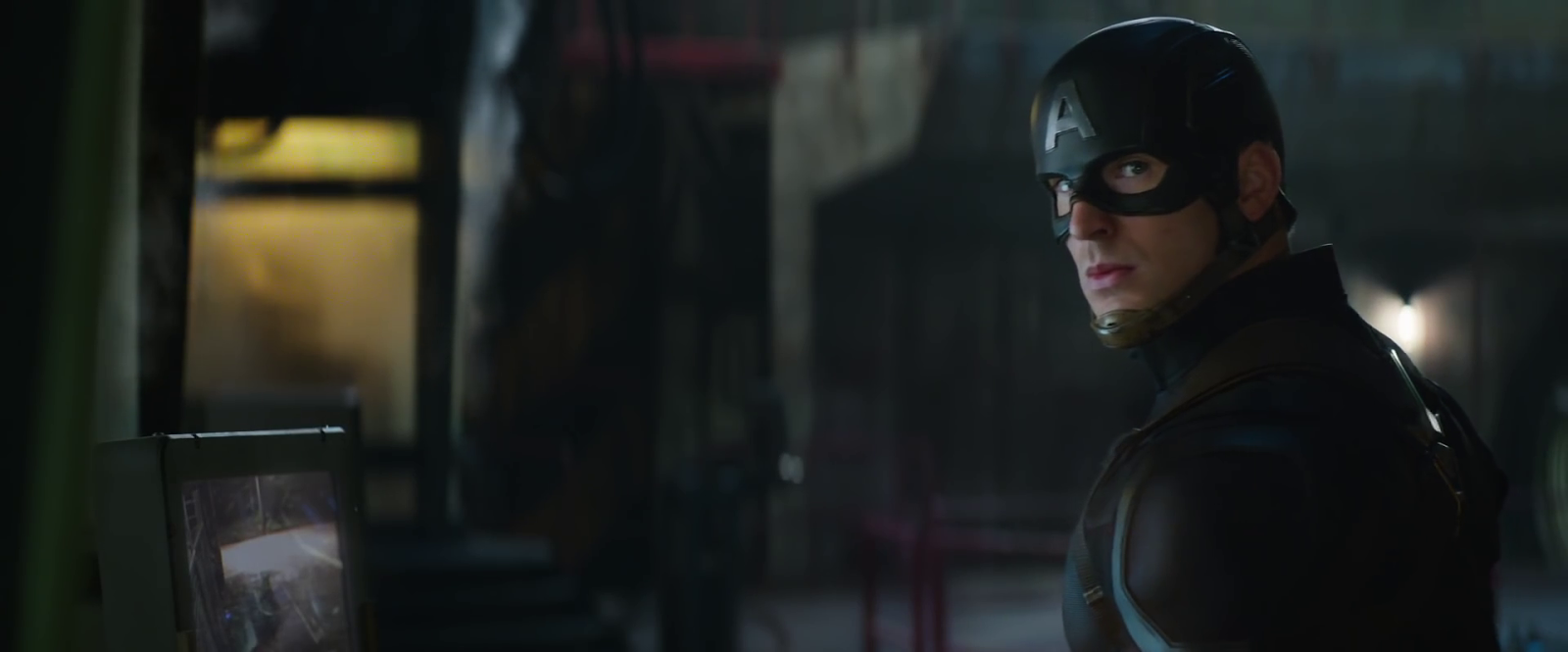
| "If you had an 'A' on your head, Tony, it'd stand for 'asshole'. You dick." |
The film has a few key strengths. Its uses of humour, while sparing, are generally effective. It also probably gets more out of its enormous ensemble cast than either of the
Avengers films did despite the fact that it has more of them than ever. It's a good introduction to the new version of Spider-Man, Vision and Wanda are both used pretty well and Ant-Man gets a really good chance to shine. On the other hand, the main conflict feels, in my opinion, very contrived. No one points out that, without the Avengers and/or Cap and his allies, Loki and/or HYDRA would have taken over the world. No one points out that only Iron Man is really to blame for what Ultron did, and that it's unfair of him to want to punish them all for what was really only his fault. It's never really clear if the Avengers are under scrutiny for the fact that people die in the battles in which they fight, even though they are generally started by villains and not by them, or if it's just for all the mess and diplomatic bother they cause when they act. We're expected to believe that, after something like the Lagos mission, Cap and chums just piss off without bothering to help anyone any further and leave the emergency services to take care of it. Does this seem very fitting with Cap's character? They could have made more of the Lagos mission, I suppose, and argued that Cap acted too soon and shouldn't have attacked in an urban area in which there was a higher potential for casualties, but they don't. They also don't really dwell upon the idea that while Cap's discretion might be reliable the discretion of the others isn't, necessarily. Are we being led to believe that when Cap identifies a threat he and the Avengers just barge in without even bothering to try to contact the local government first? They could have focused it on Cap more, perhaps, and argued that he was treating the Avengers like a combat unit in the war rather than a modern task force trying to protect innocent people in peacetime. Of course, had they taken such an angle, the film could have been more of a personal journey for Cap trying to find his place in the modern world, but they botched that a couple of films ago really.
 |
"What happens if he gets too close?"
"Uh, he can try to whack people with his arrows, I guess?" |
As it is, it feels like the entire conflict is based on a premise so flimsy that it seems completely unreasonable that such a massive feud would erupt over it. Cap doesn't agree that the Avengers should operate under UN jurisdiction, but never really has the time or opportunity to properly explain the weight or nuance of his reasoning in detail. He only has the opportunity to inform us that he believes that his conscience is the best arbiter available. Ultimately it comes down to the following dilemma: what's a better way of making decisions: the agreement of many diplomats or the conscience of one good man? Captain America is shown to make mistakes, but the most serious consequences are for his relationship with Iron Man. The question of the authority under which the Avengers should operate is, to my mind, never really resolved. The problem with making his deteriorating friendship with Iron Man the dramatic centre of the film is that, in my opinion, the friendship between them has never really been established that well anyway. In
The Avengers they frowned at each other in a flying conference room for a bit. In
Age of Ultron I can't really remember what the two of them discuss, if anything. As such, I don't see the great tragedy in the destruction of this friendship. While it's obviously a shame to see the Avengers fall apart, and a problem given that horrible alien menaces are apparently in their future, the core character drama is, in my opinion, robbed of most of its pathos due to the fact that it is built on such weak foundations in the first place.
 |
| Don't forget your stick, lieutenant. |
My evaluation, therefore, largely comes to this: the "Civil War" storyline should not have been the storyline of "Captain America 3". The fact that it's a Captain America film means that it's going to be a sequel to
The Winter Soldier, but they're trying to make it a sequel to
Age of Ultron as well. The problem with this is that they have to merge the "Captain America" plot with the "Avengers" plot, and as a result they get one weak plot when they could have chosen one of these two storylines and had one strong plot. This is a film that, in my opinion, was actually weaker than the sum of its parts. In some respects, this is the same frustration I had with
The Winter Soldier, in that it tried to make a personal story for Cap and a wider story for the "Marvel Cinematic Universe" as a whole into catalysts for each other to the enfeeblement of both. Iron Man and Thor, by contrast, have had multiple films that add to the "Cinematic Universe" plot while to a reasonable extent standing on their own. For whatever reason, Cap is not afforded this luxury, his films being expected to pull double duty as a Universe-progressing event as well. This means that as a "Marvel Cinematic Universe" film its main weaknesses are the fact that Cap's friendship with Iron Man has never been sufficiently well-realised for their conflict to have enough impact and the fact that the need to focus on Cap and Bucky's storyline means that the "Accords" storyline is contrived and weak. By contrast, as a "Captain America trilogy" film its weakness comes from the fact that it barely qualifies as a Captain America-specific outing at all; his last film had the unnecessary presences of Black Widow and Nick Fury, while this one is burdened with every other hero under the sun. At times it actually feels like a Captain America-Iron Man double bill rather than Cap's own film, and at times it actually feels like Iron Man, not Cap, is the main character, and as a Cap fan this pissed me off.
 |
| It only has a flag inside. |
It strikes me that the Russo brothers don't really know what to do with Cap or don't find him to be a particularly interesting character, and have basically been using Cap's films as Avengers-lite (or in this case, Avengers-rather-heavy) as ensemble piece show reels to get the
Avengers 3 gig. Rather than bothering to explore Cap and what he means and stands for in any particular detail, they'd rather just make quasi-thrillers which happen to, perhaps begrudgingly, feature Captain America as the protagonist. This obviously takes inspiration from Ed Brubaker's run on the
Captain America comics, which took a spy-fi approach to the character, but Brubaker simultaneously confined his story largely to Cap's core supporting cast, Falcon, Sharon and to an extent Nick Fury, with only cameo appearances by Black Widow, Iron Man and the like, while also revelling in the rich history of the character and the idea that if we could have a hero from the past who was a man out of time, the evils of the past might disturbingly survive into the present day as well (usually in the form of surprisingly longeval Nazi supervillains or their descendants). There was talk shortly after
The Winter Soldier that the third film would feature the insane impostor Captain America, the racist McCarthyist who made the Cap identity look like that of a reactionary paranoiac, but obviously this never came to fruition. This would have been a great way to explore Cap's identity, perhaps with Chris Evans portraying both Steve Rogers and the deluded William Burnside, but I'm sure the idea would have been too politically charged for Disney. Thus I think there are several factors for why I was personally unsatisfied by the film. Firstly, it's too focused on Iron Man: it's
his emotional state, and rather little to do with Cap, that drives the conflict of the film and the final drama, and furthermore Cap's beliefs and opinions are given shockingly little attention considering that he's notionally the protagonist. Secondly, it's too much like "Avengers Two and a Half" and it feels too much like something slapped together to check executive boxes: tie heavily into the wider universe as audiences like that; now that we've got him, have lots of Robert Downey Jr., because audiences like that; have very little weighty political content, as audiences prefer not to be challenged.
 |
| "Don't make me push you down the stairs again, Tony." |
If they'd gone down the route that seemed to be proposed early in marketing, in which Iron Man was actually the
villain of the film, trying to hunt down a persecuted Cap who was only trying to do the right thing, it might have been a more effective "Captain America" film, but as it is it just feels like a heated debate over a rather trivial philosophical point with punching thrown in. Zemo's method is ultimately fairly compelling; I only felt that his motivations could have been more interesting. Also, despite the more effective aspects of Zemo's realisation in this, the Cap fan in me would also have dearly loved to have seen him with a purple sock over his head and furry shoulder cuffs, fighting Cap with a sword. All in all,
Captain America: Civil War has its strengths but I believe it's let down by some shortcomings I simply can't overlook. It is, however, probably better than
The Winter Soldier in that the action scenes are less repetitive and the portrayal of, ironically, the Winter Soldier himself is more interesting. As a viewer of the "Marvel Cinematic Universe" I found it to be better than
Age of Ultron but more or less as average as most of the stuff they've been releasing for the last few years. As a Captain America fan in particular I found it deeply unsatisfying, but I fear that, absurdly, Captain America fans are not the target audience of Marvel's
Captain America films. My knowledge of the character's very long published history is not comprehensive, but if you want some entertaining eras deriving from my own knowledge, I would recommend Brubaker's run, naturally, especially the first 50 issues or so, and Cap's outings in the early 70s.