Saturday, October 8, 2022
"The Excavation of Hob's Barrow"
Saturday, September 24, 2022
"Return to Monkey Island"
Full spoilers for Return to Monkey Island contained within.
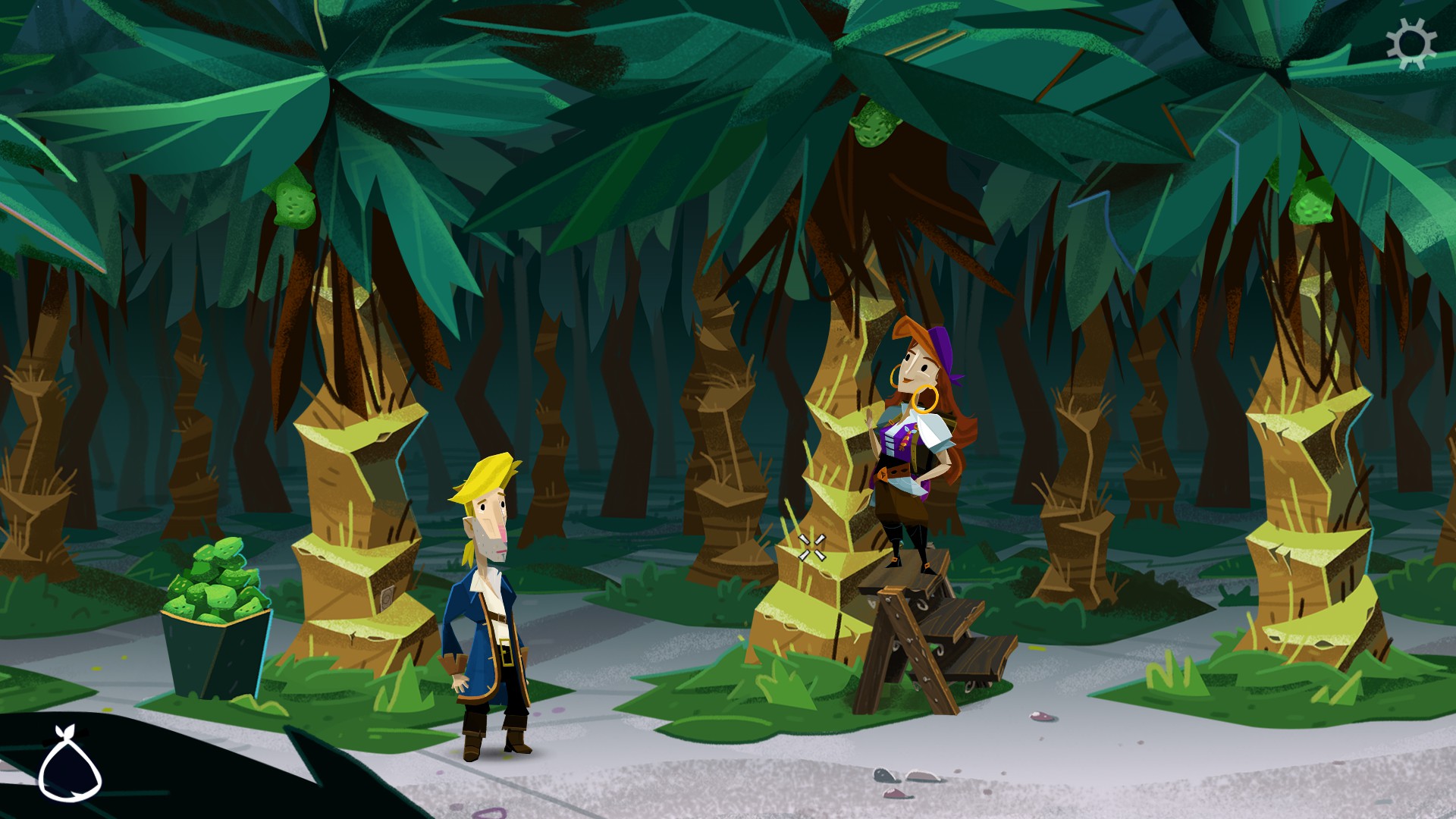
I’m one of those people for whom Ron Gilbert and Dave Grossman coming back to Monkey Island was a big deal. I’ve been a huge enthusiast for these games since I was about four years old, having first played The Secret of Monkey Island in 1993 and LeChuck’s Revenge not long after, and playing each of the subsequent games in the series as they came out. LeChuck's Revenge is my personal favourite, and since I was old enough to understand that the development had changed hands several times over the years I’d been aware of the desire for the original designers to return, and with the announcement of Return to Monkey Island it seemed like that was what was finally going to happen. When it did come out m’colleague and I even did things as we would when we were kids, playing together and passing the mouse back and forth.
Playing Return to Monkey Island was a fairly intense
experience for me because of the significance it holds for me, but after
replaying it on Switch (my first play-through was on PC), and then again on PC, I think I’ve more or
less settled on an opinion: I like this game. I love parts of it. But it’s also
an absolute mess, with way too many ideas, uninteresting unfunny secondary characters
with too much dialogue who Ron and Dave clearly loved a lot more than I did,
plenty of elements that feel out of place even for a concept as ambiguous as
Monkey Island, an unnecessarily convoluted plot and an over-reliance on uncompelling
MacGuffin-hunting to structure the story.Saturday, April 9, 2022
The "Return to Monkey Island" Announcement
On April 5th it was announced that a new entry in the Monkey Island series of adventure games, "Return to Monkey Island", has been in development and is due for release in 2022. For the first time in over thirty years the game is being designed and written by series creator Ron Gilbert and one of his two collaborators on the first two games, Dave Grossman. M'colleague and I recorded some thoughts on the announcement which can be heard here:
I wanted to add something that only occurred to me after recording: that this is, in a manner of speaking, a "Return to Monkey Island" in multiple senses. The game may (or may not) involve player character Guybrush Threepwood's return to the fabled Monkey Island. But it's also a return to the franchise and is also Gilbert's (and Grossman's) metaphorical return to "Monkey Island" as in the series itself. And this leads me to imagine that there's a good chance that the game is going to be just as much about the idea of what a text or series of texts is in the hands of its original creators as opposed to continuations by others. But perhaps I'm overthinking it and it won't be about that at all.
Speculation is rife online about how this new game is going to fit in the game's admittedly messy storyline. Publisher Devolver Digital is marketing it as "the long-awaited follow-up to the legendary Secret of Monkey Island and Monkey Island 2: LeChuck's Revenge" and also as "a new game by Ron Gilbert that picks up where Monkey Island 2: LeChuck's Revenge left off". However, Ron Gilbert has also tweeted that "MI3 doesn't go out of canon. We were very careful about that. Murray is in this game." The inclusion of this fan-favourite character from non-Gilbert-developed instalment The Curse of Monkey Island suggests that the game is set after that sequel. However, I have seen many people online assuming that it is set between LeChuck's Revenge and Curse.
Personally I doubt that the game has been designed to be a mere bridge between the second and third games, and that it's much more likely to be a continuation of the storyline that doesn't contradict anything from the non-Gilbert games without referring to them in any detail. It's noteworthy that Devolver are using terms like "follow-up" and "picks up where Monkey Island 2 [...] left off." They're not saying "a new game set between Monkey Island 2 and The Curse of Monkey Island." I have a suspicion that the new game is going to still be, technically, set after Tales of Monkey Island and will simply treat the intervening games as more of a digression, returning to the story as it was set up at the end of the second game. Are Guybrush and LeChuck really brothers? Are they really children in an amusement park (and perhaps games three to five were merely a continuation of the fantasy)? What is the secret of Monkey Island? And does any of it really matter? I have a strong suspicion that the answer will be "no", and that the game will poke fun at fans who have taken the storyline of this silly series of comedy pirate games so seriously for the last three decades.
The Secret of Monkey Island created a fantasy that captured the imaginations of adventurers all over the world. LeChuck's Revenge gleefully tore it down. Perhaps a third game in this story will propose a resolution to this conflict. Perhaps it will encourage us to return to Monkey Island in the sense of going back to the idea that we shouldn't worry so much about what's real and what's illusion, and just enjoy the ride.
Friday, March 4, 2022
"Who's Lila?" and Lynchian mystery
Full spoilers for Who's Lila? and potentially a bunch of David Lynch
films follow.
Initially, Who's Lila? appears to be an experimental adventure game about the role that facial expressions play in how we interact with the world. Saying something while frowning will contain a wholly different meaning to saying it while smiling or with no expression at all. We are seemingly controlling a possibly-neurodivergent young man named William Clarke who struggles to convey how he feels and must force his emotional reactions when interacting with others. A standard play-through of the game's narrative establishes a few mysteries: what happened to Tanya Jennings, who was last seen by William himself? Why, when William receives a phone call early in the game, is he referred to as "Lila"? And, indeed, who is Lila?
It seems from following the game's directions that Tanya was a young woman William knew; he murdered her and dismembered the body. Lila is William himself or something inside William. In the end William is arrested and enough evidence found to convict him of the crime.
However the game does not have one storyline but many: when you confront Tanya's friend Martha, who is assisting the police, on the roof of the school, it's possible for William to get thrown off the building by Tanya's boyfriend Graves and end up in a surreal other-world. It's possible, after being arrested, to confess to the murder, frame Graves for the murder, or confess to being Lila and not William. It's possible to not bother going to school at all: to go to the train station instead and confront Strupnev, the last other surviving member of the Lila-summoning cult of which William was a member. It's possible to explore the burnt-out ruins of the cult's headquarters. It's possible to take the bus back in time to the night of the party at which William and Tanya first met. Each of these storylines has its own end, after which the game returns to the menu screen. Apart from some information conveyed in some storylines which grants the player knowledge of how to find others, and a few items carried from one storyline to the other, many of the storylines can be played in any order.
As this might indicate, the game touches upon a number of philosophical ponderings: the nature of time and possibility; the concept of identity as merely a momentary perception of the self on the part of one's own mind; whether consciousness and ideas have an existence in and of themselves which humans merely access or perhaps imitate. The most central, however, is implicit in the game's title itself: who's Lila?
"Augmented Reality" elements of the game suggest that Lila the character is a kind of sentient idea which feeds on human attention, summoned by the cult of which William was a member. The game of course mockingly addresses a number of other common analyses of such characters, such as that Lila is a demon, or a ghost, or a representation of the character's inner psyche. Detective Yu, whose name is an obvious pun, seems to represent a player who wants the mystery to have clear answers. In that sense Lila is the game itself, which "feeds" on players playing it, thinking about it and discussing it. But speaking to a hidden character in the game reveals that "Lila is the mystery of who Lila is."
Before I go into this it's worth discussing the overt influence of the works of David Lynch on the game. This influence is not at all subtle. There is a Blue Velvet poster on Martha's bedroom wall, and William/Lila hides in her closet like Jeffrey does in that film. The bin area outside William's building resembles the yard behind Winkie's in Mulholland Drive. And at several points William encounters a silent character who resembles but is not quite identical to himself, identified as "The Stranger", whom the game's developer has compared to the Mystery Man from Lost Highway but is evocative of the many doppelgangers and not-quite-doppelgangers throughout Lynch's works (the latter always being more effective, in my view, than the former)[1]. And these are just the ones the developer has acknowledged on social media; there are plenty more. For instance, the creatures like Lila appear to travel through plumbing the way Black Lodge entities use electricity in Twin Peaks. Further, at one point seemingly the "real" William is encountered by the player (seemingly as Lila) in the form of a hissing, clanking mechanism not unlike the presentation of Phillip Jeffries in Twin Peaks' third season.
Throughout Lynch's work there is always a sense of something which is more intuitive than it is explicit. In some interviews Lynch refers to this as "think-feeling" and associates it with "dream logic", the idea that things which would not conventionally make sense in the cause-and-effect, object-permanent world of what passes for waking reality are accepted unquestioningly and appear wholly natural and correct in dreams. That is why when people watch Lynch's films they often try to piece together "clues" to explain what is happening in some rational, waking-world way. For example there is a conventional interpretation of Mulholland Drive which perceives the first two-thirds of the film, about Betty and "Rita", to be a mere dream on the part of Diane in the final act, an interpretation I largely reject. Similarly Lost Highway is interpreted as a parable about jealousy, and Inland Empire as a metaphor, much like Mulholland Drive, for the exploitative nature of Hollywood. And despite the fact that I have stated that I reject at least one of these (partly because it is just an effort to explain the story's events and not actually an attempt to contemplate its ideas), this is not to say that these interpretations do not lack validity, that the films do not address these points at all; they do. But the dreamlike nature of the presentation has a greater scope than those themes, which I think is not always grasped.
It is that reaching for a solution, an explanation, an interpretation which is one (but not the only one) of the main purposes of the dreamlike elements, because by resembling a dream Lynch conveys in his films the impression of things implicitly, intuitively, making sense, even if to the waking mind there appear to be gaps, omissions or inconsistencies. An enthralling intrigue is created by the feeling that things almost make sense, that there is key to all of this that, were it merely discovered, would put everything into place, like the dénouement of a detective novel. It is that feeling that these things make sense, that they must make sense, but it is not clear why, that gives truly dreamlike narratives their impact.
And thus the answer to the question "Who's Lila?" is that Lila is the mystery
of who Lila is. The mystery is the answer, it is the point. The question is
its own answer. And thus Who's Lila? functions effectively as an
interpretation of more or less any Lynchian mystery without, despite its heavy
and often overt influence, being a Lynchian mystery itself. This is not to say
that the game is not Lynchian at all, regardless of influence; it is, but it's
much more willing, perhaps even eager, to explain itself than one of Lynch's
own works, a few ambiguous elements notwithstanding. I was probably enjoying
the game the most during my first couple of plays-through in which, as far as
I could tell, by a wholly dreamlike reckoning it seemed that William, Tanya
and Lila were all the same person, and no further explanation was
necessary.
It may seem a bit trite to simply say "the mystery is the point", and this arguably does not in itself fully address the impact and significance of Lynchian mysteries, but it is at least refreshing to experience a piece of media which is willing to state that rather than trying to either explain things neatly or, by contrast, explain them away metaphorically or symbolically. There's more to go into concerning how the gameplay extends outside the game itself, with the augmented reality elements, the "Daemon" program which can run alongside it, and even the online sharing of hints and datamining being part of the gaming experience, and that's not even getting into how the game's visuals and control scheme relate to the experience. But others will, I think, explain that better than I can right now.
_________________
[1] A particular highlight for me was noticing in the interrogation scene that,
when William is shown Tanya's photograph by the police, Tanya, who at all
other times is shown as being exactly identical to Lila, is here shown as
strongly resembling her but not actually looking the same.
Thursday, December 30, 2021
Hindsight: A 2020 Cinematic Retrospective
UPDATE
Understandably, I really didn't see many films in 2020 (let alone 2021) so this is a short one:
Films I'm interested in but haven't seen as of writing:
Palm Springs
I've heard this is good even if it's a Groundhog Day ripoff. Redlettermedia didn't rate it though. Who knows. I don't want to have to subscribe to Amazon Prime in order to watch this.
Misbehaviour
I heard this was good. Just never got around to seeing it.
Wonder Woman 1984
Apparently this sucks, which is a shame since the previous one was decent. I still wouldn't mind seeing it.
Films I actually saw:
The Assistant
A rather uncomfortable-to-watch representation of workplace sexual harassment and the exploitation of young women in Hollywood, all framed through the experiences of an office assistant who notices what's going on but is powerless to do anything about it. An interesting way of framing the narrative and pretty chilling. Definitely recommended.
Horse Girl
Alison Brie plays a woman with an undiagnosed mental illness who thinks aliens are trying to communicate with her and possibly travels through time. She's good value as always and the nature of events is left sufficiently ambiguous to have a degree of mystery. The dream-hallucination sequence near the end is a particular highlight. I also enjoyed her character's obsession with a fictional paranormal mystery drama called Purgatory which appears to be a cross between Bones and Supernatural. Rather amusing.
The Invisible Man
An interesting take on the concept, presented as a story about gaslighting, stalking and controlling behaviour, with a satisfying ending. Probably the only unnecessary part is the explanation for how the villain's invisibility works. Elizabeth Moss is a little typecast in the role of "woman who is treated like crap by man or men" but she's a good fit for these parts. There are some decent twists, it's compelling and it takes an old idea and updates it effectively for modern issues. Another highlight.
Bill & Ted Face the Music
A decent-enough sequel to the original two Bill & Ted films. Full review here.
I'm Thinking of Ending Things
Creepy film slightly let down by spelling things out too much. My thoughts in full here.
Favourite of 2020:
I saw so few films it's hard to say, but oddly enough I feel like Horse Girl was the one that stuck in my mind the most. But it, The Assistant and The Invisible Man were all good watches.
Worst of 2020:
I actually can't award that this year because of a lack of trashy superhero films and/or exasperatingly bad Star Wars sequels/spin-offs. Probably a good thing.
ORIGINAL VERSION
This is all I got so far:
Interested in:
Palm Springs
Misbehaviour
Wonder Woman 1984 (apparently this sucks)
I saw:
The Assistant
Horse Girl
The Invisible Man
Bill & Ted Face the Music
I'm Thinking of Ending Things
Best? Dunno.
Worst? Dunno.
Happy 2021!
Sunday, October 31, 2021
"Halloween" Retrospective
Needless to say, the original and the best. While a bit slow by modern standards, the film benefits from taking its time to set up the characters of Dr Loomis, Michael and Laurie, and to establish the spooky October atmosphere. Most importantly, something most of the others forget, we get to know Laurie: she's a smart student but shy; she has a crush on a guy named Ben Tramer but she's too nervous to ask him out; she has two friends named Annie and Lynda who seem to push her around a bit, but she gets along well with younger kids, like Tommy; she likes to follow the rules and seems to be afraid of getting in trouble, such as in the smoking scene. We get to know Laurie, and all this is interspersed with the haunting scenes of Michael following her around Haddonfield. The way the film is shot enhances the menace of the Shape, the music of course fills the night with anticipation, and Donald Pleasence brings the touch of old-school class that these films always benefited from. A classic for a reason.
Halloween II (1981)
While one of the better sequels, this one suffers from the fact that, unlike the original, there isn't really a clear protagonist. With Laurie confined to a hospital bed for the first two-thirds of the film and Dr Loomis on a wild goose chase trying to figure out where Michael is going, it's not clear who we're meant to follow. Jimmy the paramedic is likeable and seems to be set up in some respects as the hero, but the film never really commits to it; he slips in a pool of blood and knocks himself out for the finale, which is back to Laurie and Michael. That being said, the understaffed hospital is eerie, the death of the trick-or-treat-er on the street is shocking, and the ties in to the origins of the Halloween tradition are intriguing. Pleasence is again great and the young cast are fun to watch, but other than Jimmy the hospital characters are pretty forgettable and you're just waiting for Michael to kill them. The gruesome deaths seem to be an obvious attempt for the film to rival its own pastiche, Friday the 13th, and are in some respects perhaps needless; more understatement wouldn't have gone astray. The revelation of Laurie as Michael's long-lost sister is pointless and doesn't add the drama that Carpenter seems to have thought the script needed. It's a decent sequel, but a bit routine.
Halloween III: Season of the Witch (1982)
The one that has nothing to do with the rest of the franchise, this is nonetheless an entertaining cosmic horror story which presages Carpenter's own In the Mouth of Madness (1994), with a mystery in an isolated town leading to the discovery of an apocalyptic plot, and a satisfyingly dark and pessimistic ending. I don't know that Tom Atkins is quite the leading man that some Carpenter fans seem to see him as, but Dan O'Herlihy is great as Conal Cochran, and there is an atmosphere of dread and emptiness which compensates for the limitations of the leading characters. This definitely justifies its place as the hidden gem of the franchise; the shots of kids all across America trick-or-treat-ing at dusk is the stuff that this franchise should be made of.
Halloween 4: The Return of Michael Myers (1988)
I didn't expect to like this one at all; in fact, I didn't even intend to watch it, but I'm glad I did, because I definitely fall into the camp of those who think that this is the best of the sequels. What makes all the difference in the world is that Danielle Harris and Ellie Cornell are so sympathetic and likeable as Jamie and Rachel. Even though I think the idea of Laurie being Michael's sister is stupid, the idea of Michael having a niece is interesting regardless of who her mother is, and the image of this remorseless killer hunting down an innocent child is, appropriately, horrifying. Pleasence makes a welcome return as Dr Loomis, the police are sensible and take Michael seriously, and when things get out of control with the mob they don't get too ridiculous. The image of the crashed ambulance in the river is fantastic and says it all. I don't know, with the ending, if they seriously thought Jamie would replace Michael as the killer, but I think anyone who thought it would go that way was kidding themselves. What it really comes down to, however, is that, like with Laurie in the original, we get to know the characters: Rachel is a girl trying to have an ordinary life; there's a guy she likes but he's not faithful to her; she wants to be protective of Jamie, but finds it challenging to understand her problems. Jamie's a little kid who has lost her parents and knows that her uncle is a serial killer; she's bullied by the kids at school and is afraid of Halloween; she wants to be part of the family with Rachel and the Carruthers, but it's hard to fit in. We don't even need Michael Myers for any of this to work, and that's why it does work. Easily the best sequel.
Halloween 5: The Revenge of Michael Myers (1989)
Obviously a weak entry, it's mostly worth watching for, once again, Loomis and Jamie. Rachel gets killed off too early and while I didn't find Tina, Samantha and Spitz as annoying as some do, I don't care much about them either. At first I thought Tina was meant to be the girl who picks up Rachel and Jamie from school in the fourth film, but it turns out she's a completely different character; too many perms. That girl was meant to be Lindsay from the original, too. Anyway, Loomis' confrontation with Michael is enjoyable, although I don't quite buy this film's explanation that Michael has a rage he is trying to contain. Once again you feel for Jamie in her plight, and Tina's sacrifice is a decent moment. All the "Man in Black" stuff is unnecessary of course and the film should have cut it. It's more or less what you would expect from a rushed sequel to the fourth film.
Halloween: The Curse of Michael Myers (1995)
Despite having only so far seen the so-called "Producer's Cut", this is the one where I don't really understand what they were going for. The opening and closing have all this guff about a cult trying to use Michael Myers to bring balance to the universe through ritual murder or something, whereas the middle just seems to be about Michael being annoyed that Laurie's uncle's family moved into his house. Paul Rudd gives a weird performance as Tommy but he's Paul Rudd, you can't dislike him too much. Kara is an interesting concept for a character as a single mother moving back in with her parents, but doesn't have much to do; Danny seems pointless. The biggest problem is the way Jamie is used, i.e. to have a baby and then get killed. Putting aside the vulgar implication (or outright fact, in the Producer's Cut) that her uncle Michael is the father of her child, it's a bizarre way to use the character who was the hero in the previous two films; the sixth film should have been about Jamie finally dealing with her uncle, not weird stuff about cults and the invention of a whole new Strode family. Donald Pleasence's last outing, while undignified for an actor of his caliber, is at least elevated by his presence, while Danielle Harris' absence severely detracts from the film, although given how bad Jamie's role is in this film it's probably better that she wasn't in it. The idea of an insane psychiatrist trying to control Michael is interesting, but it's not handled well here and wasn't handled much better in the 2018 film. This is a bad film but the non-cult-related parts are at least watchable as more Michael Myers antics.
Halloween H20: Twenty Years Later (1998)
The first film to ignore the sequels, Jamie Lee Curtis makes a welcome return as Laurie, but the film itself is pretty mediocre. All the best stuff happens in the opening, with Michael attacking Nurse Marion's house, bashing in a young Joseph Gordon-Levitt's face with an ice skate, and absconding with a car that he later replaces in a spooky scene at a rural rest stop. Everything else, however, falls a little flat. As would happen again in the 2018 film, this film's Laurie feels nothing like that of the original or even the sequel, with Ms Strode, or "Tate" as she calls herself here, just seeming like a hard-drinking Jamie Lee Curtis who has panic attacks. The setting of a private boarding school in a Californian Spanish villa compound feels very artificial and lacks the ambience of the earlier films' suburban menace. The supporting cast are all pretty forgettable and the entire thing feels very "Nineties", with a bright lighting, lots of wide shots and an orchestral soundtrack. The best bit is almost certainly Laurie decapitating Michael with an axe; the rest is pretty routine and for a film that wanted to ignore several previous films it commits some of the same sins.
Halloween: Resurrection (2002)
It doesn't really bear mentioning that this is one of the worst if not the worst film in the franchise, with a completely arbitrary premise and no interesting or likeable characters. In fact the most likeable character in the whole thing is probably Michael himself, as the scenes where he is on screen are really the only times the pace picks up. The idea of filming a reality show in the Myers house, while believable for the time period, offers nothing in terms of interest, and none of the characters are, once again, portrayed in enough depth to make them sympathetic. Sara is almost devoid of personality. Other than that, seeing a young Katee Sackhoff get decapitated and some of the ridiculous Busta Rhymes one-liners are really the only spare moments of ironic amusement in a deeply tedious film.
Halloween (2007)
Rob Zombie's remake of the original is visually appealing, with effective cinematography, colour and lighting. I also don't find the characters as annoying as some people make them out to be. The problem is that once again there's no one to root for; we don't meet Laurie until about an hour into the film, and she's just an ordinary girl without much detail afforded to her personality. The film is more interested in Michael Myers, but by depicting him as having the psychopathic traits characteristic of real-life serial killers, like abusing small animals and perhaps confused sexual urges, the film ultimately doesn't work when, after the first act, it transforms him into the mute incarnation of death characteristic of the original. Zombie wants Michael Myers to feel like Michael Myers, but by doing so he renders the first half of his film pointless, because we can't see that kid in the character of this faceless killer. The final chase in the Myers house is boring and we don't care enough about Laurie to want to see her win. It's a messy remake with some interesting ideas mishandled, and it's mostly carried by its visuals, not its writing or character direction.
Halloween II (2009)
This sequel to the remake only makes the flaws of the remake worse, as the focus is now on the boring Laurie, whose trauma at the events of the first film and horror at discovering her familial relationship with Michael lack impact because, again, we don't get to know her well enough as a character. The film needed more scenes like Laurie eating with Leigh and Annie Brackett (played well in the previous film and here by horror alumnus Brad Dourif and franchise stalwart Danielle Harris) and fewer extended dream sequences of Rob Zombie's wife, and Laurie being chased around a hospital by a grunting, roaring Michael. I had trouble getting through this one because I found it so boring. It only really picks up at the very end when Loomis arrives to confront Michael; other than that, and again the strong visuals, I don't feel like this misery-fest has much to recommend it. I watched the theatrical cut, and supposedly the director's cut is better, but I doubt I could face watching this again any time soon.
Halloween (2018)
Pulling the same trick as H20 by ignoring previous sequels, this time every sequel altogether, the 2018 film works by making Michael more mysterious and therefore more threatening, but the characterisation of Laurie isn't, in many respects, massively different to that in H20, nor is her relationship with her child. We see the effects of trauma, but it could be handled differently. The point I've laboured throughout this article is once again true here, that the new characters aren't given enough characterisation to make me care. I want to care about Karen and Allyson, but all we see about them is their relationship to Laurie and her past. We don't get to know them well enough in themselves. The podcaster characters and the Loomis-replacement psychiatrist are slightly ridiculous, feeling like caricatures in a film which is notionally trying to ground itself in the relative realism of the original. The ending confrontation in Laurie's house, and the scene of Michael's senseless massacre in the neighbourhood, are the best bits of this somewhat awkward reprise.
Halloween Kills (2021)
I've reviewed this in full
here, but suffice to say that this is more of the same as the previous,
struggling to find interesting characters outside of Laurie and Michael, and
delivering a weak and inept message. Like the film before it looks nice and
has a fairly strong atmosphere, but it's mostly worth it for the gore effects,
the presentation of Michael, and the flashback scene to 1978, and that's
mostly going to be of interest to horror fans and fans of the franchise
specifically. Yet the film tries to be more than that, tries to have something
to say about society, and doesn't really succeed. It's messy, as these films
often seem to be when they try to do too many things at once.
"Halloween Kills"