Sunday, August 21, 2016

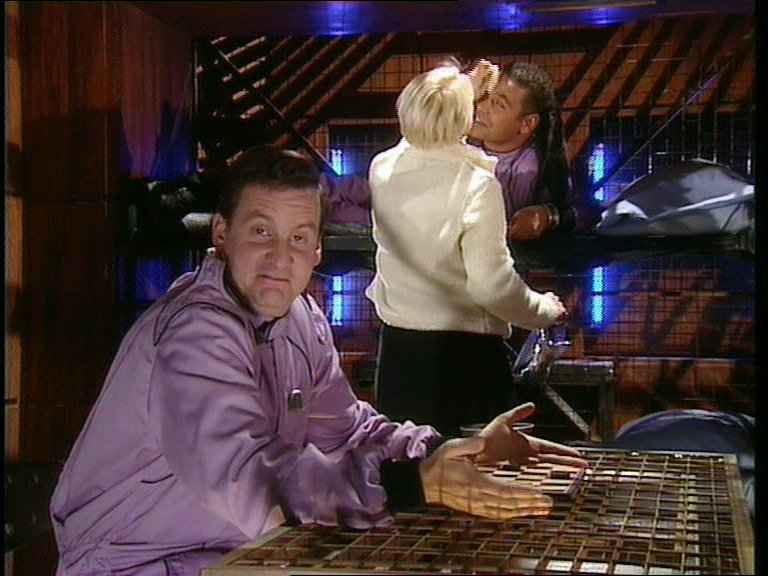
Red Dwarf Series VIII Overview

Publishing note: I'm going to give my thoughts on some Red Dwarf in the leadup to Series XI. I'm starting with VIII because it's the one I most recently rewatched and it's also the easiest to criticise. 
I think it's obvious watching Series VIII that by this point, after being on the air almost continually for about a decade, Red Dwarf in its original run had well and truly had its day. That's not to say I'm upset that it's back; quite the reverse. I like "Back to Earth" (although I know many do not) and I like Series X. I think, however, that the show needed a break, and a long one, in order to do a bit of soul-searching. I first saw Series VIII when it was released on DVD in late 2006, and I was excited because it was more Red Dwarf I hadn't seen. While I didn't think it was as funny as previous series, I was willing to give it a pass largely because Rimmer was back and because of how much I fancied Chloë Annett (I was about seventeen at the time). With the benefit of ten years under my belt since then, and having not watched Series VIII in probably eight or nine years, I can still appreciate the return of Rimmer (and I still fancy Chloë Annett) but I can see with the benefit of a little age and somewhat greater maturity that Series VIII, with the exception of one episode and a few jokes scattered here and there elsewhere, is shit.

[Don't get me wrong, by the way; I think the people who made this, cast and crew alike, are all very talented people, and I'm not one of those psychotic Red Dwarf "fans" who loathes Series VIII and refuses to watch it (or, as seems to be the case surprisingly often, has a negative opinion of it despite not having actually seen it). I just think that it's misconceived and most of it doesn't work.]

In Series VIII, Doug Naylor wanted to do a "prison comedy", and that's fine, but it necessitates the knobbling of the premise of the show. The resurrection of the crew of Red Dwarf and the return of Chris Barrie, Norman Lovett and Mac McDonald to the main cast means that there are now far too many main characters for eight thirty-minute episodes. Furthermore, the show's growing ensemble cast is incompatible with Series VIII's aim, which is to refocus on the traditional dynamic between Lister and Rimmer. The series is trying to be too many things at once: an ensemble comedy, a double act, a prison comedy, a sci-fi comedy; the writers can't strike the balance. Danny John-Jules and Chloë Annett have virtually nothing to do a lot of the time (and few jokes) and even Robert Llewellyn, whose Kryten character had become pivotal in previous series, is comparatively sidelined as the show largely becomes "Lister and Rimmer getting up to all sorts of shenanigans".
While this might be seen as a return to form, if one is to ignore how much it makes the rest of the regular cast redundant, in execution it's let down by the fact that virtually all of the conflict between the two characters is eliminated despite the fact that Rimmer is meant to be the "old" Rimmer of the Series I era who was so uptight and frustrated by Lister. In fact, in Series VIII Lister and Rimmer come across more like two good friends who occasionally squabble, rather than the "odd couple in space" whose conflict drove the early series of the show. Chris Barrie and Craig Charles obviously have a terrific rapport, developed over many years working together, but it doesn't gel well with the broader premise of this particular series, which is notionally about using the prison setting to revive the old Lister-Rimmer tension.
Furthermore, while the humour in Red Dwarf always involved a fair amount of the silly and vulgar, in this series it becomes incredibly adolescent and juvenile, featuring more weak puns than ever (such as "lemonade", "post's arrived" and "rock, rock, rock"), as well as relying on a fair amount of really chauvinistic comedy, in which a sexual magnetism virus which makes people irresistibly attractive to the opposite sex is treated for laughs, as women are essentially drugged into having sex with men, and later when the male characters secretly watch women in the showers. There's a particularly horrible line in the deleted scenes, which was mercifully left on the cutting room floor, in which Lister remarks that he was hoping to use the sexual magnetism virus on Kochanski the next time she was drunk. Jesus Christ. While Rimmer might effectively get his comeuppance for using the virus, Lister's treated as being disappointed when it wears off after Kochanski starts making out with him in the lift, and later he uses it to try to get Rimmer raped in prison. Who the hell thought that was the way to characterise our reasonably heroic main protagonist? It's easy to appreciate why the cast, in hindsight, and other commentators, refer to this series as "Men Behaving Badly In Space", especially given that the show's only female protagonist is completely objectified in multiple episodes, and to a far greater extent than she was in Series VII.
The show also descends into ludicrous fanwank territory in this series, with countless references to episodes of prior series, in addition to the unfortunately quite unnecessary return of Norman Lovett and Mac McDonald, who are both reasonably amusing, but clutter up the show. The opening trilogy of episodes is particularly fixated on references to prior stories, not just in terms of wrapping up the ending of Series VII and bringing back old cast members but also seeing the return of the luck virus, the idea of multiple Rimmers and Hollys, references to "Future Echoes" and "Backwards", and of course the revival of Duane Dibbley.
While the cast's performance benefits from being back in front of a studio audience again, it suffers in the writing department, with jokes being few and far between in a number of episodes, particularly "Back in the Red, Part 3" and "Pete, Part 2". It's clear that, after this, the show needed to be rested. In any event, at this point Doug Naylor was apparently fixated on making a Red Dwarf film, an ambition that unsurprisingly turned out to be rather unrealistic. It's not entirely clear to me whether the show would have continued being made if he hadn't been focused on the film project, but while it's possible to imagine that it's a "shame" that the show came to an end because of this unrealistic project and after such a weak final series, I shudder to think what "Series IX" would have been like if it had been made only a year or two after VIII, without the long break which, in my opinion, appears to have given Doug Naylor the time to refocus on what made the show successful and entertaining.

SPECULATION
How could Series VIII have been good, besides having more funny jokes? Here are a few suggestions, which admittedly include altering the ending of Series VII as well:
1. It needed to be more of an ensemble production. With five main cast members, each one really ought to have been largely the focus of a single episode, as having episodes focused on a specific character was common in earlier series (although as we know the attitude tended to be "when in doubt, make the episode be about Rimmer"). Note that in earlier series, most characters tend to be defined in terms of their relationship with Lister, but in this most of Lister's one-on-one scenes are with Rimmer, such that it turns into "the Lister and Rimmer show with three supporting characters". I don't think Cat gets any one-on-one scenes with Lister in the entire series.
2. The crew (other than Rimmer) shouldn't have been revived. Remember that in "Psirens", Kryten observes that someone has stolen Red Dwarf, which in "Nanarchy" is revealed to have been his nanobots. This is kind of funny, but if they really wanted to make the show a "prison comedy" they could at least have had Red Dwarf taken over by GELFs or simulants or someone who captured and imprisoned the characters so that the premise didn't have to be so heavily altered.
3. It shouldn't have been a prison comedy. If they continued down the nanobot route, it would have been more refreshing, after two series of Starbugging, to go back to the characters having the run of the ship. Rimmer could have easily been the only crew member revived, or even just resurrected as a hologram again, perhaps because the nanobots thought he was part of the ship or something; this resurrection would have been to everyone else's annoyance. There also would have been the possibility of humorous conflict between Rimmer, who had enjoyed being in "effective command" for years, and Kochanski, who outranked him. The "run of the ship" scenario would also have eliminated another problem with Series VIII, the fact that it becomes cluttered up with recurring characters: Ackerman, Baxter, Kill Crazy and the like. Some of these characters have their amusing moments, particularly Ackerman and Kill Crazy, but they're not needed, especially with the reintroduction of two unnecessary regulars, Holly and Hollister.
In the long run, at least Series VIII wasn't the last Red Dwarf.

Monday, July 25, 2016

"Batman v Superman: Dawn of Justice" (Ultimate Edition)

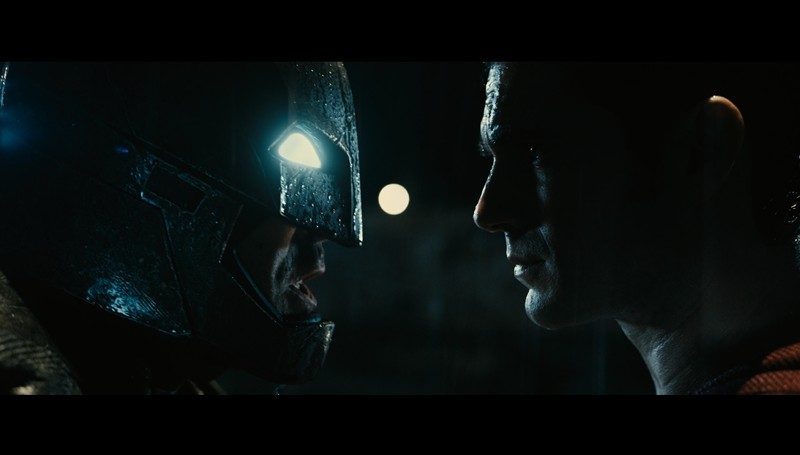
"I can't hear you with this helmet on."
Despite expecting, even desiring, badness, I actually quite enjoyed Batman v Superman: Dawn of Justice when I saw it in cinemas. Now don't get me wrong, Batman v Superman is not, in as "objective" a sense as I can muster, a very good film. It's too long with a dodgy screenplay, heavy-handed symbolism, questionable performances, thin characterisation and a fairly bad plot. For reasons I can't explain, however, that didn't bother me the first time I saw the film and it didn't bother me when I rewatched it recently in the shape of the "Extended Cut" released on the Ultimate Edition blu-ray. Despite going for two and a half hours in the cinema and three hours in the extended edition, the film didn't bore me, and it didn't annoy me particularly. Before I get onto my brief review of the film proper, however, I thought I would discuss the "Extended Cut" by answering the following question: 

Does the Extended Cut add anything significant to the film?
In my opinion the answer is "no." The Extended Cut fills in a few elements of the plot in a little more detail, but other than that I don't think it contributed that much. I'd say it feels somewhat like a more rounded film due to some added scenes about Lois's investigation into the mysterious bullet and Clark's research on Batman, but it doesn't really add any more Batman or Superman action or fill in any existing plot holes, like how Lex knows Superman's secret identity. All in all I could probably take or leave the added scenes, and although some people have, I believe, argued that the Extended Cut would have been better received than the theatrical version, I don't think that's very likely. I think people had a problem with what was already there, not with what they felt was missing.

"Stop a bullet cold, make the <Central Powers> fold..."
Anyway, here are my thoughts on the film in general:
My biggest problem with Batman v Superman is that it feels like two and a half or even three films jammed together: a decent Batman film, a mediocre Superman film and a bad Justice League prologue. The actual "Batman fights Superman" element is so perfunctory and incidental to the main plot that it doesn't really feel like a part of any of these three stories, so perhaps in that sense it's almost four films, with the fourth strand being an ideological conflict between DC's two flagship heroes. Yet, despite everything, I still feel as if the film does a decent enough job of handling these elements and synthesising them to an adequate degree. The ugliest graft onto the structure is the "Justice League prologue" element, which the film would have been better off without. The scene in which Wonder Woman watches videos about Flash, Aquaman and Cyborg on her laptop for a few minutes while the action stalls are particularly egregious. Personally I didn't find Wonder Woman to be particularly interesting and could have done without the additional heroes in the story.

The Superman Aspect
"My only weaknesses are Kryptonite
and my Irritable Bowel Syndrome."
The problem with Henry Cavill's Superman is that he always looks like he's trying to do a shit. In general we also don't get enough of a sense of who Clark Kent really is, I feel, such that it's hard to find Cavill's Superman too interesting. There aren't really any moments where we see Clark Kent enjoying himself, for instance, apart from the bit where he jumps in the bath with Lois, and all the dialogue in that scene is still pretty heavily plot driven. I feel like we need to see Superman just being a person because his character is a little lacking at the moment, I think. Jesse Eisenberg's Lex Luthor is okay, although I agree with the criticisms that he feels like Heath Ledger's Joker. Personally, however, I feel like his ranting about gods and demons and Prometheus and stuff makes him feel like a hybrid of Ledger's Joker with Kevin Spacey's Luthor from Superman Returns, which was itself a slightly more serious version of the Luthor of the Reeve era Superman films. Thus I feel like their Luthor feels heavily dependent on existing film representations rather than doing something new (or, indeed, even adapting the comic books very closely).

If only Superman could read this Lois's mind,
his job would have been a lot easier.
Lois's role in the film seems to mostly be to cause problems; not quite a damsel in distress but more of an instigator of chaos, because almost everything she does in the film, such as going to visit the warlord at the beginning or throwing away Batman's kryptonite spear just seems to make Superman's life more difficult. As for Doomsday, well, he looks like an orc from one of Peter Jackson's Hobbit films and as far as big CGI battles go the conflict with him is pretty generic. Superman already fought a Kryptonian enemy in Man of Steel, and in this he's basically just fighting a worse version of Zod again. They could have done something a bit different. I really wish they'd do Brainiac in a film.

The Batman Aspect
Batman voice courtesy of eating the set.
I don't know Ben Affleck from anything because apparently I haven't watched any films for the last twenty years or so, so I didn't respond with derision when he was cast as Batman. I didn't know what to think, really. When I saw the film, however, I was pleased. Affleck seems to get the role of Batman down easily and comfortably and I personally thought that he was the most successful part of the film. I was interested in his ever-increasing feelings of despair and impotence as he becomes more confronted by the powers of Superman and I liked the general aesthetic of his costume, the fight choreography used with him, the image of the bombed-out Wayne Manor and so on. I also enjoyed Jeremy Irons as Alfred; I felt that he fitted the role rather well. Personally I would be very keen to see the solo Batman film made by Affleck that is meant to be in development.

"I'll just get him, sir."
I believe that some have argued that Batman comes across as stupid or unlike a detective in this film, and I agree at times he doesn't appear to be as "in control" as people have come to expect, and I wonder if that's a result of them plopping this supposedly hardened, veteran incarnation of the character into our midst. For someone like me who has read many of the notionally "essential" or "definitive" Batman comics like The Dark Knight Returns and The Long Halloween perhaps it's easier to imagine what this Batman's past might have been like without having to be shown it, but I can appreciate that less nerdy viewers might be more in the dark. That's the thing about this film, I suppose; it relies upon the knowledge of the characters in popular consciousness rather than establishing versions of them in their own right. This leads me to:

The Batman vs Superman Conflict
"Are you taking a piss behind the lectern?"
"No comment."
Despite the fact that I like the fight scene, and enjoy robo-Batman beating the shit out of Superman, who seems to still use the same Kryptonian concrete in his hair as he had in Man of Steel because it still never gets mussed up, even when Batman grabs him by it, the whole conflict feels like it would have been more effective if there had been multiple Superman, Batman and Superman-and-Batman films leading up to it, such that they had an established friendship or at least relationship that was falling apart. As it is, it feels like we as an audience are expected to more or less know or understand the ideological differences between Batman and Superman based on their pre-established, existing presence in popular culture and the popular consciousness, such that the filmmakers appear to want to impress us without the bother of doing groundwork for it.

"You'll ruin my hair!"
This, I think, weakens the conflict, such that the plot is forced to pit Batman and Superman against each other rather unnaturally, with Luthor threatening Superman that he will kill his mother if he does not kill Batman, apparently to force the world to see that Superman is violent and dangerous, not benevolent and just. Yet it feels very contrived, as it's established that Batman is seen as practically a legend, if he's known at all, which makes you wonder what effect Luthor's plan would really have, or what the purpose of it is. Batman's own attempt to goad Superman into fighting him so that he can "save the world" from him is a little more interesting, but I don't feel that it's sufficiently clear why Batman sees Superman as such a threat apart from the dream sequence and the Capitol bombing, which surely an intelligent person like Batman would recognise as an effort to frame Superman. Interestingly, the Extended Cut has Lois investigate the bomber's apartment, but not Batman, which is perhaps a missed opportunity derived from the film's need to have a scene in which Batman and Superman fight for no good reason. Similarly when Superman first confronts Bats with peaceful overtures and asks for his help, Batman doesn't listen and Superman, despite being (as far as he knows, not realising Batman has kryptonite weapons) invulnerable, starts beating down on him simply because he's sick of Batman's sass or something. So they both come across as a bit dumb.

It's a fixer-upper.
The ending is also stupid. We know Superman's not going to stay dead, and the fact that he had to sacrifice himself to kill Doomsday just seems pointless, a forced dramatic moment that almost anyone in the audience would realise would only be a temporary situation. It would have been more effective to have shown the future team beginning to assemble by having Batman use the spear, given that he spends most of the fight against Doomsday simply getting twatted around the place trying not to get killed. Even Wonder Woman could have easily used the spear. I don't know; it just seems contrived to me.

Batman visits any comments section on the film.
Conclusion
Personally, I think Batman v Superman: Dawn of Justice is an adequate superhero film, even enjoyable, but I know my opinion is even more unusual than usual in this regard. I found it much more engaging than Man of Steel and probably more entertaining than Marvel's rival instalment, Captain America: Civil War, which could have easily been called "Cap v Iron Man: Dusk of Avengers". Maybe I'm just getting bored of the Marvel characters and enjoyed seeing something new; I'm certainly more interested in Affleck's Batman than seeing any more RDJ as Iron Man or anything of the sort. As I've already said, Batman v Superman is a very flawed film, but I can live with it, especially since the teaser for Justice League actually looked interesting. I can't explain my reaction to Batman v Superman. I know it's bad, but I don't care. What a hero I am.

Friday, July 15, 2016

"Ghostbusters" (2016)

No non-threatening, generic, slightly scared-looking ghosts allowed.
When I heard that Ghostbusters was going to be "rebooted" with a new cast, I felt pretty dubious. The time had well and truly come and gone for the original team, but to me a reboot sounded like an act of desperation. Then it was announced that the new cast would be all-female, and I admit I was intrigued. Why? Because my fear was that the "new" Ghostbusters would just be four guys with a passing resemblance to Murray, Aykroyd, Ramis and Hudson and the whole thing would just be a pathetic tribute act like the rebooted version of Star Trek. Four ladies taking the lead made it sound like they couldn't go down the straight "remake" route, so even though I was pessimistic about the idea in general (as I am about most things), I thought that this casting decision was actually an interesting one, something more valid than the alternatives.

The (Stupid) Controversy
"When you're walking down the street-"
It's worth taking a moment to consider the inevitable, but nonetheless stupid and pointless, controversy which occurred as a result of this casting decision. Of course the usual suspects perceived this as part of the alleged encroachment of socially-progressive totalitarianism (which somehow isn't a self-contradictory idea) which only exists in the minds of reactionary paranoiacs, mostly found in internet comments sections and on discussion boards, and the sinister power-mongers who feed them the lies and fallacious arguments that batten their delusions (usually as a way of attaining fame and money by collecting political "followers"). Anyone with a lick of common sense could see how absurd this notion was; rebooting Ghostbusters is primarily a means of Sony Corporation making money without the bother of establishing a new "brand", and if anything it could be argued that they were seeking notoriety, and thus exposure, by courting the exact controversy they received. Yet it's a disturbing rock to peer under, even for profit, because a good deal of online anti-feminism, as far as I can determine in my holding-my-nose peeping into some of the uglier corners of internet discourse, is just one tentacle of a reactionary octopus with some truly revolting conspiracy-theory beliefs at its core, including racism, its neighbours white supremacy and anti-semitism, and in some cases outright fascism and neo-Nazism. Call me a Godwin's Law invoker all you like, but there are some pretty nasty thoughts going on in the brains at the centre of these controversies, thoughts one ought to be cautious about giving too much attention to, or certain kinds of attention. This doesn't mean to say, of course, that all anti-feminists are crazy reactionary authoritarian racists, of course, just that many of their arguments are invented by such people, and many of them, wittingly or unwittingly, are being manipulated by such people. I'm also not trying to condone anti-feminism; I think sincere anti-feminism is almost exclusively just foolish paranoia. I simply think that anti-feminists might want to be aware that, firstly, they're probably taking feminism too personally (seems to be common) and secondly that many of their ideas are calculated pieces of political manipulation generated in the depths of the minds of would-be tyrants seeking money and power. Do you really want to be these people's pawns? I've never understood this train of thought that preaches rugged individualism, "standing out from the herd" as it were, and yet hero-worships "leaders" and talking heads.

On the other hand, many of these various reactionaries are probably just trolls and/or immature teenagers; I really hope so, 'cause otherwise it's a worrying thought about what the internet has really achieved if it has allowed genuine fascists and the like (ie idiots who would probably be amongst the first against the wall if their psychotic imaginings ever actually came to pass) to create giant delusory online fantasylands. At least with mad old people who are rusted-on right wingers and conservatives (usually against their own best interests) you know they mean it. With this lot you can't help but wondering what they'd do just for a laugh or to get a reaction if they had the opportunity.

"-and you see a little ghost-"
Anyway, wasn't the 90s cartoon show Extreme Ghostbusters already way more "progressive" than this? It had a female Ghostbuster, a Hispanic Ghostbuster and a Ghostbuster who was in a wheelchair in addition to the pre-established black Ghostbuster. I wonder if anyone was up in arms about that at the time. They probably were and just didn't have Facebook and Reddit as a means of finding lots of other people to vehemently agree with them and make them feel like everyone in the world was secretly on their "side". That's the thing these reactionary culture warriors don't seem to realise; the overwhelming majority of people aren't sitting around raging on Reddit and Twitter all day and actually don't give a flying shit either way about the enormous list of harmless things they're pointlessly outraged about. That's kind of something these people really need to start to realise: the "silent majority" is not on their "side" or their opponents' "side"; they're apathetic because they've got real things to worry about, like their jobs and their kids. Why don't people understand this?

On a third hand (?), those people who argued that everyone who was negative about the film was in some way being sexist and/or misogynistic were obviously making a ridiculous generalisation. The trailers were really bad and not funny at all. I think the amount of people who actually were making this argument was quite small, and exaggerated by reactionaries (surprise, surprise), but nonetheless I've read some pretty tortured arguments. These include people trying to claim that James Rolfe's video expressing his fan-oriented lack of interest in the new film, for instance, is sexist when I'm pretty sure it just isn't; I didn't find his arguments terribly persuasive, but I felt like they were his personal reasons, not something he expected anyone else to abide by. But I like James Rolfe and don't want people on either "side" to drag him into this futile "culture war" (the term "war" is dignifying these online spats with far more gravitas than is warranted). He seems pretty good on his own, though, at keeping out of these things, and a lot of people don't seem to get that for all his online exposure he's not really part of or clued into "internet culture", which as far as I can tell is an extremely good thing, largely because internet culture is stupid. For my own part, I watched the trailers and didn't think they were funny. I still went and saw the film because I was curious, because of a few early reviews and reactions saying it wasn't that bad and because of...

Casting etc.
"That's great, Ray. Save some for me."
I can't remember when the director and cast were announced, but it turned out Kristen Wiig and Melissa McCarthy were among the leads and Paul Feig was directing, and I liked Bridesmaids, so I thought: this could be funny. As I said above, the trailers were very disappointing. The jokes shown simply weren't funny and I agreed with the argument that the depiction of the character Patty, played by Leslie Jones, seemed like a bit of a racial stereotype. So that wasn't good. Also, the CGI action looked pretty ropey (and indeed it was, but I'll get to that). Nonetheless, I was still curious, and when I realised it was out the next day and a friend of mine and I observed that we both wanted to see it... we went and saw it.

This is a comedy film without a particularly strong narrative (I'll get to that) so I don't think there's much point in me reviewing this in my usual review/recap style, so I'm going to divide this up into categories and sub-categories. Here we go:

"That's the Ghostbusters theme song."
"No."
1. How does it compare to the originals?
Well, firstly, it's obviously not as good as Ghostbusters (1984). It's by its nature not nearly as original and lacks a good deal of the quirkiness of the first film. The style of humour is quite different and doesn't feature the quotable absurdism of the first film. There isn't really a main "funny" character like Bill Murray's Peter Venkman (Egon was always my favourite; poor Harold Ramis), although Kate McKinnon's Holtzmann is the most outwardly facetious. As for Ghostbusters II, well, I can't say really. I watched Ghostbusters II a lot as a kid, so I was never "disappointed" by it the way a lot of fans supposedly are, and I think parts of it are quite memorable and funny, but I haven't seen it for years. If you're in the camp in which you think Ghostbusters II is too similar to Ghostbusters (1984), you might actually find this new one refreshing. If you're in the camp that likes Ghostbusters II because it's similar to the first one, and wants more of the same, you're not going to find it here. Better go rewatch Groundhog Day or something. Maybe play the 2009 video game that featured the original cast. Nonetheless, this 2016 reboot naturally has a lot of references to the original and features cameos from all of the surviving main cast (except Rick Moranis of course, but including Slimer), although some of them come across as begrudging (guess who?).

2. Is it funny? Are the cast good?
Which inferior follow up had a better subway sequence?
This or Ghostbusters II?
Short answer: yes. This is the key thing that supersedes all other considerations: it's a comedy film, and it made me laugh. I laughed out loud quite a lot, and anyone who reads this blog knows I'm very difficult to please. There are a lot of entertaining moments, usually derived from the characterisation. The cast are unsurprisingly strong, given that they come from comedy backgrounds, but the standout is probably Kate McKinnon as Holtzmann, whose regular gags are mostly funny. Kristen Wiig is good too; one of the funniest bits of the film, in my view, is when, after emphatically denying that she believes in the paranormal any more, she sees the first ghost they encounter and enthusiastically declares her belief on camera. Smash cut to her boss at the university, played by an amusingly posh Charles Dance, watching this declaration on YouTube. I personally don't think Melissa McCarthy and Leslie Jones got the best jokes of the piece, but they get the job done. Chris Hemsworth is entertaining as well as the clueless receptionist Kevin, but at times I found him to be a little too stupid; the joke became a bit tired after a while. I think it would have been stronger if he was more eccentric than purely oblivious. He's at his strongest, I would argue, late in the film when he's possessed by the antagonist.

That's not to say there aren't weak or cliché jokes, especially one-liners, and there's a lame metal concert sequence which is totally unconvincing. I'm not a metal fan, but m'colleague used to be (and still is to a tenuous extent), and I know the difference between a real metal concert and Hollywood's twee mental image of a metal concert. Nonetheless, I felt that more of the jokes were successful than not.

I used to be a pall bearer,
but I couldn't stop coughin'.
The cameos from the original cast are a mixed bag. Ernie Hudson's is predictable and perfunctory, as is Sigourney Weaver's; you can tell when she's going to appear by a process of elimination. Annie Potts's cameo is better, but the best is Dan Aykroyd as a curmudgeonly taxi driver who inexplicably knows about ghosts but is unconcerned. Bill Murray has the longest cameo, but supposedly Sony had to threaten to sue him to get him to do it, which is very unfortunate and definitely falls into the "ugly corporate logic" side of this film's production. I'm not sure if the film makes this work in its favour; he's cast as a nay-saying sceptic who shows up demanding that the girls prove their claims to him, but his performance, unsurprisingly, is completely phoned in. The thing I'm not sure about is whether this is a weakness or if the film actually succeeds by channelling Bill Murray's expected disinterest and disdain into the attitude of a minor antagonist, given that he appears to have been the main stumbling block in the way of a "true" Ghostbusters 3 with the original cast ever being made.

3. What's the story like?
"Wanna play Boggle? Or Super Mario Bros.?"
The story's pretty average. Kristen Wiiiiiiiiiiiiiiig's character, Dr. Erin Gilbert, is reunited with her old colleague Dr. Abby Yates, Melissa McCarthy's character. Abby is now working with Jillian Holtzmann, played by Kate McKinnon, and when they see an actual ghost in an old New York mansion they decide to investigate the paranormal full time. Leslie Jones's character, Patty Tolan, joins them after she sees a ghost at her job in the Subway. Much like the original films they face government interference, but in this case it's because the FBI is investigating ghost activity themselves and wants to keep the situation hushed up. A crazy loner named Rowan is trying to get revenge on the world by bringing about the "Fourth Cataclysm"; he's exacerbating ghost activity by placing devices around the city along ley lines to achieve this. Eventually he succeeds and turns into a powerful spirit and they have to drive the Ecto-1 equivalent into a big portal to stop him. It's all pretty arbitrary, and is mostly about the characters and the comedy.

I didn't actually think this bit was that funny; it's just I've only got
so much material to work with from the clips in the trailer.
Part of the story, as should be clear from this hodge-podge synopsis, has to do with the team dealing with their public perception as frauds, and at times this feels simultaneously overplayed and underplayed. For instance, there are more than a few times when they're annoyed by dismissive or antagonistic social media posts (perhaps reflecting the leadup to the film) but at other times it seems like the public doesn't really perceive their fraudulent nature; I was expecting them to be protested against or abused by the public, but they aren't, and this plot element felt a bit ineptly handled. It's more effectively conveyed by the character of Rowan, who is basically like the Ghostbusters of this film but instead of dealing with the bad hand he's been dealt by life he thinks it's better to take it out on the world at large. This aspect, however, I didn't feel was too heavy handed and I thought it was done with adequate subtlety. My main issue was that I felt there were too many cutaways to Rowan. The audience knows about him before the Ghostbusters do, and the dramatic irony is a bit unexciting. I would have preferred more of a mystery; it might have been more effective if the only times we'd seen Rowan had been when he speaks to Patty at the subway station and when they confront him at the hotel later in the film. The other scenes in which he appears aren't that funny anyway, so as this is a comedy the film wouldn't really suffer by losing them.

In actuality the main story is, in a sense, Erin becoming reconciled to her past and rekindling her friendship with Abby, which is all the film really needs given that it's a comedy. Nonetheless, story isn't really the film's strong point. The characterisation is better, although I'd argue that Abby doesn't have the best characterisation. Honestly, I think Melissa McCarthy is the one who's short-changed by this film. Kristen Wiig's Erin gets the closest thing to a character arc, although Kate McKinnon's Holtzmann gets a more understated one.

4. What's it like visually?
Would the line "this man has no dick" somehow still work in this one?
Naturally, unlike the originals, this film uses CGI rather than practical effects, which is predictable but disappointing. The CGI is rather banal and you can tell that the actors suffer by not having anything "real" to react to. Because the ghosts are so vaporous and smokey at times they're difficult to really "see" clearly which diminishes some of the humour to be derived from their appearance. The effects from the proton packs and so on are all okay but look rather fake at times nonetheless. Probably the strongest visual elements are when physical effects and CGI seem to be blended, as I believe might have happened for instance with the bit where they're destroying the float parades, the last of which is of course the Stay-Puft™ Marshmallow Man.
"See youse all tomorrow!"
-Chris Hemsworth when he was on an Australian soap opera,
according to someone in the TV industry whom I used to know.

The time when CGI is most egregious, however, is in a pointless "battle" scene towards the finale in which the four use various weapons Holtzmann has developed earlier in the film to fight hand-to-hand with ghosts. It simply looks unconvincing, it doesn't serve the story and there are few to no jokes, so the whole thing seems pointless. The end credits feature a comedy dance sequence choreographed (in the story) by Rowan possessing Kevin, which would have been more effective than this. The friend with whom I saw the film stated that the fight scene is basically everything the film threatened to be from the trailers, but confined to one scene; as such, we're fortunate that this aspect is indeed consigned to a single scene.

5. What's my overall impression?
"Meanwhile... Deep beneath Monkey Island™..."
Overall, I was pleased. The film was a good deal better than I expected. It has a weak opening and I was initially dubious, but once it started being funny I found it consistently funny. The cast are engaging and they make the concept work with a new story and new characters. This isn't a remake so much as a reboot, because it's not trying to tell the same story or use the same characters, and in that regard I actually think it succeeds. As of my writing this it's the school holidays and a lot of kids were watching the film. I'd hate to think that this is their first taste of Ghostbusters, but it seemed to have appeal. Don't get me wrong, it's no masterpiece by any stretch of the imagination, but for me at least it got the job done, and I say that as an enthusiast for both of the originals. The film is doubtless a cash grab, as James Rolfe observes in his video detailing the failed history of the nonexistent Ghostbusters 3, but, and I hate to say it, Ghostbusters has almost always been a cash grab, with a sequel a lot of people apparently didn't like, two animated spin-offs and a slew of merchandise including toys and video games, the majority of the latter being, according to James Rolfe himself in his facetious Angry Video Game Nerd videos, not very good. Thus, by its own standards, I actually think "Ghostbusters 2016" is quite a decent item in the franchise.

"That would have worked if you hadn't stopped me."
Perhaps I was bound to be pleased because my expectations were low, but I don't think so. I wouldn't say that being a fan of the original films will automatically make you amenable to this; I'd more say that you'd want to appreciate that Bridesmaids kind of humour to enjoy this. If your assumption is that this is some kind of outrageous attack on your pre-existing love of Ghostbusters, you probably won't enjoy it. If you know the kind of humour I'm talking about but don't like it, you probably won't enjoy it. On the other hand, if you're curious, give Ghostbusters (2016) a go. When I saw the trailer I thought they'd pulled the tablecloth out, but it turns out that the flowers are still standing.
"There's always room for Jell-O..."

Tuesday, June 28, 2016

March of the Living (indie game)

Not quite the cruellest month.
No, it's got nothing to do with the Holocaust education program... it's a rogue-lite zombie indie game by Machine 22, available on Steam. Yeah. Not sure they thought that one through. Anyway, this came to my attention because I saw Splattercat playing it. I can recommend Splattercat; I started watching him at random when another indie game, The Forest, came out, and he's the only "Let's Play"-er I watch, mostly because his affable raconteur style, deriving apparently from radio experience, and his academic background, make him appealing to my sensibilities. Similarly, I like atmospheric, emergent storytelling games with pixel artwork graphics, and despite how overdone they are now zombie survival scenarios still interest me, so I kept an eye on March of the Living until it was on sale. The gameplay is obviously, and I believe quite deliberately, reminiscent of FTL: Faster Than Light, except that in March of the Living instead of controlling a spaceship flying through space you're, as is so often the case in zombie games, some guy walking across post-apocalyptic America. You move across a map from point to point and whenever you get to a new point you have some kind of encounter.
This is Greg. He is both marching and alive.
The encounters are more or less the heart of March of the Living. They range from fairly straightforward situations, like finding a place trading supplies or accidentally running into a bunch of zombies you have to fight, to more bizarre ones like finding a hole filled with zombies covered in petrol just waiting to be immolated or a travelling rock band that offers to play you music in return for food. Some of these encounters I found quite atmospheric and mysterious, like one involving seeing a strange girl with an axe in the distance; if you hang back and watch her, she just walks away. Some are rather clichéd and predictable, like one presenting a run-in with a couple who offer you free food which of course turns out to be cooked human flesh. Some I found affected, trying too hard to be cool, like one featuring a well-dressed man with heavily-armed butlers who appears out of nowhere and asks you if you have any collectible bobbleheads.
"We got this, man! We got this by the ass!"
I hate to say it, however, but the biggest problem with these encounters is that there simply aren't enough of them. March of the Living is quite a difficult game, and when you die you have to go back to the beginning. I've seen the same encounters repeatedly, and very rarely see new ones. That wouldn't be so bad if there were more options, but sometimes there is only one way to respond to an encounter; often a second option is greyed-out and unclickable unless you have a particular item that you might have arbitrarily found earlier in the game. As such, a game of March of the Living can easily become repetitive and monotonous, especially if you recognise the encounters you've seen before. Maybe I haven't made enough progress yet but personally I think a game with emergent storytelling like this needs a good deal more content, and perhaps some procedurally-generated content so that certain encounters themselves have randomly-allocated variants to keep things fresh.
What a glorious feeling.
This would also be a little more tolerable if the art was a bit more varied. March of the Living has a few "travelling between marks on the map" backgrounds and a few "in cities" backgrounds but little else in the way of dressing. Sometimes you'll come across a unique location like a lake or a log cabin, but these are rare. When moving between markers you watch the character sprite walking in front of a background, and it would be nice if these had more variety. For instance, if moving between a normal marker and a city it would be good if buildings started to appear, or the reverse if walking away from a city. Similarly, in some of the encounters it would be nice if you could see your character and a few other sprites to give you a sense of the scene. This wouldn't work for all of them, like the mysterious axe-wielding girl, but at other times it would; a campfire with a few people sitting around it, perhaps, or a couple of guys arguing by the side of the road. Judicious use of additional artwork would enhance the atmosphere where appropriate. If it was possible to have encounters in cities it would also enhance the variety. Furthermore, I think it would be more visually appealing if the map screen looked like an actual map rather than just a bunch of lines criss-crossing on a grey space, sort of like the star map in FTL.
Move the glow.
Speaking of cities, the other major element of March of the Living is the survival and combat. Your player characters need food and rest, and if attacked by zombies or, rarely, other people, they have to fight, so you also need to keep hold of weapons, bullets and medical supplies. Each character has different abilities and combat proficiencies with the game's four kinds of weapons: close combat weapons, pistols, rifles and shotguns. Much like FTL you can pause during combat to pick targets and weapons have a timed bar which fills up before they are ready to fire. It's straightforward but at times feels simplistic and lacking in nuance, as battles take place in empty rectangles with the player characters, the zombies or human enemies and no obstacles or environmental depth. In FTL this made sense as the game was set in space, but March of the Living is not, and at times it feels overly reductive and lacking the flexibility and customisable nature of a game like FTL.
Sure is flat in this part of the USA.
The survival aspect is a little better but still lacks nuance. There are different health items that allow you to heal to different degrees, but only generic food rations which always restore your hunger to full. There's an encounter featuring nicking a bunch of cooked rabbits from an unsupervised campfire which always makes me think that my guy is going to get malnutrition from eating them (digesting rabbit uses more vitamins and so on than it restores), but that isn't part of the game, although you can get the zombie disease from eating an infected deer. When you character is fully fatigued you suffer combat penalties so it's good to rest, but for some reason it's only completely safe do so in city areas. If you do it in the countryside between encounters you risk getting attacked by zombies while you sleep. This makes no sense to me; surely there would be far more zombies in the cities than out in the countryside where the population is so much lower. It's possible to get attacked by zombies in both the country and city, but in the country it seems fairly random. There is a "growls" meter at the top of the screen that fluctuates, I think telling you how many zombies you can hear nearby, suggesting that if you get attacked there will be more, but as far as I can tell you can't do anything about it, so I'm not sure what the point is. If there is a point, the game doesn't explain it; I don't recall it being explained in the tutorial.
I bet there are loads of broken umbrellas in the zombie apocalypse.
Getting attacked by zombies in the city is what can happen when you scavenge, which you can only do in cities. You can select a certain amount of time to scavenge for in various locations, and the longer you scavenge the more likely you are to get attacked; you are informed of the percentage likelihood of being attacked. If you are attacked, you need to fight the zombies before you can get any supplies (and you don't always even get supplies) but there are usually so many that it's unlikely to be worth it. You can also flee from the zombies but you lose time, can't loot that location and risk losing items. Anything can be lost as well, no matter how unlikely it might be. If you flee in the country you go back to your last visited location. In the city, the places you can loot offer different items. The police station tends to provide ammunition, the hospital might have medical supplies, the grocery store may have food, the drug store seems to have fairly random things and the apartments often have items that are only useful in encounters. Sometimes this can work in your favour and sometimes it doesn't, and unlike, say, Organ Trail, you don't have too much control over it.
Somewhere in this picture, Greg is sleeping.
There are four storylines in the game but you have to finish each one to unlock the next. I'm still going on the first, so maybe I haven't seen all the game has to offer, but so far it feels a tad limited. Aspects of it feel like a stripped-down FTL and aspects feel like a stripped-down Organ Trail. I don't mean to be too harsh, but I always feel a little surprised when I remember that the game isn't Steam Early Access; it's a full release. The problem, I would argue, is that the game's got a solid foundation, with decent writing, nice art and functional gameplay, but it needs a little more. A touch more artwork and story/encounter content would keep the rogue-lite nature engaging and somewhat more complexity to combat and survival would make the gameplay more exciting. If I was to give some unsolicited advice to the developer I would say that he should develop this game a little further in an update or (preferably free) downloadable content, or build on the experience of this game to develop a more complex title in future. When a solid foundation exists, which this game undoubtedly has, it is an opportunity to be seized, like the horrible cadaverous hands of a pixelly zombie on a victim's reluctant neck.