Showing posts with label rian johnson. Show all posts

Wednesday, December 18, 2019

The Rise of Skywalker: Initial (manic) reactions

SPOILER WARNING
Pictures to follow.
I changed my mind about both The Force Awakens and The Last Jedi upon rewatch, the latter admittedly to a greater extent, so I can't necessarily trust my reaction to the latest instalment of Star Wars, but I also can't deny it when one of my reactions, unlike those previous two, is "I'm not sure whether I even want to see it again."
On the simplest level, my reaction to The Rise of Skywalker is that I was bored and bewildered simultaneously. The film is paced utterly frenetically, with almost no room for character development, and it's hugely plot driven to an embarrassing extent, with little real sense of natural conflict. As a result, it doesn't feel much like a Star Wars film at all, which both of its predecessors, in my view, did in their best moments, especially The Last Jedi.
It's been argued that the Sequel Trilogy had nowhere to go after Episode VIII, but to me it was fairly obvious: how will Rey fulfill her role as leader and inheritor of a great legacy? How will Kylo Ren be redeemed? What's noteworthy about this is that in this structure the conflict between the Resistance and the First Order is not particularly important; it's just dressing for the story of two young people who find themselves in positions in which their decisions will affect the fate of many: not a bad place for a narrative, in my view.
The Rise of Skywalker, however, either doesn't recognise this or doesn't want to, because while the film touches upon these points amid its relentless Macguffin-driven plotting, it pays them so little attention and breathing room amid the endless journeying and changing of location that they are practically lost, and in this regard the film, in contrast to, to make an obvious comparison, Return of the Jedi, cannot deliver a clear and satisfying resolution for its primary hero and villain.
The film has a handful of good moments, mostly centred around the bond between Rey and Kylo, and Kylo's moment of redemption, but these are soon over. In its inability to construct a character-driven drama, the film lurches from place to place in an exhausting fashion, struggling to give Poe and Finn some depth by giving them single conversations with irrelevant secondary characters who contribute nothing to the story. The film also suffers in its use of the legacy characters, with the exception of Han. The presence of Leia, achieved using old footage of Carrie Fisher, is unnecessary and encumbers the writing, and Luke's scene has absolutely no presence or gravitas, especially in contrast to Yoda's appearance in The Last Jedi.
The film is also frustrating in its cowardice and laziness, undermining the previous film by presenting Rey as Palpatine's inexplicable long lost granddaughter and using Palpatine as its villain rather than driving its narrative through meaningful conflict between Rey and Kylo. Instead of taking a mature approach in continuing the previous film's narrative it tries to create a new and arbitrary threat which also undermines the previous trilogy. The story structure and writing feel "off", out of kilter with the other films in their heavy focus on exposition, and consequently lack emotional impact.
I shouldn't be surprised that a film cowritten by Chris Terrio, who worked on some of DC's worst recent offerings, felt this way, but it's frustrating to see this writing inflicted on characters who may have had some potential for a satisfying resolution in more subtle hands. I feel particularly sorry for Daisy Ridley and Adam Driver, who are given roles with none of the relative meatiness of the previous film outside of a couple of scenes still compromised by the grotesque focus on Star-Wars-mythology-based exposition. Their characters are not allowed to reach satisfying dramatic conclusions, only endings produced by the inertia of the plot; Rey wielding two lightsabers to disintegrate Palpatine with his own lightning means nothing when it's not clear what character journey is being completed in that moment.
The film wants to do something interesting with showing Rey's temptation by the dark side, and a noteworthy highlight is when Rey, in her desperation to save Chewie (she thinks) uses Force Lightning and seemingly kills him. However, this is lumbered with the unnecessary associations of Rey being a descendant of Palpatine rather than the situation symbolising an ordinary human desire for control in difficult circumstances. As a result the film pointlessly rehashes the thesis presented in The Last Jedi that lineage is not important, but in a rushed, clumsy and unsatisfying way.  Rey's temptation by Palpatine to assume the leadership of the dead Sith Order is a complete reprisal of his temptation of Luke in Return of the Jedi but without the tension and drama which that film possessed due to Luke's relationship with Vader; by eliminating Kylo from the scene by that point no relationship exists to inform Rey's decisions apart from her distant affection for Finn and Poe, which this film fails to provide with much chemistry despite trying to cram a madcap adventure for the three of them into the film's middle act. There's simply not enough motivation for Rey to want to join or lead the Sith, and thus the climax is weightless and lacking wholly in tension.
Similarly, the redemption of Ben Solo, born of Rey's kindness and his mother's sacrifice, is somewhat effective, largely due to the conversation with Han, but this is just a brief moment in a film too lacking in clear character arcs for the development to be wholly effective. I criticised The Last Jedi for not giving its critical character moments enough structural focus; in The Rise of Skywalker they don't receive enough composition at all. The film has the seeds of interesting ideas within itself, but they are completely drowned by the mindless obsession with plot and excessive action.
As irritating and frustrating as the other two films in the Sequel Trilogy could be, when I was watching them I always at least felt that I was watching a film with some degree of structure and vision. With The Rise of Skywalker I felt more like I was viewing a studio-mandated mess in the manner of Suicide Squad or Justice League. The Star Wars film it reminded me of the most, sadly in my case as I consider it the worst of the Disney-era projects  (perhaps until now) is Rogue One: characterisation dumped in favour of plot-driven setting-hopping and fanservice. Despite, say, Canto Bight, I dearly wish Rian Johnson had accepted the writer/director job after Colin Trevorrow was let go; even if what we'd received was flawed, even annoying at times, it probably at least would have been measured and thoughtful. Maybe I'll change my mind if I can face watching this again, but Lucasfilm and Abrams let down not fans or audiences but their cast and themselves in this stupendously botched finale.

Saturday, November 30, 2019

"Knives Out"

You, your friends and your Johnson.
"It's good and I enjoyed it." I can see this being my review of Rian Johnson's 2019 murder mystery in my as-yet-unwritten "Hindsight 2019" film recap, and while it's never as much fun praising a film as it is explaining what I disliked about it, I have to admit that as someone with more than a soft spot for half of his 2017 outing, The Last Jedi, I'm pleased to see that audiences and critics seem to be enjoying Johnson's newest film. It's a quirky murder mystery with an all-star cast, strong direction and excellent cinematography. So what am I going to say about Knives Out that isn't just me saying what everyone else has already said?
Wasn't I going to do a "Halloween sequels"
review project one of these days?
Ever since The Last Jedi, Johnson has developed an often-mocked reputation for "subverting expectations", although in that case it was mostly the expectations of media-manipulated unimaginative Star Wars fans, not average cinema-goers. I wouldn't want to spoil any of the plot of Knives Out but it still conforms to this pattern, changing direction on a number of occasions. Spoilers beware, so don't read on if you care, but it starts, seemingly, as a fairly conventional murder mystery, then becomes a story about the killer covering their tracks with only the culprit and the audience in on it, and then it becomes a sort of moral drama, and then it goes back to being a murder mystery again. What this means is that, given the length of the film, it maintains a sense of pace and structure without the kinds of conventions that usually prop up detective mysteries.
Please just end the Bond franchise after No Time to Die.
As a result there's no major need for the film to string an extended series of crimes together which occur during the investigation, to involve an extensive hunt for clues, or to rely on any particular character being too obvious or too conspicuously implausible as the villain. This does have the effect, in the denouement, of making the plot revelations a little confusing to follow. Johnson takes a relatively light touch with his storytelling, beginning the narrative in the middle of the investigation and keeping expository flashbacks relatively brief and quick, and while for most of the sequence of events this keeps things pacey, admittedly there are a couple of times in which information can be a little unclear. In addition to the final revelations, there is one secondary character who becomes relatively important late in the story whose role was not made sufficiently clear, in my opinion, early on. There is a level to which I appreciate the story expecting the viewer to pay attention, but I did feel that this could have used a touch more emphasis. This only means, however, that the film will reward repeated viewings.
I was initially very confused about who she was meant to be.
It's also worth discussing the film for its political message, something much more explicit than Johnson was mindlessly accused of including in The Last Jedi. It's hard not to see that he must have been influenced by the nonsensical and repugnant "culture war" discourse surrounding his Star Wars episode when writing this, as several of the younger characters toss about online political jargon, with one of the elders pointedly observing that they don't have a clue what the kids are talking about. This kind of bickering between wealthy, privileged whitebread elites is strongly juxtaposed to the kindness and compassion of Marta, the deceased's nurse. The racial and cultural screaming match of US politics is contrasted to one woman's simple humanity, and Johnson cleverly has this recognised not by the East Coast literati of the deceased's family, but rather by the broad-Southern-accented detective played with much relish by Daniel Craig. The film's message, ultimately, is rather radical: personal kindness is more important than partisanship. The justice served in the film, as a consequence, goes beyond the spirit of the law and functions on a human level.
"That's actually hilarious."
I'd probably argue that of the three film's of Johnson's I've seen, the other which I haven't otherwise mentioned being Looper, Knives Out is the most effortlessly, consistently enjoyable. Much of it is carried by the performances of Craig and Ana de Armas, but the rest of the large cast has fun in fairly simple whodunnit-archetype roles; Christopher Plummer, Jamie Lee Curtis, Michael Shannon, Don Johnson and Toni Collette are all entertaining to watch, and you seemingly can't go wrong with Chris Evans. Humour and lightness suit Johnson well, and his rigorous approach to scripting, which I felt made The Last Jedi at times over-intellectualised, works aptly here for reasons of pace and plotting. Oddly enough, the night before watching Knives Out I'd been complaining to two friends that mainstream audiences never watched anything but superhero films anymore, so I was pleasantly surprised to find myself in a full house to see this. I could almost see Johnson occupying a weird space somewhere between Tarantino and Wes Anderson with more films of this stripe. What if Rian Johnson saves mid-budget Hollywood? Wouldn't that be the ultimate triumph?

Sunday, January 21, 2018

"There are alternatives to fighting": Good vs Evil in "The Last Jedi"

In Star Wars (or A New Hope, if you prefer), when the Millennium Falcon is pulled into the Death Star by tractor beam, Han Solo declares, "they're not going to get me without a fight!", to which Obi-Wan Kenobi replies, "You can't win. But there are alternatives to fighting."

In The Last Jedi, I struggled to see the relevance of Finn and Rose's sojourn to Canto Bight, where the upper crust of the galaxy luxuriate in the spoils of war profiteering. Rose informs Finn that "There's only one business in the galaxy that'll get you this rich [...] selling weapons to the First Order." It turns out that Rose isn't completely correct. DJ later reveals to Finn that in fact Canto Bight's patrons sell to both sides, the First Order and the Republic/Resistance. He recommends to Finn that the best course of action is to "live free; don't join."

Like Kylo Ren's sentiment that "It's time to let old things die", this has been misinterpreted as a message of the film, but it isn't. Kylo's mistake is his belief in the need to "let the past die". Yoda puts us on the right course: "the greatest teacher failure is." Similarly, we're not meant to agree with DJ. He isn't even firm about his own arguments. When Finn challenges him later in the film, arguing that he's wrong to perceive the conflict as he does, DJ replies, "Maybe."

Yet the film clearly isn't advocating, as some reactionaries have argued, a nihilistic message that good and evil are meaningless and that we're all just pawns in a capitalist machine. We're still clearly positioned to see the Resistance as good and the First Order as evil. Instead, the film is arguing that good doesn't have to win through violence. This is particularly emphasised in the film through its depiction of the human cost of "righteous violence". Poe's attack on the dreadnought Fulminatrix (yeah, I remembered the name from a Wookieepedia article) gets a huge proportion of the Resistance's members killed. He ultimately recognises this in the finale when he calls off the speeder attack on the (poorly named) battering-ram cannon.

How all this becomes relevant, ultimately, is how it is borne out in Luke's narrative. In the conclusion of the film, Luke projects himself using the Force to appear on the planet Crait, and single-handedly faces down the entirety of the First Order's ground forces. In the ensuing confrontation, he completely humiliates Kylo Ren and makes the First Order military look utterly incompetent and impotent, and he does all of this without striking a single blow.

In The Empire Strikes Back, Yoda tells Luke that the Force is to be used for "knowledge and defence, never attack". In The Last Jedi, Luke never attacks, and he still wins. In my review of The Last Jedi I said that Kylo Ren wins "politically" by usurping Snoke, but more accurately, in terms of his long term goals, he loses. He gains rank, but fails to destroy the Resistance and kill Rey, or kill Luke, who instead peacefully becomes one with the Force. Luke won because he used an alternative to fighting.

This doesn't mean that the film somehow advocates pacifism or surrender. Far from it. What it relates, however, is a long-standing theme that good cannot and should not win by being like evil, by matching their raw violent strength with strength of the same kind. In The Last Jedi, despite the failures of Rey, Finn and Poe to turn Kylo, outwit the First Order and outfight it respectively, the Resistance still "wins" because they humiliate the First Order and make them look stupid and pathetic.

In Star Wars and Return of the Jedi, the Rebel Alliance wins great victories over the Galactic Empire. Yet they do not do this by mounting full-scale campaigns of war against the Empire, seeking to conquer planets, seize resources and acquire better and more powerful weapons. Rather, they use the resources they have to destroy two weapons, the first and second Death Stars. No one in either of these films ever advocates capturing the Death Star and turning it against the Empire, or for the Rebellion to construct superweapons of its own to terrorise and attack enemy systems. In this regard the Original Trilogy is reminiscent of The Lord of the Rings: Sauron is defeated by destroying his greatest weapon (the Ring), not by using it (or similar weapons) against him. The Force Awakens rather unimaginatively reused this concept.

Nonetheless, in this manner The Last Jedi offers another response to evil: good wins if it can expose the limitations of evil and, going by the kids at the end, if it can inspire hope and resistance. Evil cannot win if its weaknesses are exposed and if it fails to dominate the hearts and minds of those it seeks to control. Again, this is not to say that good does not need, to some degree, to fight back, but the battle is not won purely through overwhelming military force. This is entirely consistent with how the Rebellion wins in the Original Trilogy, by destroying the Death Stars rather than trying to conquer the Empire. In the same manner, in Return of the Jedi, Luke avoided falling to the dark side, firstly by insisting that he would not fight his father, and ultimately by refusing to kill him, refusing to match violence with violence and hate with hate. Similarly, the elite of Canto Bight only flourish through their clients' mistaken belief that victory only comes through physically destroying one's enemy. There are alternatives to fighting, and ultimately they are more powerful than evil can possibly imagine.

Note that this doesn't excuse The Last Jedi's structure and pacing issues and the weakness of some of its humour, and it doesn't change the Canto Bight plot from feeling heavy-handed, distracting or clumsy. It just occurred to me that perhaps some of its disparate elements are more connected than they first appeared. Seriously, though, couldn't there have been a minute or two for Luke and Yoda to discuss what "learning from failure" might mean for force users in general or future Jedi specifically, and what being a Jedi might mean in a galaxy recognising that the force "does not belong to the Jedi"? After The Force Awakens, people expected the next film to answer a lot of "plot" questions: who are Rey's parents? What's Snoke's deal? Where'd the First Order spring from? I didn't care about that, but obviously it bothered other people. More importantly, in my opinion, I think Episode IX needs to resolve the thematic questions set up by The Last Jedi: having learnt from the mistakes of the past, what is the future of the Force and the Jedi? How can the Resistance win without resorting purely to militarily overpowering the First Order? What are the consequences of Luke's very public humiliation of the First Order on Crait? I'm a tad concerned that this is just another course for viewers to be disappointed as the direction of the Sequel Trilogy again changes hands.

Thursday, January 18, 2018

"The Last Jedi": The Fanboy Cut


EXT. AHCH-TO - DAY

REY hands LUKE SKYWALKER the official Anakin Skywalker's Lightsaber™.

REY
We need your help to fight the First Order!

LUKE
Okay, let's go.

INT. FIRST ORDER FLAGSHIP - DAY

The Millennium Falcon flies into the hangar, guns blazing. Stormtroopers are blown up left and right. The hatch descends and Luke, Rey, CHEWBACCA and R2-D2 run out. Luke ignites his GREEN LIGHTSABER.

REY
I have a bad feeling about this.

Rey is instantly knocked out by stormtroopers. Luke shrugs.

LUKE
More for me, then.

INT. FIRST ORDER FLAGSHIP - DAY

Luke runs down a corridor on the flagship, cutting down stormtroopers with his GREEN LIGHTSABER.

INT. FLAGSHIP BRIDGE - DAY

GENERAL HUX is watching a monitor. The WILHELM SCREAM is heard over the intercom as Luke cuts down more stormtroopers.

GENERAL HUX
He's heading for Snoke's chamber! Warn the Supreme Lead-argh!

General Hux is shot by Chewbacca, who roars.

CHEWBACCA
[roars]

INT. ELEVATOR - DAY

Luke is now in a glass elevator heading up. Space can be seen through the glass. Two Star Destroyers are heading towards the Flagship.

LUKE
I don't think so.

Luke stretches out his hands and then brings them together. Using THE FORCE, he causes the two Star Destroyers to collide and explode. Suddenly, the elevator stops. Luke speaks into his communicator from A New Hope.

LUKE
R2! I need this elevator running!

INT. CONTROL ROOM - DAY

R2-D2 electrocutes a stormtrooper, plugs into a wall socket and spins the dial.

R2-D2
[beeps]

INT. ELEVATOR - DAY

The elevator resumes its ascent.

LUKE
Thanks R2.

INT. ANTECHAMBER - DAY

The elevator doors open, revealing Luke. He raises one eyebrow.

REVERSE SHOT --

The dreaded KNIGHTS OF REN™ ignite their LIGHT BLADES. DARAK REN is armed with a LIGHT SPEAR. SHENDAR REN is armed with a LIGHT AXE. ZEKRUS REN is armed with a LIGHT GLAIVE. IJNIL REN is armed with two LIGHT-CHUKS. FELMAN REN is armed with a LIGHT NAGINATA. DONF REN is armed with a LIGHT FALCHION. All six of the dreaded Knights of Ren™ are available in an action figure combo pack for $59.99 at Wal-Mart.

LUKE
It's time to say Good Knight.

They fight. All six of the dreaded Knights of Ren™ are defeated, although they survive so that they can appear in Episode IX. Luke goes through the door at the end of the Antechamber for the next round.

INT. ANTECHAMBER 2 - DAY

The door opens to reveal KYLO REN. He looks angry.

KYLO REN
You will never defeat m-

LUKE
Nope!

Luke uses FORCE PUSH to smash Kylo Ren into a wall. He proceeds through the door to the third round.

INT. RESISTANCE BASE - DAY

FINN and POE stand around doing nothing.

INT. SNOKE'S THRONE ROOM - DAY

SUPREME LEADER SNOKE is sitting on his throne.

SNOKE
Welcome, Master Skywalker, to the last day of the Jedi!

LUKE
It's time to end this, Snoke - or should I say Darth Plagueis?

Dramatic chords are heard.

SNOKE
So, you discovered my true identity. Then you must know I can never die due to my immense power with the Dark Side!

LUKE
I'm willing to put it to the test.

They fight. Snoke uses a RED LIGHTSABER, while Luke uses his GREEN LIGHTSABER. Eventually Luke disarms Snoke, who resorts to using FORCE LIGHTNING. Luke struggles.

SNOKE
You see, you fool? I cannot be beaten!

LUKE
Oh really? You think I spent all those years on that island for no reason at all?

Raising his arm, Luke uses a new FORCE POWER on Snoke: FORCE LIGHT. A beam of light shoots from his hand. Snoke dodges, but the Force Light blasts off his right hand. Shocked, Snoke runs for the escape pod behind his throne, where he is joined by Kylo Ren and the dreaded Knights of Ren™. They clamber inside.

SNOKE
I'll get you next time, Skywalker! Next time!

The escape pod blasts off. Luke wipes his brow.

INT. RESISTANCE BASE - DAY

LEIA gives Luke another medal, as well as giving a medal to Chewbacca. Luke winks at the camera.

SMASH CUT:

CREDITS
WRITTEN AND DIRECTED BY
RIAN JOHNSON

etc.

Thursday, December 14, 2017

"Star Wars: The Last Jedi": Initial (Baffled) Impressions

The title crawl should have been in red.
That would have really pissed people off.
Another year has come and gone, so the other night I dutifully donned my homemade Emperor Palpatine robes and m'colleague and I trudged off to the cinema to watch another Star Wars film.

I looked like this about halfway through.
I have to admit that, despite my criticism of The Force Awakens, I was quite eager for The Last Jedi. I'd gotten it into my head that Rian Johnson was the right man for the job, and that what he was going to deliver would be a solid, satisfying Star Wars outing which would probably be a bit better than The Force Awakens. We'd have Rey and Luke, Finn and Poe, some action, and a set up for things to come. I wasn't as hyped as I might have been, but I was ready to watch a Star Wars film which would leave me thinking that what I'd just seen was a sci-fi action film which would be a worthwhile addition to the Star Wars rewatch cycle along with the despecialised editions of the Original Trilogy and the occasional touch upon Episode VII.

This'll be exciting in the finished film, right?
That's not quite what I actually got, and if I am to give The Last Jedi credit for anything, it ought to be for the fact that it surprised me. This was overtly not J.J. Abrams' Star Wars, almost wholly lacking the slavish devotion to George Lucas' narrative style and cinematography which dominated Episode VII. The Last Jedi in many respects feels like its own beast, although admittedly at times it feels, like its predecessor, like a remix of its equivalent episode in the Original Trilogy. This, I think, is what made The Last Jedi challenging for me, and at first viewing ultimately somewhat disappointing, as I juddered back and forth between thinking "This is a bold take on things" and "What the hell am I watching?!"

Tosses the tone over his shoulder too.
My initial reaction is that The Last Jedi is an overly-long, rambling, unfocused, confused mess of a film which doesn't fully appreciate its own strengths and is torn between two parallel narratives, one which is fundamentally engaging and another which is intrinsically tedious. This is a result of a problem with pacing and structure which makes the film suffer substantially. The film regularly snaps back and forth between Rey and Luke scenes on the planet Ahch-To, which I found engrossing, and Finn and Poe stuff with the Resistance fleet, which over time bored me to tears, and as I often say about films regarding which I have mixed feelings, this is a game of halves.

"What should I do with Kylo Ren in the middle acts?"
"I dunno, stick him in a room for hours."
It's my impression from one viewing that, as both director and screenwriter, Rian Johnson comes across as overwhelmed, trying to give a substantial narrative to all of his growing cast of major characters: Rey, Finn, Poe, Kylo Ren, Leia and Luke, as well as newcomer Rose, and whether of his own volition, or mandated by Lucasfilm/Disney, the film ultimately fails to wholly recognise that it is only Rey and Luke's story (and by extension Kylo Ren's) which is especially interesting or substantial. This is particularly egregious in the final act of the film in which Rey, notionally our main protagonist, almost disappears, being relegated to manning Luke's old firing position on the Millennium Falcon rather than actively participating in the plot. That's not to say that the ending isn't about Luke and Kylo Ren, but it has a particular insistence at the same time in focusing on the Resistance, as represented by Poe, Finn and Leia, a narrative which in my view wasn't the crux of what the film explored most effectively: not the idea of resistance, but rather of balance. I particularly wondered as I watched whether the depiction of the First Order as an unstoppable tyranny, despite being crippled at the conclusion of the previous film, was some kind of political statement reflecting  the popular conception that "the bad guys are running America" at the moment, which is arguably true in a greater-or-lesser-of-two-evils sense, but feels inconsistent with the previous instalment and almost exhausting; if the First Order is still so strong, and the Resistance so utterly weak, it's hard for me to care. I want to avoid delving into hypotheticals in this article, but I can't help but feel as if the narrative would be more interesting if it was more microscopic in scale, with the conflict limited to a small section of the galaxy and the belief that even the most remote and seemingly-unimportant part would be worth fighting for if its freedom was threatened.

Was he not played up as much in the
promotion for this one?
The fact is that the film is a bombardment, much like a First Order dreadnought firing lasers at the Reistance fleet, with a plot which seems to take place over the course of about seven acts and is constantly assailing the viewer with new elements and situations; calling them developments might be overstating matters. I was constantly wavering between deep interest, particularly when Rey and Luke were onscreen, and complete bewilderment whenever we returned to Finn and Rose or Poe, wondering why their plot needed to exist at all, why I should care about it and when it would get back to the half of the story which I found interesting. Another thing which occurred to me is that this feels less like an Episode in its own right and more like a followup to The Force Awakens, especially in the reuse of settings and the close connection of the two narratives, which leaves me feeling like there should be another couple of films rather than just one. Who knows? Perhaps there will be if the Disney accountants have anything to say about it. Perhaps this trilogy will bleed into Sequel Trilogy II.

Let's cut the rest of the fat and get to what I liked and didn't like.

What I Didn't Like
1. The Resistance Plot
Stay in the pod, Finn!
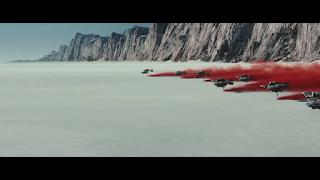
As I've established, I simply wasn't interested in the large percentage of the narrative devoted to the Resistance fleet trying to escape from the First Order. This element, depicted equivalently in the first act of The Empire Strikes Back, here covers almost the entirety of the film. It reached the point in which it became utterly absurd, in my view, that the two fleets were pursuing each other through space seemingly in first gear, with neither side able to catch up to or outrun the other for reasons which weren't clear to me. I understood that the fleet couldn't jump away without being caught again, but why was it so hard for the First Order to simply catch up to the Resistance and blow them out of the sky? They have a ship the size of a small country, but they don't have the technology to go a little bit faster than their enemies?

Dead Phasma toys: only $9.99 each.
Somehow, the course of this pursuit gives Finn and Rose time to go to a completely different planet, find help and come back. Furthermore, after it's over, following multiple scenes of devastation on the part of First Order battleships, Finn and Rose going to a casino, Finn, Rose and Benicio del Toro going to the First Order flagship and getting captured, BB-8 driving an AT-ST and hyperdrive ships slicing other ships, the Resistance lands at a giant bunker which looks like a snow plow to have yet another fight with the First Order. By this point I couldn't believe how long the extended conflict between the two parties was going for. It was just too much. If this had been, say, half an hour of the film it would have been tolerable, but it dominates it, and distracts needlessly from the film's strongest elements.

If only he'd stayed dead.
I also didn't particularly enjoy Poe's character arc in this. In The Force Awakens he came across as a fairly pragmatic combatant who was, for instance, prepared to abandoned the Jakku village if it meant he could keep the map from the First Order. Here he just seems like some cocky try-hard who can't take orders and needs to learn a lesson about leadership. Was it really necessary? Oddly enough, despite liking the character in The Force Awakens, in this film I found him a bit annoying.

Monkeyshines.
2. Too Much Humour
Obviously Star Wars is pretty lighthearted at times, and the Original Trilogy has plenty of memorable one-liners, but The Last Jedi is somewhat overwhelming in this regard, starting with a joke featuring Poe pretending he can't hear Hux over the radio and only becoming bigger from there. Hux looks like a complete buffoon, Luke plays practical jokes and delivers snarky one-liners, Finn and Rose exchange quips and so on to the point at which it's hard to take anything seriously. It feels like they took Poe's brief piss-taking of Kylo Ren in The Force Awakens, and a few sarcastic Han lines and excited Finn remarks, and blew them completely out of proportion in this script. I'm a miserable, joyless, self-hating, lonely, jaded wretch, but give me a break. The audience in the cinema was laughing it up, though, so I guess it hit the right spot for some. My biggest issue was that Luke came across as too flippant and dismissive a lot of the time, and insufficiently consistent with the character we last saw in Return of the Jedi.

Luke's Star Wars: The Card Game set.
3. The Best Stuff is Not Fleshed Out Enough
So Luke's a recluse who wants the Jedi Order to die, Rey and Kylo Ren have developed a telepathic link, Leia can survive a hard vacuum and the Force still needs balancing. These are all interesting elements of the film, but they just don't get the attention they need to really satisfy. There are conversations between Luke and Rey about the Force and the Jedi which are too short and leave us begging for more. Meanwhile, when Rey is communicating with Kylo Ren, we don't have a good sense of what Ren is doing at the time in order to contextualise his experience of this link. He just seems to be standing around in a room. We get some philosophising about the Force, including a surprise appearance from Yoda, but it's all glossed over in a few short scenes. If we'd spent less time mucking around with Finn in Casino Night Zone and the Resistance and First Order fleets participating in the slowest car chase of all time, I feel as if the screenplay could have really come to grips with these elements, which instead to me felt rushed and incomplete, as if we were only seeing edited highlights of something more complex and profound.
"Steady, Dack. Attack pattern delta."
4. Lack of Atmosphere
Just a small thing, but when we met Snoke for instance I felt like there was very little sense of tension and presence. It was similar with Rey being around Luke, I suppose. Something in the cinematography and sound design at these points made me feel distant rather than immersed, as if I were watching the film through a window in another room. Perhaps that was an effect of exhaustion and Irish whisky, but I can't help but feel that a trick was missed at some of the notionally most awe-inspiring moments of the film. Then again, perhaps it was deliberate, as I'll detail in the next section.

What I Did Like
1. Spins on ideas set up in The Force Awakens
Phone home.
...I've never seen E.T.
Who's Snoke? Just an arrogant, overconfident idiot with delusions about how much control he really has, like the Emperor but even more foolish and blind. Who were Rey's parents? Nobody important. What has Luke realised in his time away? That the Jedi were selfish hypocrites. All this stuff seemed fairly bold to me, with Rian Johnson slicing through all the "mystery box" bullshit set up by Abrams in the previous film. The answers are straightforward and convincing. Killing off Snoke in particular was a sensible and gutsy move, preventing him from seeming entirely like a rehash of the Emperor (although he still kind of is; he's just a shittier version of the Emperor, basically). Here I wonder if the lack of atmosphere was deliberate, so that we could recognise that Snoke was not all that he seemed. Establishing that Rey's parents were nobodies is a refreshing touch of realism. In this respect, the film seems like an antidote to the more egregious rumour-mongering elements of Episode VII, which only really existed because of the famed twists from the Original Trilogy.

The lightsaber kind of looks like a plastic tube in this scene.
2. Rey and Luke
Although we didn't see enough of them, both of these character were welcome. I still think Daisy Ridley's Rey is the best part of the new Trilogy, despite the fact that I think she could have come across as a little more aware of the nature of Luke's successes and failures and how they could be applied to her own experience. I suppose she possesses a little hubris, which ultimately is another way in which aspects of this film echo both The Empire Strikes Back and Return of the Jedi, as the film is somewhat like Luke's motivation in Jedi with Empire's outcome: tries to turn villain back to the light but fails.
Good thing he didn't really quit voicing the Joker.

Mark Hamill is entertaining as Luke, and although at times I thought he came across as too dry and jaded, he fitted well enough into the role of a character who has been scarred by his experiences. In particular, the cool confidence Luke presents in Return of the Jedi is gone for much of this, replaced by self-awareness and resignation. In his final confrontation with Kylo Ren, however, much of the strength of Luke in his prime re-emerges, as we see Rey re-ignite something of his faith. This would all have been improved if the film had simply had more time to devote to these characters. I'm almost reminded of the Hobbit films, which became endlessly distracted from Bilbo in an effort to be more epic. In this, I feel like the film keeps wandering away from its titular Last Jedi (singular or plural), which is frustrating, but when they're around they're generally worthwhile. I criticised the lack of "atmosphere" surrounding Luke, but again, perhaps it was deliberately to make his later scenes more satisfying. This would have worked better if we'd seen more.

"My nose still hurts."
3. Kylo Ren
Dildo Ren was a bit more interesting in this than he was in the previous, particularly in his Force-based conversations with Rey, in which they test each others' character. With all this stuff it's not contextualised or developed to its fullest extent, but it's still interesting. In particular, we gain a more complex insight into his backstory, thinking that Luke betrayed him and establishing his Vader-like desire not just for power but for order, and this is played upon by showing him, unlike Vader, killing his master in order to seize control. We're left wondering where the narrative can go next, which I suppose is as good a selling point for Episode IX as any. I liked the idea of Ren usurping Snoke's place as Supreme Leader of the First Order; it's noteworthy that when he tells Rey that they need to dispose of the past, he collectively refers to the Sith and the Jedi, but only to the Resistance in isolation, establishing that he cares more about the ideology of the First Order than might otherwise appear.

4. Leia can breathe in space
She still didn't hug Chewie.
...oh wait, yeah she did.
A lot of people didn't like this element, apparently, but I thought it was kinda cool. She's meant to be strong with the force, albeit untrained. Why shouldn't she survive being blasted into a hard vacuum? I only wish that I understood better her role in the plot overall. It was pretty obvious that she wouldn't be killed so abruptly on the bridge, although I fear that this sequence was intended to set up Episode IX elements which will no longer be possible to fulfill.

"Gawsh, this Jedi training is rrrather
different to what I expected, eh what?"
Conclusion
I still don't know where I stand with The Last Jedi. Was it an occasionally-good blockbuster which is receiving rave reviews because it's full of big explosions, corny one-liners and over-egged "cool" moments to please the dummies, or is it subtler than I'm giving it credit for and warrants more viewings? Perhaps it's a little of both. Perhaps I'm no different to the Original Trilogy fanboys walking devastated from the cinema in 1999 because they didn't get exactly what they imagined in the preceding years. Maybe the film's composition is meant to represent its themes, with the balance between light and dark being reflected in the balance between interesting reflection upon the franchise and mindless slush. On the other hand, maybe it won't bear that much scrutiny. Perhaps only time and an endless cavalcade of better or worse Disney Star Wars films will tell.

So anyway, do the Jedi need to die out or not? Luke thought so, and Yoda seemed to agree with him, but then at the end Luke seemed satisfied that Rey would allow the Jedi to continue on. I'm sure there's some deep and detailed explanation buried deep in the film...
Do Wookiees age in reverse? He looks
a lot more sleek than he did in '77.